




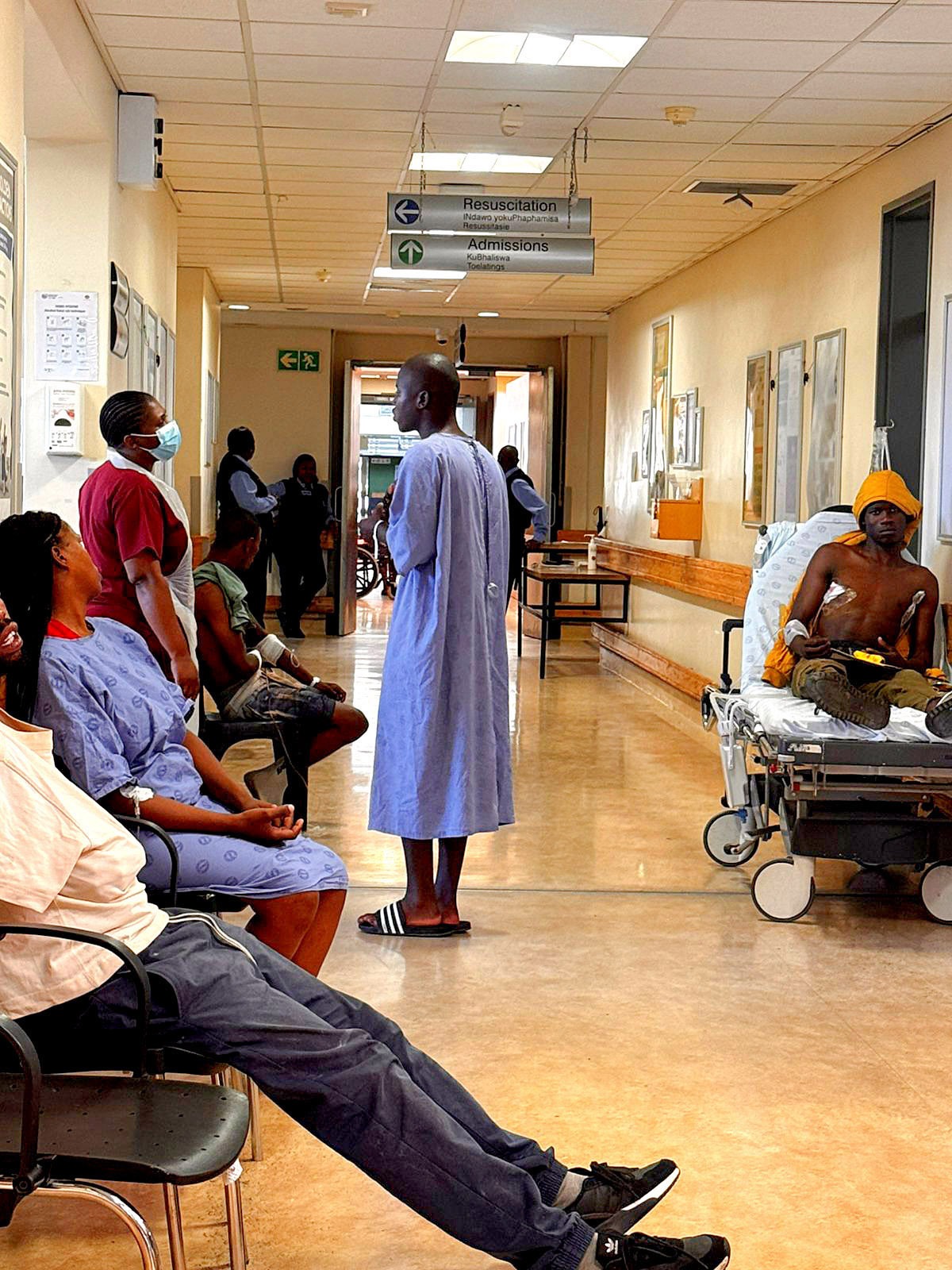
 The passage leading to the Emergency Medicine Unit at Khayelitsha District Hospital. (Photo: Courtesy of the hospital's Emergency Medicine Team)
 Over the past two months, two community service doctors in Khayelitsha have been forced off the road, and one was robbed at gunpoint. An internal medicine registrar narrowly escaped an attempted robbery. All were women. One doctor was so traumatised she was unable to function and took two weeks off work.
Dr Crispin Kibamba, the head of Emergency Medicine at Khayelitsha District Hospital, said construction work on the nearby Spine Road had increased staff vulnerability. In one incident, attackers smashed a doctor’s windscreen and threatened her with firearms. “They demanded money, which she immediately handed over. Luckily, they did not take her or the car,” said Kibamba.
In another case, a community service officer noticed a car with two men following her and drove to a police station, with the suspects close behind. When the police confronted the men, they claimed she had been “stalking” them. A third incident involved a registrar whose vehicle was boxed in by two cars. She managed to find a narrow gap and sped towards the hospital.
/file/attachments/orphans/WhatsAppImage2025-12-18at172841_523676.jpeg "The car of a community service doctor who was ambushed by robbers who took her wallet at gunpoint while she was en route to work at Khayelitsha District Hospital. (Photo: Khayelitsha District Hospital’s Emergency Medicine team)")
Kibamba said the matter had been escalated to senior management, who consulted with the police about establishing a safe travel corridor for staff. “But it’s inconsistent and depends on whether a patrol van is available,” said Kibamba. In the meantime, staff attempt to mitigate the risk by travelling in groups or leaving and arriving in convoys.
The impact on patient care is immediate. Any time taken off by doctors increases pressure on colleagues who collectively see between 3,000 and 3,500 patients a month. The emergency centre deals with the full spectrum of trauma, polytrauma and medical emergencies, much of it driven by alcohol and drug use. These peak at month-end, payday and social grant payout days.
Khayelitsha District Hospital’s emergency unit gained international attention in 2014 when the South African Medical Journal reported on its exceptional survival rate for stab wounds to the heart. That rate has remained at about 75% — roughly 60% higher than international norms cited in medical literature.
Gunshot wounds
However, the profile of trauma has shifted. “Khayelitsha was not known for gunshots,” said Kibamba. “Now we are seeing more and more.” He pointed to recent cases of patients shot in the chest and limbs who survived because of rapid emergency intervention.
Kibamba described several “syndromes” driving pressure on the system. One involves patients arriving directly from the Eastern Cape after long bus or taxi journeys, often without local family support. They receive treatment and then travel straight back home.
Another is the festive season “dumping” of elderly relatives at the hospital by family members travelling to the Eastern Cape, leaving patients with nowhere else to go. “We can have on average 10 extra patients for up to three weeks,” said Kibamba.
A third involves patients returning in January after running out of chronic medication while away, often presenting with serious complications that add to bed pressure.
The hospital, completed in 2012, was built to serve about 400,000 people. Its catchment area has since expanded to include Emfuleni, pushing the estimated population served to around 2.3 million. Census figures do not fully capture migration from the Eastern Cape or the widespread practice of maintaining homes in two provinces.
Khayelitsha District Hospital has 330 beds. The emergency centre has 20 trolleys and seating for a maximum of 16 patients. During heavy periods it can barely cope with an additional 30 intoxicated or drug-affected patients with minor injuries. On average, about 70% of patients are treated and discharged or referred.
/file/attachments/orphans/WhatsAppImage2025-12-18at160528_901558.jpeg "A victim of a community assault after he was accused of committing a crime in Khayelitsha. The weapon of ‘retribution’ was boiling water. (Photo: Khayelitsha District Hospital’s Emergency Medicine team)")
Other contributors to trauma include what Kibamba calls the “party syndrome”, linked to social events, major restaurants and soccer matches, and the “extortion syndrome”. Gangs extort money from an estimated 5,000 businesses in Khayelitsha and Emfuleni, with late or missed payments sometimes resulting in violent assaults and hospitalisation. The resulting cash flow fuels the illegal gun market.
About 90% of trauma cases are drug- or alcohol-related. Substances include tik, nyaope, cannabis and, increasingly, “dirty” cocaine. Mental health emergencies — often involving drug-induced psychosis — consume large amounts of staff time. Patients are sedated and held for the statutory 72 hours before discharge or referral to Lentegeur Psychiatric Hospital in Mitchells Plain.
New mental health facility
Some relief is expected when a new 30-bed psychiatric and mental health facility on the hospital grounds opens in March next year, easing pressure on the emergency centre.
The unit sees an average of 700 children a month, rising to about 1,200 during the December-to-April surge season when diarrhoea and pneumonia peak. Since the hospital opened, overall paediatric mortality in the area has dropped by more than 50%, while trauma-related child deaths have fallen by about 80%.
Kibamba estimated that 60% of all trauma cases involved violent injury, evenly split between men and women. What the unit needed most, he said, was a formal review of staffing norms and standards. To run an efficient emergency centre, he reckoned he needed 22 permanent doctors, excluding consultants.
Currently, the unit has three emergency medicine consultants, two registrars, two interns on short rotations, eight community service doctors and three permanent medical officers (18 in total).
“I am not coping because most of my staff are junior,” said Kibamba.
Locums help fill gaps, but the unit frequently runs over budget. After the first week of December, all leave is refused except on compassionate grounds.
Despite this, Kibamba runs a tightly organised operation. Each day begins with a full staff briefing in the resuscitation bay, checking staff wellbeing, reviewing the previous night’s challenges and allocating work to four-person doctor-nurse teams. Consultants divide workloads to maintain patient flow, and debriefings follow particularly difficult cases.
His predecessor, Dr Sa’ad Lahri, now head of Emergency Medicine at Stellenbosch University and clinical head for Cape Metro East, said Khayelitsha’s emergency unit performed advanced primary repairs before transferring patients to Tygerberg Hospital, Red Cross War Memorial Children’s Hospital or other facilities when beds are unavailable.
“Strokes and heart attacks contribute significantly to the load and require rapid triage to prevent long-term damage,” said Lahri, citing recent cases where clots were removed from patients’ brains. “That cannot happen in a non-functioning system.”
He attributed the metro’s relative success to responsive leadership and improved specialist nursing capacity. Mental healthcare, he added, remained the most tragic burden, with families often devastated by addiction-driven violence and theft in the home.
Western Cape Healthcare operations director, Dr Saadiq Kariem, said that together with the departments of Community Safety and Mobility, his department was educating staff about the ‘dos and don’ts of hijacking’.
“In addition, we are trying to improve safety by creating some ‘safe zones’ — but of course ... that is only when police have the resources available. We’re also trying to provide safe passage for our Emergency Medical Services vehicles,” he added.
(Kibamba earlier said that there were several “no-go” areas in Khayelitsha which ambulance staff refuse to enter). DM