




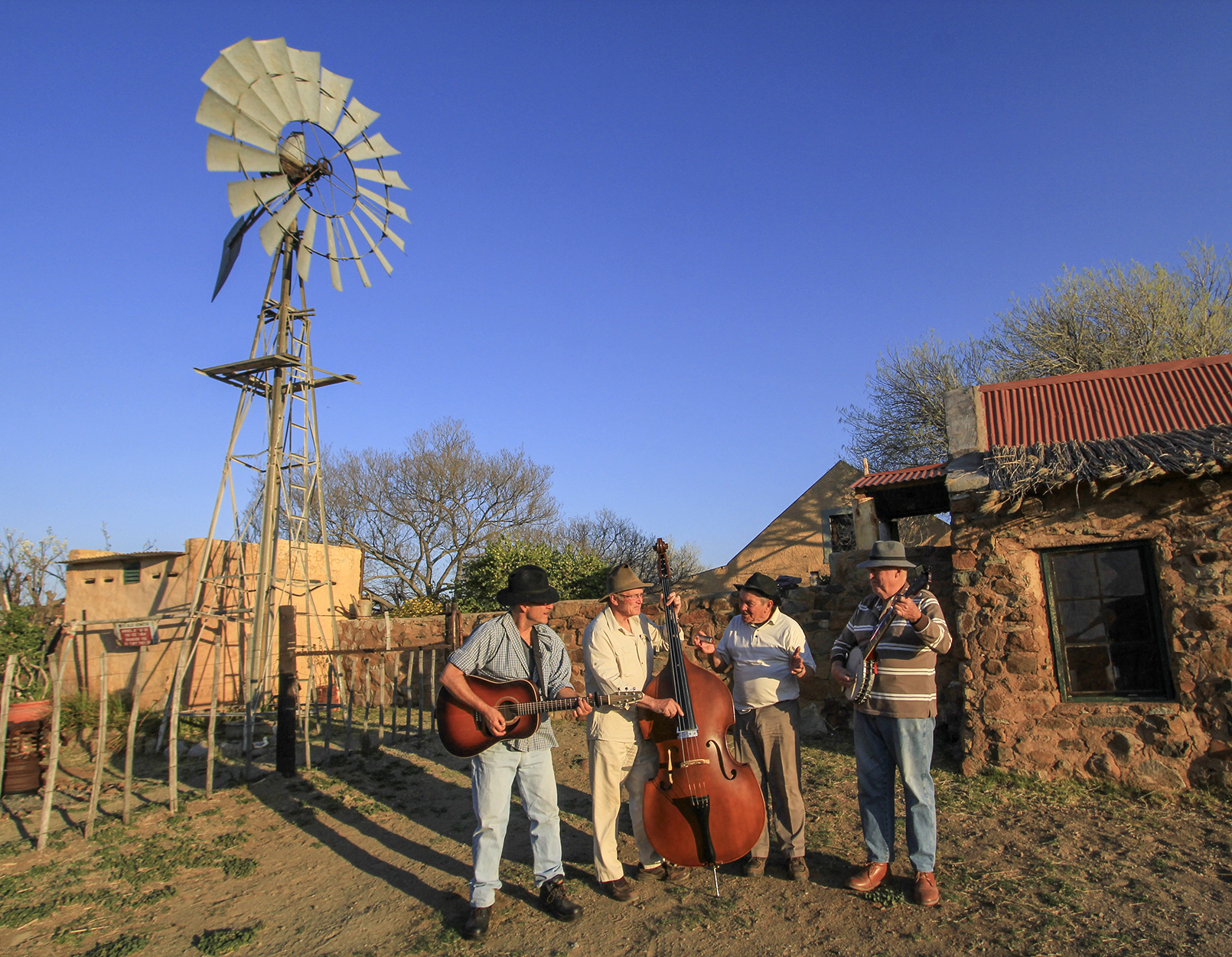
 Ginger’s Fault at their best rehearsing back on the farm. (Photo: Chris Marais)
 Rolbosse and incomers
When the original Calvinia creatives, Dr Erwin Coetzee and his wife Alta, arrived in the little Hantam town in the early 1990s, they couldn’t understand why the locals kept their distance.
“It’s because you’re rolbosse,” they were told. Tumbleweeds.
After two years in Calvinia, they were asked: “So where do you intend to go next?”
“I’m not sure,” answered the feisty Erwin, “But I know where my body will go – up there to the Calvinia cemetery.”
The word went out: the Coetzee family was here to stay.
Arriving as an eccentric in the Karoo, expect a temporary chill as the locals get used to your particular flavour. Pretty soon, however, they see you for the nice guy you really are, and they leave you to your business. But first, you have to earn your space, which means beginning at the bottom rung where the rolbosse roam. No matter. Use the time to settle in, find some like-minded cohorts and begin your new country life.
After a while, you graduate to Incomer Class, and that’s where you remain.
“You can buy ground, but you can’t buy background,” the old families might caution. But with time, luck and a fair wind, they will warm to you.
However, the rolbosse who become incomers tend to hang out together, make the most positive changes, do the craziest things, market the town like gangbusters and generally keep the lights on way after closing time.
/file/attachments/orphans/DrErwinCoetzeeoftheHantamHuisinCalvinia_ChrisMarais_362257.jpg "Dr Erwin Coetzee of the Hantam Huis in Calvinia. (Photo: Chris Marais)")
A second bite at the apple
A beloved granny who lived well beyond her 100th year on a farm south of Gariep Dam ascribed her longevity to “the Karoo water and a little sweet thing before bedtime every night”. Whether she was referring to her husband or a good night pillow chocolate is unclear.
As long as you’ve sorted out access to medical facilities, the Karoo is a country for old folks. It’s the calcium in the soil and water, it’s the quiet, it’s the circle of friends, it’s the dawn, the twilight and the pure joy of having escaped the rat race.
You’ll see us in the winter, chasing the midday sun around in the back yard with our kitchen chairs. You’ll see us in the summer, three old crusties sharing a delicious bottle of red wine on the stoep, strumming on a guitar.
Elderly farmers still drive out to mentor their sons most days of the week, and their wives are the warm hearts of their towns. They are the organisers, the “can-do tannies” of the Karoo.
Some greybeards will be addressing furious letters to the district municipality to get the leiwater up and running again, others will be beavering away in their workshops carving intricate little motorbike models from their youth, and yet others are busy stuffing winter duvets with freshly plucked goose feathers.
An aged stockman will be wrestling his team of donkeys into harness for the day’s toil while a retired jackal hunter will be settling down at his little desk in the old age home to continue writing his memoirs.
Everyone’s getting their second breath.
/file/attachments/orphans/OldfolksboogiedownintheKaroo_ChrisMarais_794150.jpg "Old folks boogie down in the Karoo. (Photo: Chris Marais)")
The constant gardener
In 2004, Max Ndamane of Richmond had no work and was desperate to earn a living. One day, he realised he simply had to “stand up and do it myself”.
He is good at fixing things, and so he saved up his earnings from repairing washing machines, irons, hairdryers and stoves in order to buy some tools and become a one-man garden service.
Max built himself a cunning little trailer which fitted onto the rear hub of his bicycle. This carried a spade, fork and rake. He worked carefully on his bike as well, installing a portable radio, lights and a holder for his gardening gloves.
Everyone in the village knows Max the Gardener and his amazing bicycle. He is a man who loves cultivating and caring for living things. At his house on the edge of town (a converted old ramstal), he has planted fig trees, peach trees and spinach beds.
In the field next to his house, Max grows pumpkins, beans and mielies, selling them to individuals as well as the local school hostel.
When we last saw him, he was running a small herd of livestock as well – “drie besies en twee skapies”. They graze in the veld around his house but sometimes wander a little too far. He has bought himself a pair of binoculars so he can monitor their movements lest the beasts go grazing out of bounds.
“But they come back every night.”
/file/attachments/orphans/MaxNdamanetheConstantGardenerofRichmond_ChrisMarais_537093.jpg "Max Ndamane, the Constant Gardener of Richmond. (Photo: Chris Marais)")
Ginger’s Fault
There was once a pop-up “old man’s band” roaming the Karoo that came complete with a double bass, a mondfluitjie, a banjo and four Wags (wives and girlfriends) who willingly provided an occasional blizzard of flying Pep Stores panties at performances.
They were part of a world-wide trend of elderly Baby Boomers who simply refuse to “go gentle into that good night”, as the poet Dylan Thomas said.
Called Ginger’s Fault (long story), they played in the huiskonsert (home concert) slots at festivals, they entertained little groups of mid-morning champagne-quaffing pensioners in towns along the N1 and they inflicted old chestnuts from the Sixties on village bars all over the Karoo.
The late, great Ginger Seipp on banjo, Maeder Osler on mondfluitjie, Antony Osler on double bass and Chris Marais on vocals made up the bones of this motley crew that got together and practised once a year on someone’s farm and then ventured out to play gigs.
You couldn’t do this in the city, where your band would have to be original, finely rehearsed and well geared up with sound equipment. Imagine singing Country Roads to a discerning crowd in a trendy club in Melville, Joburg.
But Ginger’s Fault had found its place here, in the shearing sheds, watering holes and old age homes of the Karoo. It also helped that the vintage rockers played mostly for diesel and snacks. Any money raised invariably went to children or animals in need.
And there are many of those out here in the Karoo.
PS: Ginger’s Fault disbanded after the death of their beloved Banjo Man. DM
/file/attachments/2984/book-promo_675310_47c9ccf5bbdc7efa7ac10973cfb023d5.jpg "Karoo Space books by Julienne du Toit and Chris Marais.")
For more stories on life in the South African Heartland, get the Karoo Quartet set of books (Karoo Roads I-IV with black-and-white photographs) for only R960, including taxes and courier costs in South Africa. For more details, contact Julie at julie@karoospace.co.za