




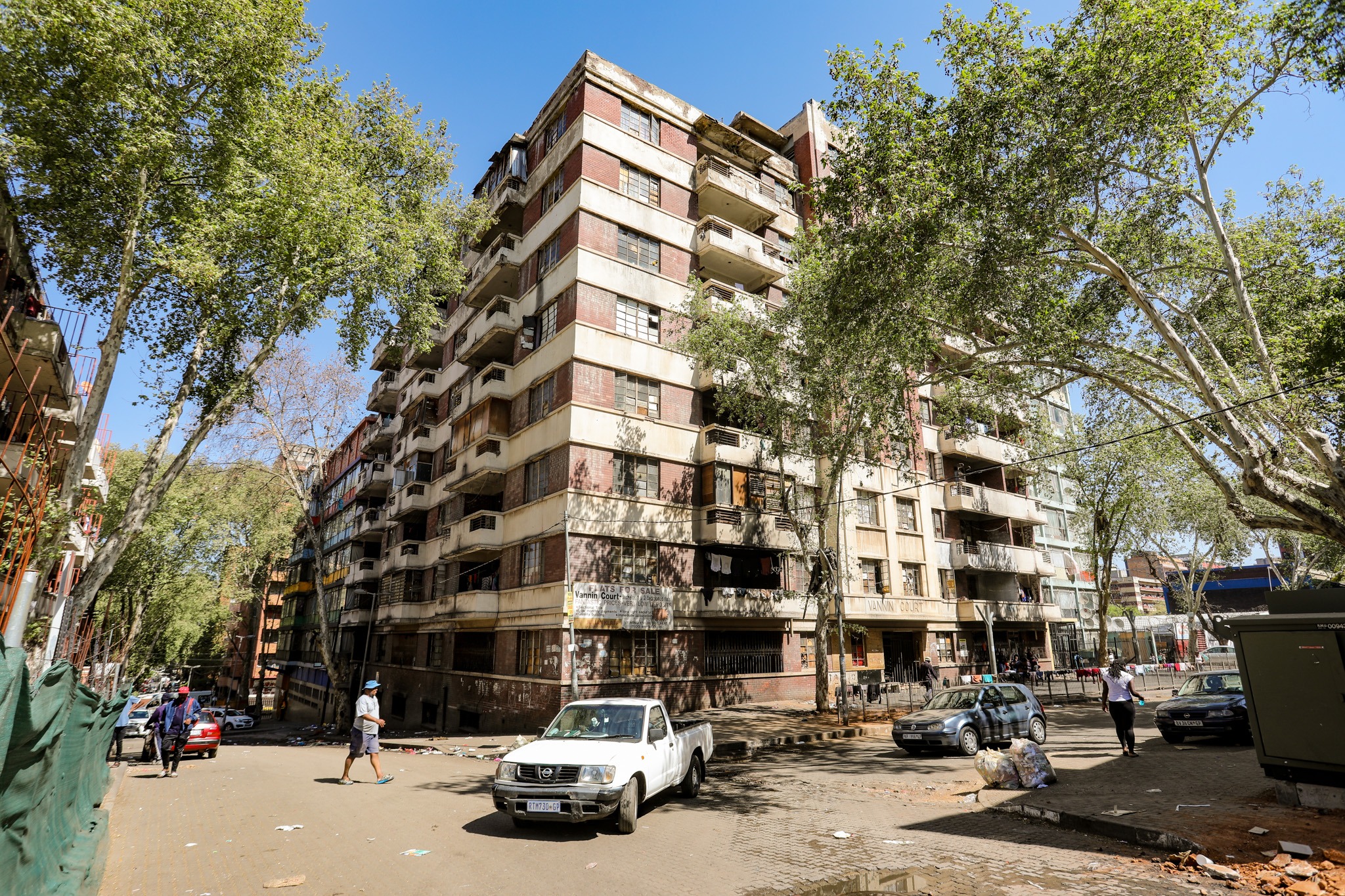
 Vannin Court in the Johannesburg Central Business District on 8 September 2023. Residents reportedly say that they are forced to live in dire conditions because they have nowhere else to go. (Photo: Gallo Images / Fani Mahuntsi)
 When Joburg Mayor Dada Morero appeared in an October 2025 Facebook video — orange safety vest on, cracked concrete and smashed windows behind him — he announced that the city had secured “over 10 court orders” to reclaim hijacked and distressed buildings. He presented these as evidence that the city was “taking back control” of Joburg’s most dangerous structures.
Then, following the murder of Warrick Stock, better known as DJ Warras, the city deployed MMC for Public Safety Mgcini Tshwaku, SAPS, city departments and the JMPD to several buildings over the festive season. The operations included inspections and engagement with building hijackers and occupants.
Videos posted on Facebook show illegal electricity and water connections being cut, dangerously exposed wiring removed, compliance notices issued, identification checks conducted and patrol vehicles positioned outside building entrances.
Yet the reality is there has been no real progress – one eviction in the whole inner city area, no permanent securing of buildings, and no relocation of residents.
Little progress
The city has been making promises for years. After the August 2023 Marshalltown fire that claimed 76 lives, city officials launched what they described as an urgent campaign to address derelict buildings.
A year of litigation followed, filling the Gauteng Division of the High Court in Johannesburg’s files with thousands of pages of engineering assessments, affidavits and urgent applications. But a review of court records obtained by Daily Maverick for properties such as Florence Nightingale Hospital, Casa Mia, Wimbledon, and Moth shows that the legal process has moved far faster than the city’s operational response, while many of the buildings themselves continue to deteriorate.
/file/attachments/2987/MG_9427_688403.jpg "Inside a subdivided room in the Moth building in 2012. (Photo: Greg Nicolson)")
/file/attachments/orphans/20V7454_927500.jpg "The Florence Nightingale Hospital in Hillbrow near the Constitutional Court. (Photo: Felix Dlangamandla)")
Despite repeatedly pleading “urgency” in court, the city has made almost no physical progress on the ground.
Read more: City of Johannesburg pays lip service to tackling ‘hijacked’ buildings
These recent public displays obscure the deeper crisis. Joburg still has at least 188 hijacked buildings in the inner city, according to its own audits — a figure supported by police data and academic research, which places the true number closer to 200 to 300 if derelict and partially hijacked buildings are included.
The seven buildings for which the city has enforceable court orders represent a tiny fraction of the problem. Even those seven have largely stalled: four remain fully occupied despite being declared unsafe.
Despite the mayor’s claim of “over 10 court orders”, the city provided Daily Maverick with documentation for only seven buildings: Moth, Delvers, Remington, Vannin Court, Casa Mia, Wimbledon and Florence Nightingale. The mayor’s number includes expired or historic matters, draft applications and compliance-related court actions that do not authorise eviction.
City spokesperson Nthatisi Modingoane said three buildings — Delvers, Moth and Remington — have been cleared of occupants, but under different legal processes. Delvers and Moth were declared unsafe for human habitation, after which evacuation orders were issued and executed, with residents relocated to transitional emergency accommodation (TEA).
Only one building on the city’s seven-building court-order list has progressed beyond evacuation into actual rehabilitation – Remington Court. While the city told Daily Maverick that all three evacuated buildings were “vacant and secured”, it did not disclose that Remington Court had, in fact, already been redeveloped.
In October 2024, a private developer completed a R25-million refurbishment, converting the former hijacked building into managed student accommodation.
Read more: Remington Court — notorious Joburg building to become student digs in R25m revamp
/file/dailymaverick/wp-content/uploads/2024/10/IMG_5430.jpeg "Remington Court, the once infamous hijacked building on the corner of Jeppe and Nugget streets in Johannesburg’s inner city, is being turned into student accommodation. (Photo: Michelle Banda)")
This makes Remington Court the single exception in an otherwise stagnant programme. It is the one instance where a lawful eviction order, an available redevelopment partner and a functional implementation pipeline aligned. Every other building with a valid court order remains occupied and unsafe, with no appointed developer, no decanting budget and no timeline for rehabilitation.
The contrast is stark. Remington Court demonstrates what is possible when the city executes an order and a development plan exists. Yet it also underscores how little has been achieved elsewhere. Six of the seven buildings named by the mayor remain in exactly the condition described in their structural-engineer reports: unstable slabs, fire hazards, blocked escapes and severe deterioration caused by years of zero maintenance.
The remaining four buildings are fully occupied.
Modingoane said: “Vannin Court, Casa Mia, Wimbledon and Florence Nightingale were declared unsafe for human habitation and evacuation orders were granted. The city is currently awaiting the availability of TEA for the evacuation of the occupiers.”
He also confirmed that Vannin Court, Florence Nightingale, Wimbledon, Delvers, Casa Mia and Moth were not structurally sound.
/file/attachments/orphans/ED_466563_907156.jpg "Vannin Court in the Johannesburg Central Business District on 8 September 2023. It is reported that residents say they are forced to live in dire conditions because they have nowhere else to go. (Photo: Gallo Images / Fani Mahuntsi)")
When asked why the city had not executed the court orders, Modingoane made the position clear: “The Johannesburg Property Company could not execute the orders as there is currently insufficient alternative accommodation available. Human Settlements has been assigned responsibility for the provision of TEA for Vannin.”
On funding, he said: “There is no municipal budget allocated for decanting.”
Daily Maverick asked what measurable targets the city had set for hijacked-building recovery in 2025. Modingoane responded: “The city remains committed to hijacked building recovery. Progress will be made as resources and accommodation become available.”
No numerical, operational or time-bound targets were provided.
Structurally unsound
Engineering reports presented in court papers for Moth, Casa Mia, Florence Nightingale, Vannin Court and Wimbledon all state that “no maintenance has been done” for years, causing severe deterioration. Structural assessments are typically commissioned only after fires or major failures.
Even city-owned buildings, such as Casa Mia (owned by the Johannesburg Social Housing Company), have been allowed to deteriorate to the point where internal plumbing has collapsed and residents draw water from street fire hydrants.
/file/attachments/orphans/ED_591366_743278.jpg "A view of the building during a Public Safety Press Conference at Wimbledon Court in Johannesburg on 23 December 2025. (Photo: Fani Mahuntsi / Gallo Images)")
With buildings overcrowded and unsafe, engineers warned that meaningful structural work could not begin while residents remained inside — yet residents cannot be moved because TEA does not exist.
Lusanda Netshitenzhe, head of the Sub-Group on Human Settlements within the Presidential Task Team on Johannesburg’s Hijacked and Unsafe Buildings, said the city could not meaningfully address hijacked buildings until two urgent, fundamental obstacles were resolved: the absence of TEA and the lack of a comprehensive social audit of residents living in these buildings.
Netshitenzhe said the task team — which brings together national, provincial and local government, law-enforcement agencies, the private sector and civil-society stakeholders — had held multiple meetings and a workshop to identify what was blocking progress.
The group found that the crisis repeatedly collapsed at the same point: the city had no emergency accommodation and no money to create it. Without TEA, evictions cannot proceed legally, court orders cannot be executed, and private developers cannot take over buildings, Netshitenzhe adds.
“This is the point where everything gets stuck. No one can move forward without this.”
Read more: City of Joburg’s bid to provide emergency accommodation highlights housing crisis
The second fundamental problem was the absence of a full, building-by-building audit of who was living inside hijacked or unsafe buildings. “We cannot fix what we don’t know.”
Without this information — whether residents are indigent South Africans, foreign nationals, working families, people who can afford formal rentals, or those excluded by poverty or discrimination — the city cannot design lawful, human-rights-compliant solutions.
“Nothing in the city can be for free. We need to know who can pay what, and who needs assistance,” she said.
She stressed that many hijacked buildings housed deeply vulnerable people exploited by criminal syndicates, and any intervention had to comply with constitutional obligations. A proper audit would also allow the city to approach the National Treasury or the National Department of Human Settlements for funding based on evidence-based need.
The private sector, she added, was willing to redevelop hijacked buildings, but only once they were vacant. There were also NGOs available to do these audits, but they, too, would need a budget.
“The city does not have money for these audits, which is extremely concerning, indicating that the financial problems are worse than we know.”
What worries Netshitenzhe most is that the city appears to lack any long-term plan to resolve the crisis, raising deeper questions about Johannesburg’s financial stability and its ability to meet its housing and safety obligations.
Vannin Court, a prime example of city failure
No building illustrates the city’s paralysis more starkly than the infamous Vannin Court. Promised for redevelopment in 2017, when this story starts, as a flagship Mashaba-era regeneration project, it was meant to be transformed into affordable housing through a R45-million developer-financed programme. That project collapsed.
/file/attachments/orphans/ED_466568_463705.jpg "Vannin Court in the Johannesburg Central Business District on 8 September 2023. (Photo: Gallo Images /Fani Mahuntsi)")
Modingoane explained: “The property was initially awarded in 2017; however, the award subsequently lapsed as a result of material breach by the developer.”
On the frequently cited R45-million figure, he clarified: “The R45-million was not funded by the city. The amount was the development cost the developer would have invested in the property in line with the development lease agreement that lapsed.”
Nine years later, Vannin Court remains occupied, structurally compromised and without a redevelopment tender. It is known to house wanted criminals. On future plans: “A developer has not yet been appointed for Vannin Court. JPC is currently undertaking the packaging process… Once these steps have been finalised, the tender for the property will be released in due course.”
No timeline was given.
In a new twist
Following the recent raids, Tshwaku repeatedly told his social media viewers that he was “engaging with the people inside these hijacked buildings” and “negotiating with them so we can reclaim the buildings peacefully”. In a clip filmed outside Vannin Court, he said: “We are talking to the occupants so the city can take over again.” Another video outside Casa Mia showed Tshwaku saying residents “have agreed to work with us so we can return this building to the city”.
These statements — and Tshwaku’s repeated claims that he is “reclaiming” buildings through direct engagement with occupants — prompted ActionSA to escalate the matter to the Gauteng premier, requesting provincial intervention under Section 139 of the Constitution.
In their submission, ActionSA Johannesburg caucus leader Councillor Marcel Coutriers and public safety whip Councillor Sarah Wissler argue that Tshwaku’s actions appear to bypass the legal frameworks governing evictions, building control and municipal executive authority.
“While the MMC frames these engagements as cooperative negotiations, they amount to exercising powers not conferred on him by legislation, and create the false impression that executive discretion can replace judicial oversight,” Coutriers said.
They argue that negotiating with occupants of hijacked buildings — many under the control of criminal syndicates — is not recognised in law as a mechanism for changing building control; that any removal or handover requires a court order under the Constitution and the PIE Act; that no council-approved policy empowers an MMC to negotiate building returns; and that Tshwaku failed to attend a mandatory oversight meeting of the Section 79 Public Safety Committee.
“For these reasons, we have asked the premier to intervene and to instruct the executive mayor to open a mayoral investigation into whether Tshwaku acted outside his legal mandate and exposed the municipality to legal and governance risk,” Coutriers said.
The MMC did not respond to detailed questions from Daily Maverick requesting the legal basis for his negotiations, his authority to do so, or whether the executive mayor or council had approved this approach.
Here’s a breakdown of the seven buildings.
Joburg’s seven buildings under court orders and ownership
Moth – a rare city success, but ownership unclear
Moth is one of the few buildings the city has successfully evacuated and secured after structural reports warned of failing slabs, corroded reinforcement and dangerous wiring.
Ownership: unclear; the city’s court papers did not identify a registered owner, and no corporate landlord has surfaced.
Status: Vacant and secured, with no appointed developer, no allocated budget and no rehabilitation plan.
Delvers – evacuated and secured, but still owner-obscure
Delvers followed a similar path: declared unsafe, evacuated and secured, then left in limbo.
Ownership: not publicly documented in court filings or media.
Status: vacant, structurally compromised and awaiting reinforcement, repurposing or disposal. The city has not clarified who must secure the building long-term, who funds rehabilitation or whether JPC will package it for redevelopment.
Remington Court — eviction executed, owner unclear
The only building subject to a true eviction order, rather than an evacuation for safety.
Ownership: not identified in public sources; historically associated with slumlord control and later advertised for redevelopment, but no formal titleholder is cited.
Status: Redeveloped as student accommodation.
Casa Mia – unsafe, fully occupied, city-owned
Casa Mia is one of the few buildings where ownership is clear.
Ownership: City of Johannesburg.
Status: occupied and unsafe, despite structural findings of compromised slabs, severe water ingress and inadequate fire-safety systems. The city says it cannot evacuate the building due to a lack of temporary emergency accommodation (TEA).
Wimbledon – unsafe, occupied, owner unknown
Declared unsafe with an evacuation order issued, but no action has followed.
Ownership: unknown; neither court papers nor media identify a titleholder.
Status: still occupied despite hazardous conditions; no evacuation, securing or rehabilitation has begun, with enforcement stalled pending TEA.
Vannin Court – occupied, unsafe and under municipal control
Vannin Court appears in public records as a city-owned or city-controlled building that was later hijacked.
Ownership: City of Johannesburg (historical municipal ownership/control).
Status: occupied and unsafe. Although a court order authorises evacuation, the city has not acted because TEA remains unavailable.
Florence Nightingale Hospital – dangerous, occupied, ownership disputed
This building is severely compromised; engineers flagged water-damaged slabs, cracked beams and unsafe internal circulation. The high court declared it “unsafe and not fit for human habitation.”
Ownership: disputed or unclear; earlier reports reference conflicting claims between private landlords and the city, while the structural assessment mislabelled it “Big Busty,” suggesting administrative confusion.
Status: fully occupied, unevacuated, unsecured and without any redevelopment plan. DM