



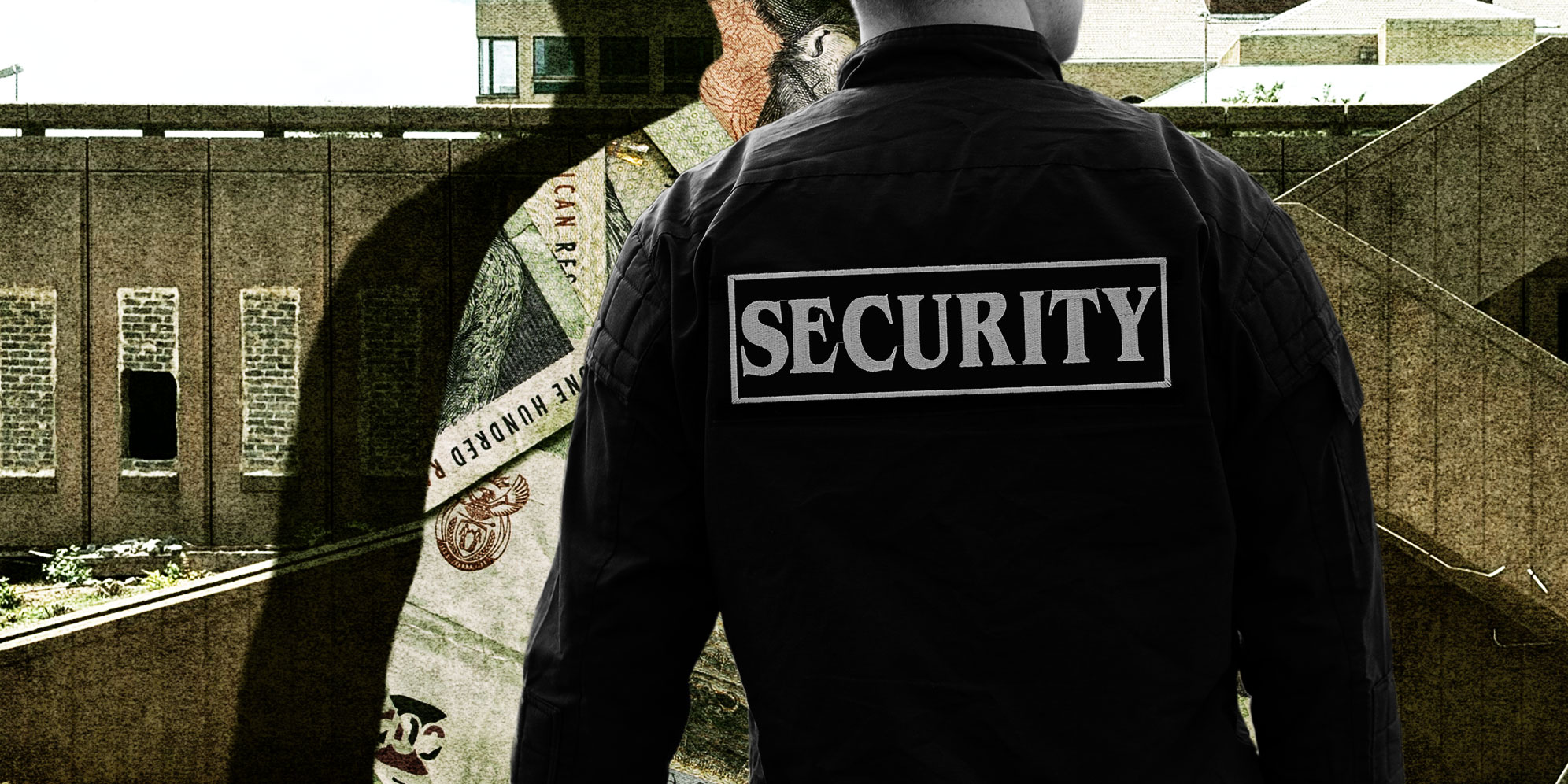
 Illustrative Image: Security guard. (Photo: Freepik) | Money. (Image: Istock) | Joburg’s abandoned Metro Centre. (Photo: Supplied)
Joburg is spending more than R16-million every month on outsourced private security, including more than R1-million just to guard the condemned Metro Centre, a building so unsafe it cannot even house municipal staff.
Yet despite this huge expenditure, break-ins at city facilities have cost the City more than R182-million over the past five years, according to written responses to questions submitted by DA councillor Shakes Chabalala during the October council meeting.
The Metro Centre, once the heart of Joburg’s administration, was evacuated after structural and fire safety failures rendered it uninhabitable. But despite being empty and guarded at this huge cost, syndicates continue to gain access to the basement archives, removing building plans and property records – documents now reportedly being sold on the black market to desperate developers and residents unable to obtain them legally.
Read more: Property chaos as syndicates raid abandoned City of Joburg plans archives
/file/dailymaverick/wp-content/uploads/2025/05/PHOTO-2025-04-25-15-01-21.jpg "Abandoned: Joburg’s Metro Centre. (Photo: Supplied)")
Despite this, the City continues to pay more than R1-million every month to secure the unused precinct through outsourced contractors.
According to Chabalala: “The City used Regulation 36 to push these contracts through urgently, and we are questioning why the urgency.” This regulation allows municipalities to bypass competitive bidding in emergencies or when it is “impractical or impossible” to follow normal procedures – a clause widely criticised for enabling abuse.
He continues: “We have our own internal guards – 1,028 officers actually deployed – and a total of more than 4,000 insourced security personnel on the payroll. Why are we paying private contractors when we already have our own people?”
Chabalala also alleges political interference: “We suspect some of the companies are linked to high-ranking politicians. This raises red flags about tender manipulation and political influence and that is why we are concerned about the secrecy that results from Regulation 36.”
Many of the City’s permanent guards were originally stationed at the Metro Centre, yet have not been redeployed to replace private firms. For Chabalala, this represents a double cost: “Taxpayers fund permanent staff, and then pay again for private contractors doing the same work.”
/file/dailymaverick/wp-content/uploads/2023/12/ferial-fires-joburg-monday2-copy.jpg "Johannesburg‘s Metro Centre in Braamfontein. (Photo: Wikipedia)")
‘Deeply ineffective system’
But the Metro Centre is just one part of a far bigger system. The written responses show that 145 municipal facilities are guarded by private firms at a cost exceeding R15-million every month, in addition to the Metro Centre’s bill. Yet vandalism, copper theft, equipment stripping and illegal occupation remain widespread.
Over five years, these security failures have resulted in losses exceeding R182-million, which Chabalala says “shows the system is not only expensive but deeply ineffective”.
He argues that Joburg continues to rely on private firms despite insourcing more than 4,000 guards in 2018/19, a move once celebrated as a cost-saving milestone.
“We have the staff,” he says. “What we don’t have is management, proper deployment, equipment, uniforms, radios or vehicles. So instead of fixing internal problems, the City keeps extending private contracts, some for years, without open tender.”
While residents are repeatedly told the City is financially constrained, Chabalala says they are simultaneously paying for a security model that duplicates costs and produces poor results.
Read more: Revealed: City of Joburg executives' soaring pay breaks the rules — while services collapse
The irony, he notes, is that the millions spent guarding the empty Metro Centre could have funded its long-delayed repairs. Engineers warned in 2023 that the building needed urgent structural work and fire safety upgrades. Instead, more than R12-million a year is spent protecting a facility the City cannot use.
Repeated contract extensions under Regulation 36, Chabalala warns, “create an environment ripe for patronage, inflated pricing and zero oversight”.
The result, he says, is a system that pays twice and still fails: the City funds permanent guards, pays private guards, suffers multimillion-rand losses from break-ins, spends millions securing an empty condemned building, and continues awarding politically linked contracts – all while service delivery collapses around residents.
To restore accountability, Chabalala says Joburg needs a full audit of all private security contracts, transparency on political links, proper redeployment and equipping of insourced guards, and an immediate end to contract extensions without open bidding.
VIP security and tender controversies
The City’s silence comes amid two additional spending scandals previously revealed by Daily Maverick, both raising serious questions about political influence and procurement integrity.
In 2024, Daily Maverick exposed a draft VIP protection policy that would have dramatically expanded the number of politicians receiving personal security.
Read more: ‘Another slap in the face’ — cash-strapped City of Joburg splurges on bodyguards for bigwigs
The policy proposed:
• 24/7 close protection for MMCs, committee chairs and senior officials;
• Dedicated driver-bodyguards;
• Use of high-end vehicles; and
• A centralised VIP unit reporting directly to the political executive.
The high court later ruled the policy unconstitutional, finding that:
• It had no lawful basis in municipal legislation;
• It created an excessive and unjustifiable personal benefit for politicians;
• It diverted resources away from genuine public-safety needs; and
• It exposed the City to major unauthorised expenditure.
Despite the ruling, the City never disclosed who drafted or authorised the policy, why it was pursued, or how much was already spent on related security arrangements.
Chabalala and other councillors have repeatedly argued that the effort to expand VIP protection “signals a political appetite for preferential security, even as ordinary facilities remain unprotected”.
Again, in 2024, Daily Maverick revealed that a cluster of companies – some owned or co-owned by:
• Relatives of senior City officials;
• Politically connected business associates;
• Individuals previously flagged in other municipal tenders
– were awarded portions of R1-billion multiyear Bus Rapid Transit/Rea Vaya contracts.
Read more: ‘No problem,’ says Joburg as R1bn tender goes to officials’ families or friends
The City initially announced an internal investigation into the tenders after councillors raised alarm about:
• Direct family relationships between bidders and officials;
• Irregular bid documentation;
• Questionable scoring during evaluation;
• Conflicts of interest that were never declared; and
• Pricing discrepancies far above industry norms.
However, within months, the promised investigation was quietly shelved, with no report released to council, no disciplinary action taken, and no explanation provided to the public.
Read more: Joburg clears officials after making U-turn on investigating R1bn tenders
Opposition parties accused the City of “protecting politically connected beneficiaries” by burying the findings and allowing the contracts to continue unchallenged.
City spokesperson Nthatisi Modingoane did not respond to current Daily Maverick queries but, at the time insisted that “all procurement processes are lawful, compliant and properly vetted”, dismissing concerns about political influence, irregular extensions or misuse of security budgets.
No conclusion
Neither the VIP protection scandal nor the R1-billion tender controversy has ever been transparently resolved – reinforcing doubts about how Joburg’s security spending is governed.
As residents face worsening service delivery failures, Joburg continues spending more than R16-million every month guarding buildings – yet remains unwilling to explain why the system costs so much, delivers so little and benefits so few.
Questions the City is refusing to answer
Despite numerous requests over the past month, the City of Johannesburg and its public safety department have repeatedly declined to respond to these questions from Daily Maverick:
• The total monthly spending on outsourced security;
• Contractor identities;
• Procurement processes;
• Regulation 36 justifications;
• Tender extensions;
• Why insourced guards were removed;
• Break-in loss values;
• Accountability for failing firms;
• Steps taken to probe political links;
• Integrity screening;
• Performance monitoring; and
• Value-for-money assessments. DM