



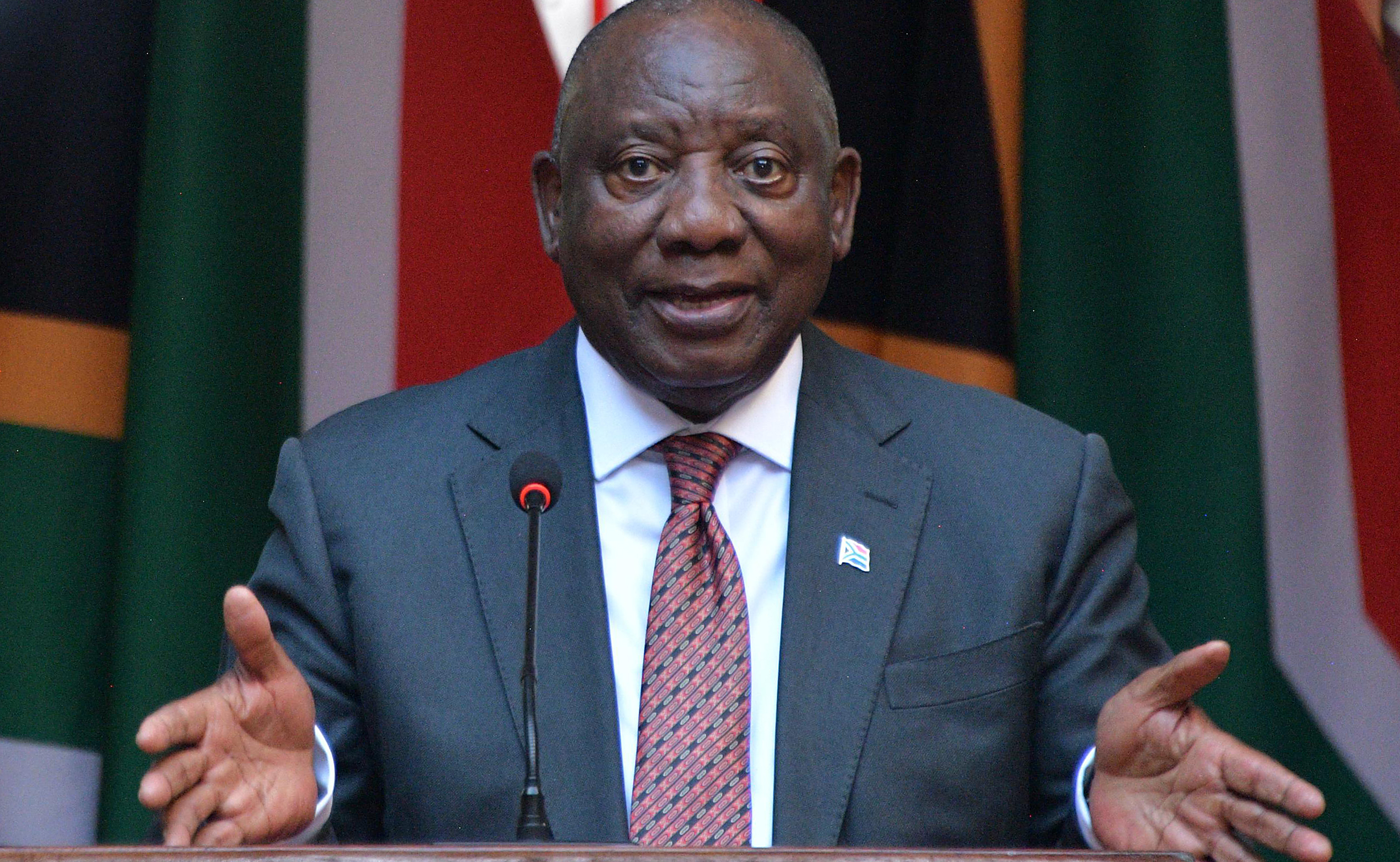
 President Cyril Ramaphosa launches the second phase of Operation Vulindlela at the Union Buildings in Pretoria to unleash more rapid and inclusive economic growth. (Photo: Elmond JiyaneGCIS)
/file/dailymaverick/wp-content/uploads/2025/10/label-Op-Ed.jpg)
Adrian Enthoven’s Thought Leader lecture at the University of Stellenbosch on 4 November 2024 commanded national attention and sparked a searching conversation about whether the country has genuinely turned the corner after more than a decade of grave socioeconomic crisis.
Enthoven positions himself within the camp of the optimists. His case rests on convincing improvements in key state-controlled functions: the near disappearance of load shedding since 2023, the turnaround of critical transport and logistics systems including Metrorail, Transnet Freight Rail and Durban port, and second-order improvements such as clearing visa backlogs that had accumulated to over 300,000 skilled professionals.
Then there is the Government of National Unity itself, born from the collision between the ANC’s loss of its parliamentary majority and the meteoric rise of radical populist parties EFF and MK. It has survived serious disagreements and brought relative political stability that has enabled state performance improvements and delivered growth expected to reach slightly above 1% this year.
Has South Africa, then, turned the corner from fifteen years of destruction?
The question matters urgently as the country enters critical local government elections amid escalating global instability. Since Enthoven’s lecture, South Africa has faced a 30% US tariff on its exports, congressional designation as “an adversary of America”, and uncertain Agoa eligibility despite the programme’s three-year extension.
Operation Vulindlela: Stabilisation without transformation
Behind the progress Enthoven observes lies Operation Vulindlela. This was launched in October 2020 when, under the combined blows of the pandemic and a decade of State Capture, the country faced grave crisis.
Constituted as a partnership between the Presidency and the Treasury, Operation Vulindlela was founded on the concept of binding constraints to growth – identifying the most serious obstacles to capital investment and economic activity, triaging among them to determine which removals would yield the highest payoff at the least cost, then acting decisively.
Operation Vulindlela breaks with the failed grand plans of the past: the New Growth Path, the National Development Plan, and the endless sectoral plans with sweeping long-term goals nominally owned by everyone but implemented by no one. Operation Phakisa – owned by no one and similarly implemented – gathered sector stakeholders, who argued, negotiated, planned comprehensively and moved on.
Operation Vulindlela is designed to be highly operational, institutionally narrow, and focused on the short to medium term. Critically, it was sold to Parliament and the public as a budget-neutral intervention on the ingenious if misleading argument that “structural reform costs nothing” – a political sleight of hand that concealed the reality that the initiative was gravely under-resourced and delivered little until private sector funding was mobilised in 2023.
Business for South Africa – a joint venture among the Black Business Council, Business Leadership SA and Business Unity SA created in early 2020 to assist government with the Covid crisis – partnered with government to establish the Resource Mobilisation Fund. The RMF was initially endowed with R100-million, then expanded to R170-million.
The fund is independently managed by Tamela Holdings, a black-owned independent investment firm, and operates through an indirect mechanism, financing initiatives such as Necom (energy), NLCC (logistics) and JICC (crime) that are aligned with and directly support Operation Vulindlela’s priorities rather than directly funding the operation itself.
Operation Vulindlela in action
Operation Vulindlela has applied the binding constraints framework (the most serious obstacles limiting economic expansion) to sectors most critical to unlocking investment: electricity, water, logistics, telecommunications and visa systems. It has prioritised constraints where removal would yield the highest return on reform effort and the lowest fiscal cost.
The operational method proved consistent across sectors: identify the specific regulatory, institutional or administrative blockage, assemble a small technical team vested with direct Presidential authority to resolve it, and execute decisively within a medium-term horizon of 18 to 36 months per reform.
/file/dailymaverick/wp-content/uploads/2025/11/ED_584841.jpg "Rudi Dicks, who heads the Project Management Office in the Presidency and jointly leads Operation Vulindlela. (Photo: Gallo Images / Fani Mahuntsi)")
In electricity, regulatory changes unleashed a private renewable energy pipeline of 220 gigawatts in development, of which 72 gigawatts have reached advanced stages, while South Africa achieved 160 to 300 consecutive days without load shedding and Eskom returned to profitability for the first time in eight years.
In freight logistics, opening the rail network to private train operating companies shattered Transnet’s monopoly as 11 private operators were allocated capacity across forty-one routes, recovering freight volumes to 160 million tonnes from a 2020 nadir of 149 million tonnes.
Water licence processing times contracted from over 300 days to approximately 90 days. Visa backlogs exceeding 300,000 accumulated applications were cleared.
Operation Vulindlela’s impact: Less than meets the eye
Treasury forecasts project growth at 1.6% in 2026 and 1.8% in 2027. Independent economists anticipate 1%. Since 2022, growth has remained essentially stagnant around 1%, persistently below population growth and thereby ensuring continuously declining real GDP per capita – a pattern characteristic of South Africa since 2014 when growth fell decisively below 2%.
Treasury’s conservative estimates are consistently over-optimistic. Since 2009, the two-year forecast has overstated outcomes by an average of 1.4 percentage points – a 48% overstatement. Had Treasury’s forecasts proven correct since 2011, the economy would be 37% larger, but instead it has expanded by a paltry 12%, cementing South Africa’s position among the world’s most stagnant economies.
Despite this unwarranted optimism, Treasury’s forecasts for 2025-2027 represent a clear-eyed if implicit admission that Operation Vulindlela’s growth-generating capacity is intrinsically limited.
/file/dailymaverick/wp-content/uploads/2025/05/Fer-Vulindlela-Phase2b.jpg "President Cyril Ramaphosa launches the second phase of Operation Vulindlela at the Union Buildings in Pretoria to unleash more rapid and inclusive economic growth. (Photo: Elmond JiyaneGCIS)")
Operation Vulindlela is estimated to have unlocked R500-billion in cumulative investment over five years – a meagre 1.5% of total GDP and barely 10% of total fixed capital investment since 2020. Fixed capital investment remains stubbornly at 14% of GDP since 2021, compared with 17% during the post-global-recession Zuma years. It stands at less than half the 33% middle-income country average and far below the international standard of approximately 26%.
Among Operation Vulindlela’s core mandates stands the imperative to raise investment sufficiently that economic activity beyond debt-financed consumption can meaningfully restart, yet there exists scant evidence it has achieved this crucial goal. Gross fixed capital formation measured in constant 2015 prices declined from R740-billion in 2019 to R660-billion in 2024 – a loss of R81-billion in productive capacity. After the patent failure of the developmental state model, it is precisely private sector investment that Operation Vulindlela seeks to lift, yet this is demonstrably not occurring.
The operation’s macroeconomic impact remains largely confined to the crucial but narrow stabilisation of Eskom. While continuing to turn the network industries around proves critical and reforming local government constitutes an urgent priority, none of these interventions will meaningfully trigger the scale and scope of capital investment required to lift growth, decisively address epidemic unemployment, reduce poverty or decrease national indebtedness in the short and medium terms.
Since Operation Vulindlela’s launch, the gross national debt load has increased by R1.8-trillion – nearly four times the investment the operation has generated.
What Operation Vulindlela is, and what it is not
Operation Vulindlela constitutes crisis management rather than comprehensive structural reform. The regulatory changes it drives are primarily intended to enable, stabilise and lock in operational turnarounds in the network industries rather than to fundamentally recast the political economy of the state – a distinction central to understanding both what it has achieved and where its limits lie.
The operation functions at a peculiar political intersection. It exploited the emergency powers created by the pandemic, factional compromises within the ANC during Ramaphosa’s first term, the shock of the July 2021 riots, and the accelerating infrastructure failures between 2020 and 2023.
Operation Vulindlela exploited the political space opened by the pandemic. It routed decisions through the Presidency and National Treasury, effectively bypassing much of Parliament, Cabinet and the senior bureaucracy.
This allowed it to force through actions that remained deeply unpopular within key ANC factions. It represents both a sleight of hand and a compromise: an elite, technocratic mechanism operating where just enough political agreement exists. Private sector involvement has become either ideologically acceptable or unavoidable, given glaring state failure. In essence, the state attempting to repair what it broke, at immense cost to the country.
At the same time, Operation Vulindlela has deliberately avoided sectors that remain politically contested, whether because the public sector remains the mandated provider – health, policing, basic education – or because policy in those domains remains explicitly state-centric.
It functions on an unspoken political compromise within the ANC, between the ANC and its government of national unity partners, and between government and business – a settlement that constitutes both its strength, granting it room to act in targeted spaces, and its weakness, leaving the underlying settlement over the role, capacity and accountability of the state fundamentally untouched.
How the ANC destroyed the economy by subsidising capital and excluding labour
/file/attachments/orphans/Democratic-developmentalism_472537.jpg "National Treasury statistics of South Africa. (Graphic: Eunomix analysis)")
South Africa’s economic crisis is nothing else than a productive collapse – the systematic dismantling of the economy’s capacity to generate wealth that began in earnest after the 2011 recession, became self-replicating during 2014-2015, and accelerated sharply in 2018-2019.
The pandemic caught South Africa in an extremely vulnerable position; one I characterised at the time as a “textbook growth collapse” with “rapidly rising odds of serious economic crisis”, making clear that the pandemic did not cause the collapse but rather exposed and accelerated dynamics already deeply entrenched:
- Deindustrialisation. Manufacturing’s share of GDP has contracted from 13.5% in 2015 to 11% in 2024, a trajectory that will carry it below 10% by 2030 – the threshold below which a country ceases to count as industrialised. Mining declined from 8% to 6.5% despite commodity price booms. The combined productive core has contracted from 21% to 18% of GDP, as South Africa ceases to function as a resource-rich manufacturing country. The services sector expanded from 67% to 70%. But this was not a transition towards high-productivity services seen in advanced economies. Instead, deindustrialisation led to economic inactivity – a hollowing that replaced wealth generation with debt-circulating, subsidised consumption.
- Productivity collapse. Each rand of capital deployed in the South African economy now generates 9% less output than a decade ago, as the GDP-to-capital ratio fell from 0.8 in 2015 to 0.75 in 2024, while real GDP per worker declined 7% and total factor productivity declined an astounding 20% over the same period.
- Innovation failure. Resident patent applications have collapsed to a fraction of 1980s levels, the country possesses zero semiconductor manufacturing capacity while consuming $1.85-billion annually in chips, and government invested R484-million in artificial intelligence over four years – less than one-tenth of Kenya’s commitment. The Johannesburg Stock Exchange is dominated by consumer services. Resource and manufacturing listings are small and shrinking. No listed firm qualifies as a globally leading company in the key technologies of the future, from microprocessors to artificial intelligence, from nanotechnologies to robotics, from quantum computing to nuclear fusion.
- Tax base inversion and welfare dependency. The tax base peaked at 6.3 million registered taxpayers in 2012 before contracting to 4.3 million by 2019. The 2024 nominal recovery to 7.5 million masks a reality wherein more than one million represent government employees, such that private-sector taxpayers remain below 2012 levels. Against this, social grant recipients exploded from seven million in 2003 to 28 million in 2024 – a 300% increase against 35% population growth – such that each private-sector taxpayer now supports over four grant recipients.
The culprit: The ANC’s developmental welfare state experiment
The 2009 developmental state model diagnosed post-1994 growth as having seriously failed to address unemployment, poverty and inequality.
The ANC manifesto committed to “state-led industrial policy” and “a massive public investment programme”. This rested on three mechanisms: First, social grants would create demand, leading the poor to spend and firms to expand. Second, government would direct capital towards strategic sectors while state-owned enterprises invested in infrastructure. Third, borrowed money would finance productive investment, and the growth generated would pay for the debt.
This theory has been tested empirically with devastating results: as planned, the red ink side of the ledger rose dramatically, but contrary to all expectations, the black ink side collapsed:
- Red ink rising. Government expenditure surged from 27% of GDP in 2009 to 33% in 2024, while social grants spending rocketed from R50-billion to R267-billion annually, a staggering 434% increase, and state-owned enterprises absorbed cumulative bailouts exceeding R2-trillion between 2009 and 2024, constituting the largest peacetime expansion of government economic intervention in South African history. Debt rose from 32% of GDP in 2009 to 77% in 2024, while government debt service now consumes 21.4% of revenue, exceeding the entire education budget of R275-billion.
- Black ink collapsing. Public capital expenditure declined from 7.7% of total government spending in 2015 to 5.5% in 2024, while total public infrastructure spending fell from R289-billion in 2019 to R237-billion in 2024 in real terms, an 18% contraction. Despite receiving R2-trillion in bailouts, state-owned enterprises delivered steadily declining capacity, with Eskom’s generation capacity declining 25% from 2015 peaks and Transnet’s freight volumes falling 28%.
In a 2009 paper I authored for an ANC stalwart (shelved, obviously), I argued that developmental state advocates were “proposing that the cure lies in injecting more of the illness into the patient’s body”, observing that South Africa faced a state capacity crisis wherein adding responsibility would compound the failure of a breaking state.
The outcome was straightforward to predict: greater state investment would “lead to significant disruptions in the productive sector, decrease economic efficiency” and could “turn South Africa into an anti-developmental state, weakened and impoverished”.
In 2022, I attempted to comprehend the scale of this failure through an innovative analytical approach, recognising that traditional measures of revenues, expenditures and debt as percentages of GDP proved inadequate given that the developmental state’s central premise was debt-neutral growth generation.
I therefore inverted the traditional ratios, measuring GDP per unit of government expenditure (GDP/expenditure ratio) and GDP growth per unit of government debt (growth/debt ratio) to capture the core promises: does government spending generate growth, and does borrowed money generate returns?
The findings, updated to 2024 data for this essay, are indicting: the GDP to government expenditure ratio declined 24% between 2007 (pre-developmental state) and 2024, falling from 4 to 3, meaning each unit of government expenditure now generates 24% less GDP than before the developmental state model was implemented, while the GDP growth to debt ratio crumbled an astounding 96% across the 15-year period, plummeting from 0.20 (each unit of debt generates 0.20 units of growth annually) to 0.0078. These represent not marginal deteriorations but systemic inversions of the theory’s central premises.
Political-economy trap: Why reform remains constrained
The developmental welfare state model subsidised precisely the wrong capital – state-owned enterprises, select industrial sectors, infrastructure projects – and subsidised it through blank cheques issued to incompetent and corrupt cadre deployees operating without performance conditions, accountability mechanisms or consequences for failure.
Boards were stacked with political loyalists rather than technical experts, management was rotated based on factional allegiance rather than delivery, procurement became patronage, and strategic decisions were subordinated to short-term political imperatives.
The model assumed capital deployment would generate employment, growth and revenues. But it produced precisely the opposite. R2-trillion in capital subsidies produced declining capacity. Eskom’s generation fell 25% and Transnet’s freight volumes fell 28%.
Meanwhile, the population excluded from productive participation and surviving on social grants swelled to 28 million as the tax base contracted by two million while the population grew by seven million, leaving each private-sector taxpayer supporting 4.3 grant recipients in a blatantly unsustainable demographic and fiscal inversion.
South Africa subsidised the wrong factor of production in the worst conceivable manner. It poured capital into state-controlled entities led by political appointees accountable to no one. These appointees predictably destroyed value.
Meanwhile, labour – the country’s most abundant resource – was not mobilised. The result: the economy hollowed out as predicated because capital was subsidised where it could not generate returns while labour was excluded from productive participation. Astoundingly, for a self-labelled social-progressive party, the ANC replicated a central attribute of apartheid: it locked the majority out of economic participation beyond subsidised, subsistence-level consumption, thereby precluding durable development.
This raises the fundamental question: why has this fundamental developmental and democratic failure not found resolution through either technocratic intervention or democratic adjustment?
The political-economy framework: The evolving interplay between economics and politics
Understanding why this failure persists requires a framework I developed in 2016. It tracks South Africa’s trajectory by measuring two forms of capital. Political capital comprises legitimacy, mandate and institutional strength. Economic capital represents economic performance, both inherited and created. What matters is not their absolute levels but how they move in relation to each other – whether they converge or diverge, and in which direction.
Political capital can override economic capital at roughly a two-to-one ratio for extended periods, such that a leader commanding strong political capital will survive weak economic performance while a leader lacking political capital will not survive even if economic performance proves strong. Thabo Mbeki’s second term demonstrated this dynamic: his economic capital was rising while his political capital collapsed.
Jacob Zuma’s first term inverted the pattern precisely as the model predicted, as his political capital rose through consolidation of control over the ANC and deployment of populist appeal with devastating political effectiveness while simultaneously creating the foundation for economic crisis, even as his economic capital declined with the developmental state model’s launch, State Capture’s commencement, and growth falling below 2% after 2011, yet the equation indicated he would be re-elected, and he was.
Yet economics does reassert itself, eventually and brutally, as severe economic collapse destroys political capital. By 2018, both of Zuma’s capitals had converged downward following poor governance that had been allowed to go on for nearly a decade. His forced exit followed inexorably – as I predicted then for a few clients.
These structural political economy dynamics seem to explain much of South Africa’s chronic economic underperformance. Political leaders from the apartheid era through the present are structurally incentivised to ignore economic deterioration until the moment it destroys their political base, by which point it typically proves too late for them.
Ramaphosa inherited ruins and delivered the expected ANC defeat
Cyril Ramaphosa assumed the ANC presidency in December 2017 with negative overall political capital. His Nasrec victory margin of 180 votes out of 4,700 delegates reflected deep party divisions rather than a mandate for transformation, his National Executive Committee remained divided, and the party machinery and patronage networks stayed mostly beyond his influence. What he possessed was not a mandate, but merely crisis legitimacy resting on personal popularity – he was not-Zuma, and in the wreckage of 2017 that just got him through.
He also inherited profoundly negative economic capital, as growth had collapsed to 0.6%, load shedding was intensifying toward what would become the worst years on record, unemployment had risen above 30% and was accelerating, debt was climbing toward 77% of GDP, and state-owned enterprises were consuming R100-billion annually in bailouts and guarantees while delivering steadily declining capacity, meaning the productive collapse documented earlier in this essay was already well advanced.
Ramaphosa possessed no political resources with which to pursue structural reform, given that such reform requires substantial political capital – the ability to confront entrenched interests, force through contested decisions, absorb short-term pain for long-term gain, and sustain the effort across years.
Yet he could not simply preside over continued collapse as the economy took a worsening turn with the Covid shutdowns, such that Operation Vulindlela emerged as the only politically feasible response.
Ramaphosa lacked even the political capital to secure budget allocation for this limited intervention, leading to the solution arrived at in 2023 whereby Business for South Africa would finance the technical capacity required.
This arrangement functioned tactically, but political capital continued its decline as the July 2021 riots exposed the state’s fragility at grave scale, MK formed in 2023 and drained the ANC’s KwaZulu-Natal base with startling speed, and internal party structures continued hollowing out, such that my political-economy framework’s prediction proved straightforward: electoral defeat absent an economic miracle – precisely what occurred in May 2024 when the ANC fell from 57% to 40% and lost its parliamentary majority for the first time across 30 years of democracy.
Rejection without renewal: Fragmentation accelerates
The ANC’s defeat did not translate into a coherent alternative taking power; the party’s loss was not captured by any single opposition force. The Democratic Alliance gained marginally to reach nearly 22% – hardly the surge expected given the scale of the ANC’s failure.
The EFF held steady at 9.5% despite considerable internal turbulence. MK, contesting in only seven provinces as a new party, captured 10.8% nationally and more than 45% in KwaZulu-Natal. This signalled the mobilisation of the ANC’s traditional rural and township base against the party itself.
What emerged from the 2024 election was not realignment, but fragmentation in the absence of direction. South Africans had decisively rejected the ANC’s developmental welfare state model, yet had not coalesced around any replacement vision.
Post-election polling across the first six months of the GNU’s existence revealed an electorate precise in its assessment: early 2025 surveys found 57% of respondents believed the GNU was “performing well” while simultaneously 71% said the country was “heading in the wrong direction”.
These findings reflected the fact that South Africans recognised the GNU had averted immediate institutional catastrophe as the grid had not collapsed entirely, ports had not ground to a complete halt, and the state had not disintegrated, yet did not believe this marginal stabilisation represented a reversal of South Africa’s underlying decline.
By September 2025, the verdict hardened: fully 80% of South Africans declared the country was heading in the wrong direction – a near-consensus cutting across racial, class and geographic lines. By December, Social Research Foundation polling showed the ANC at 37% and the DA at 32%, a statistical tie unthinkable even two years earlier, as for the first time in democratic history, significant cohorts of black urban professionals were defecting to the DA.
The pattern proves clear: voters credited the GNU with ending load shedding, a tangible achievement, yet rejected the notion that this achievement constituted adequate transformation, distinguishing between crisis management and structural change and finding the GNU offering only the former.
By-elections reveal geographic and demographic fracture
If national polling offers a blunt instrument for measuring public sentiment, by-elections provide granular precision. They confirm accelerating fragmentation along geographic and demographic lines.
In Gauteng’s metropolitan municipalities, the ANC haemorrhages support to the DA and ActionSA among professional and middle-class voters, with dramatic swings in the Ekurhuleni metro. In KwaZulu-Natal, the pattern inverts as the ANC loses ground to MK, particularly among rural and township voters, with MK winning its first metropolitan by-election in eThekwini.
The ANC is losing everywhere.
/file/attachments/orphans/Fragmentation_111927.jpg "IEC offical results. (Graphic: Eunomix analysis)")
Yet no single party is winning nationally. Instead, a patchwork of regional and demographic alternatives, each capturing a different constituency of discontent, but none offering a coherent national vision, is taking hold. Fragmentation.
Beneath the shifts in party allegiance lies a fundamental fracture: turnout in the 2024 national election fell to 58.2% of registered voters – the lowest figure recorded in the democratic era. Only 60% of eligible South African adults are registered to vote at all.
The largest bloc in South African politics is not any party, but the nearly 40% of citizens who have withdrawn from formal political participation.
/file/attachments/orphans/grootes_461879.jpg "When non-voters are asked why they have withdrawn from political participation, their responses reflect alienation rather than apathy. (Photos: Daily Maverick) | Generic Parliament (Photo: Daily Maverick) | Cracks (Image: Freepik)")
When asked why, non-voters offer remarkably consistent explanations: “Voting changes nothing,” “All parties are the same,” “No party represents my interests” – responses reflecting not apathy, but alienation, a considered judgment that the political system is not the mechanism through which their material conditions will improve.
Three cohorts dominate this democratic exit:
- Youth aged 18 to 35, South Africans born after apartheid who have known only the democratic era and its failures – for them, democracy and dysfunction are synonymous;
- Poor, unemployed adults in rural areas and townships for whom the cost and effort of voting bear no relationship to any change in their survival prospects; and
- Educated urban middle-class citizens who have either emigrated or turned entirely towards private solutions – medical aid rather than public health, private security rather than policing, generators and solar panels rather than relying on the grid.
These are not marginal groups, but together represent a historic fracture in the social contract, as they are not choosing between political alternatives but withdrawing from the belief that politics can deliver alternatives.
The ethno-regional threat: From July 2021 to MK’s consolidation
Fragmentation carries a clear and present danger. This was demonstrated in July 2021 when violence erupted following Jacob Zuma’s imprisonment for contempt of court. The unrest was not random or nationally distributed but geographically concentrated in KwaZulu-Natal and Zulu-majority areas of Gauteng.
It was ethnically mobilised. The violence killed more than 350 people, destroyed billions of rands in property and infrastructure, collapsed supply chains and paralysed major highways and ports. The state proved incapable of either preventing the violence or containing it rapidly.
July 2021 was a warning. It demonstrated that ethno-regional mobilisation under the right conditions could paralyse the South African state and economy within days.
MK’s rise in 2024 represents the political institutionalisation of that warning. It functions not as a national party but as a Zulu-nationalist, KwaZulu-Natal-regional vehicle led by the same figure whose imprisonment triggered the 2021 violence. Its success in capturing over 45% of the KwaZulu-Natal vote demonstrates that the political base for ethno-regional mobilisation has consolidated into an electoral force.
Local government as the nexus of fragmentation and state failure
This year’s local elections promise further fragmentation, as announced by polls and by-election results.
Coalition governments have become the norm, as the 2021 local government elections delivered about 70 hung municipalities, up from 27 in 2016. By 2024, political instability in these coalition-governed municipalities had become endemic, with manifestations including not merely dysfunction but systematic violence.
In KwaZulu-Natal, at least 19 councillors were assassinated between September 2022 and early 2023, and since 2011, more than 150 politicians have been killed in the province – the vast majority murdered by rivals within and across political parties.
Police investigations document multiple ANC, IFP, NFP, EFF and ACDP councillors murdered between 2011 and 2023 – violence that is not random but strategic, targeting those who control or contest access to power, patronage and procurement.
The consequences of instability have proven ruinous. The Auditor-General’s 2023-24 audit of municipal finances showed only 41 of South Africa’s 257 municipalities received clean audits, representing a collapse from 14% to 8% within a single year. The Mistra Coalitions Barometer tracking coalition government performance found that, despite coalition volatility declining marginally after 2023, there was “little improvement in service delivery or accountability” with “frequent realignments further blurring responsibility.”
The City of Johannesburg is the ultimate exemplar of this dysfunction. Since the 2021 elections, the city has experienced continuous political realignment. Coalitions form, fracture and reform with dizzying speed. Residents bear the cost through collapsing service delivery: persistent power cuts beyond those imposed by Eskom, erratic water supplies, uncollected refuse, cratering roads and deteriorating infrastructure.
Microparties holding single seats have become kingmakers, wielding influence disproportionate to their mandates. Larger parties, including the ANC and EFF, exploit this by lobbying microparties into coalition arrangements, then installing them in mayoral positions. This allows the larger parties to exercise control behind the throne while deflecting accountability.
The GNU’s structural limits
The Government of National Unity has arrested some dimensions of institutional collapse as Operation Vulindlela has improved energy supply, begun clearing port and rail backlogs and restored a degree of predictability to core state functions – genuine achievements entirely within the parameters of the existing political-economic settlement, yet not altering it fundamentally.
The GNU is not that different from municipal politics. It rests on conditions inherently unstable:
- Cyril Ramaphosa must survive politically until 2027;
- Business must continue to provide off-budget funding (despite the state commanding a national budget exceeding R2-trillion); and
- The ANC and DA must contest local elections with potentially immense political implications while sticking together. Any one of these conditions could fail before 2027.
And then, what after? What is the plan beyond the ANC’s leadership election? The DA has thrown its hat into this contraption with gritted teeth, pushed by its funders irrespective of how little governing it has been allowed by the ANC to conduct. With both parties now owning the successes and failures of the GNU, and the citizens so dejected, a serious political realignment in 2029 driven by this accumulation of frustration is not a threat anyone should carelessly dismiss.
Quo vadis, the 2030 failed trajectory?
In 2019, employing the country risk framework my firm Eunomix developed to track state performance across 200 countries, I forecast that South Africa would meet the technical definition of a failed state by 2030. This was based on the marked deterioration across key markers of state performance. South Africa’s decline between 2005 and 2018 had been the steepest of any country not at war. Absent radical political and policy intervention, South Africa would cross into failed state territory within a decade.
The latest data, to end 2023, shows stabilisation in the country’s global fragility ranking, after a major drop in 2021.
Based on this, my new forecast, released here, anticipates that instead of catastrophically falling to rank 143 in 2030, South Africa would reach rank 113. This represents a major inflection – slow slide to very fragile state rather than steep decline to failed state.
The stabilisation of Ramaphosa’s post-Covid, pre-2024 elections governance is reflected in the country’s global rankings. I expect that the further stabilisation seen in 2024 and 2025 will positively reflect when the data for these two years becomes available.
Overall state fragility data, however, hides granular declines: South Africa continues to slide in economic, security and public safety rankings. In competitiveness, it ranked 49 in 2019, had deteriorated to 76 in 2024, and is projected to worsen to 88 by 2030. In security and public safety, it ranked a very poor 128 in 2019, had worsened to 142 in 2024, and is projected to reach 156 by 2030 – levels of countries at war.
What has been achieved is stabilisation in some dimensions of state performance with continued deterioration in others. This is managed decline, not turnaround. Citizens know this. Investors too.
The Path Never Travelled: A true South African developmental state
What is a developmental state? Nothing more than a strategy to uplift living standards via an economy that sustains itself over the long term. There are as many developmental state strategies as there are states that embarked on the mission – from East Asia to the Middle East to Eastern Europe.
The condition for a developmental state is a governing elite that is pragmatic and realistic, technically competent and capable of long-term visioning, aware of its own limitations and of those of the country, capable of seizing opportunities and navigating risks. The developmental state exploits the nation’s assets in order to overcome its liabilities.
This is not what South Africa has done.
The developmental welfare state has created a non-competitive, non-innovating, hollowed out, debt-funded, consumption-exclusive economy with power and wealth concentrated in small political and business elites. In doing so, it has undermined its own foundations and compromised its own future. It cannot grow more than marginally. It is fragmenting politically along ethno-regional fault lines.
Because the rules have not changed, nothing prevents the return of State Capture under a populist government. All that would take would be for ministers to appoint new board members and senior executives. And it would begin again.
A challenging road
But there is a path. And while it is a challenging one, it is no more challenging than the one the country is on, with its cycle of crises, emergencies and human miseries.
That path remains anchored in the developmental welfare state, not as a goal but a means to an end – a stable, prosperous, just and democratic South Africa.
Importantly, that path does not require an implausible realignment of politics and an end to the self-serving calculations of elites that have demonstrated both their selfishness in not doing enough and their sense of survival to do more than nothing. The country owes its stabilisation to this phenomenon: Operation Vulindlela was born of the pandemic. The GNU was born of electoral defeat.
It is reasonable to assume that 2026 will focus the elites’ minds on their survival as the local election confirms ethno-regional fragmentation, the ANC chooses its next leaders, and South Africa finds itself near the eye of the rising geopolitical storm. If it does not, then worse things will come.
The path is very much a continuation and scaling up of Operation Vulindlela, but with significant changes to its philosophical foundation and scope.
In essence, the path recognises that the welfare state is a survival necessity for the majority, and a guarantor of relative stability for the country. But the welfare state is not affordable without economic growth beyond 1-2%, and growth beyond 2% is not durably achievable under current policy and circumstances. Something has to give.
/file/attachments/orphans/Hollowing_390452.jpg "Political economy framework. (Graphic: Eunomix analysis)")
The path switches from subsidising the wrong production and the wrong consumption to subsidising the correct production and the correct consumption. Here, the citizenry would receive, in addition to social grants, two forms of subsidies:
- A social wage that would encompass credit to access key public services; and
- A wage subsidy that would complement below minimum wage salaries to reach a living wage – adjusted to the social wage.
This system would deliver interconnected, mutually reinforcing benefits.
First, it would redirect scarce and costly state resources away from the ineffective middlemen that are the SOEs, public health, housing and education systems, and toward those who are supposed to be the beneficiaries of these middlemen.
Second, the social wage and wage subsidies would immediately raise the living standards of the majority, thus slowing fragmentation down and increasing economic growth through more efficient, empowered consumption.
Third, it would generate capital investment in the infrastructure and services needed to effect the social wage and in the productive capacity rendered possible by the decrease in the producer labour cost.
Fourth, it would create human capital in the form of a healthier, better-educated, and in part employed, population on its way to lower middle-class status.
The approach would spur innovation in social services as the state, via competitive public-private partnerships, establishes a world-leading e-government where citizens are allocated social credit and wage cards against which they purchase essential services like healthcare, education, transportation, electricity, water and the like.
It would decrease prices as service providers compete under different mechanisms – free competition, concessions, build-operate-transfer, and so on – to attract consumers, replacing failed public monopolies.
From a fiscal standpoint, this approach would initially be designed to be neutral as costly budgetary allocations are shifted from inefficient producer to empowered citizen. In time, it would become fiscally positive as investment turns into corporate profits and personal income tax.
The state’s role would shift to the crucial roles of designing the path, legislating it, funding it, regulating and enforcing competition and ruthlessly ensuring proper service delivery, competitive markets and universal access.
These are not insignificant tasks for a state so limited in capacity, yet with remaining centres of excellence, meaningful budgetary resources and a highly competent private sector eager to get growing again.
This path is thus not ideological, wholesale privatisation.
It is a pragmatic acknowledgement of the systematic, national to local, failure of the developmental state in South Africa – and its replacement by a sustainable democratic South African developmental state focused on the citizenry, manifesting the long-delayed promise enshrined in the Bill of Rights. DM
Claude de Baissac is CEO of Eunomix, a geopolitical and country risk management advisory firm.