



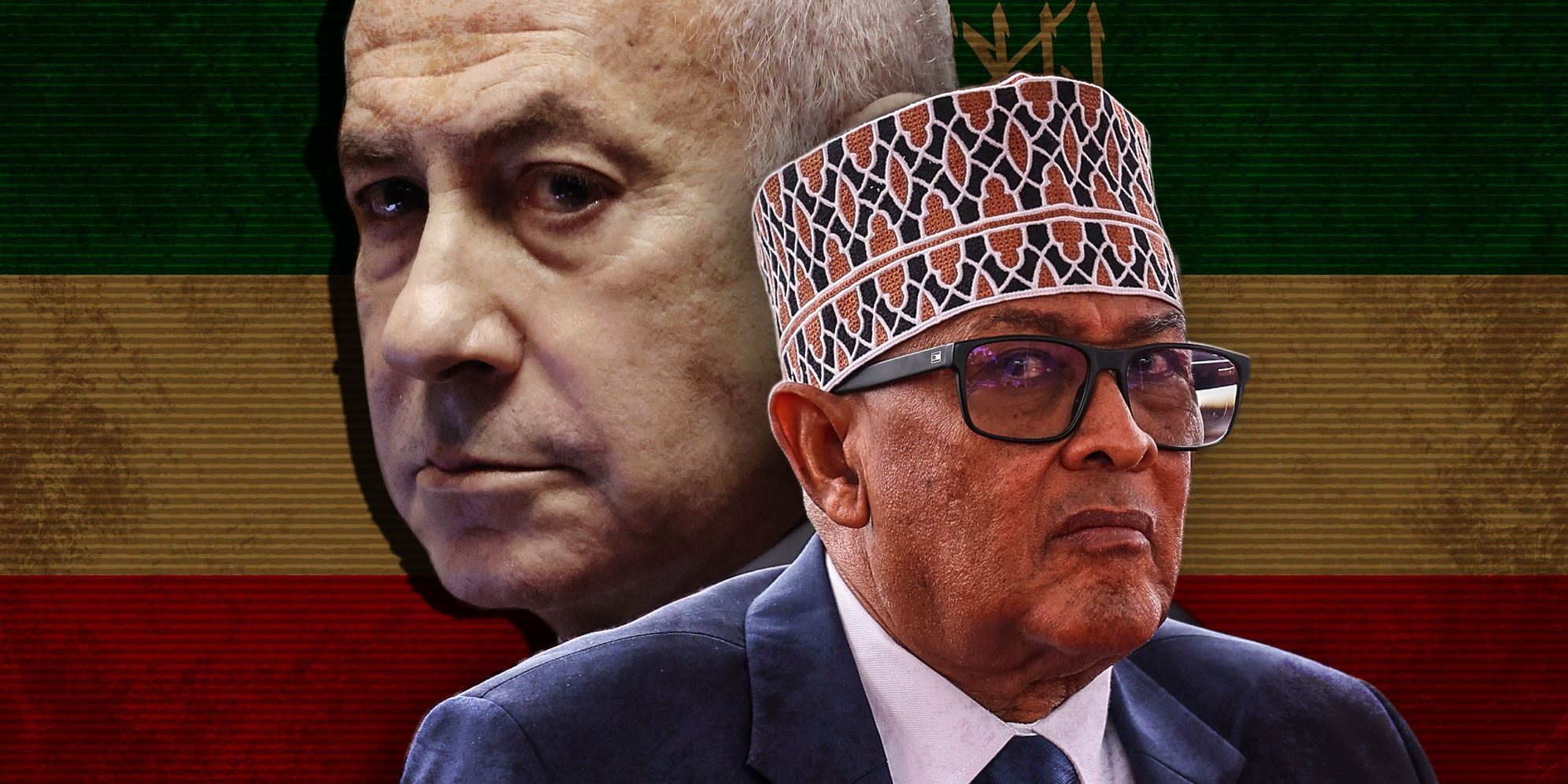
 Illustrative Image: Israeli Prime Minister Benjamin Netanyahu. (EPA / ABIR SULTAN) | Somaliland President Abdirahman Mohamed Abdullahi. (EPA / DANIEL IRUNGU) | Somaliland flag. (Image: Istock) | (By Daniella Lee Ming Yesca)
/file/dailymaverick/wp-content/uploads/2025/10/label-analysis-2.jpg)
Israel’s controversial recognition of the statehood of the breakaway country of Somaliland has rocked the region, raising hopes – or fears – that other states might follow suit. Somalia, which considers Somaliland as part of its territory, the African Union and many individual states, including South Africa, have strongly protested against Israel’s move.
Israeli Prime Minister Benjamin Netanyahu and Somaliland’s President Abdirahman Mohamed Abdallah signed an agreement on 26 December 2025, in which Israel recognised Somaliland “as an independent and sovereign state”.
Somaliland has enjoyed de facto independent statehood for 34 years, since unilaterally seceding from Somalia in 1991 after the ouster of the Somali dictator Siad Barre, and the collapse of Somalia into complete chaos. Somaliland has functioned as a relatively stable and democratic state since then, even as Somalia has remained chronically unstable.
Although many Western states in particular sympathised with Somaliland’s quest for official statehood and it lobbied hard for recognition, no state had recognised it until last week.
Landlocked Ethiopia came close to doing so in 2024, seeking in exchange a route through the country to the sea. But after vehement protests from Mogadishu and diplomatic interventions, it backed down from formal recognition, though retaining an agreement to use Somaliland’s ports.
Somalia has of course condemned Israel for violating its sovereignty by recognising Somaliland, as have several other states, especially Arab ones.
/file/attachments/orphans/13253185_264553.jpg "Israel's Deputy Permanent Representative to the United Nations, Jonathan Miller, speaks during an emergency Security Council meeting at the UN headquarters in New York on 10 August 2025. (EPA / Olga Fedorova)")
Chrispin Phiri, the spokesperson of SA’s Department of International Relations and Cooperation (Dirco), said: “The recognition constitutes a violation of the Federal Republic of Somalia’s sovereignty and territorial integrity and a direct threat to peace in the Horn of Africa.” He added: “Israel’s action validates fragmentation and risks a domino effect of instability.”
Implicit in this statement is the fear – among Somalia’s supporters – or hope – among Somaliland’s supporters – that Israel’s recognition has broken the ice, heralding a flood of recognitions by other countries that would make Somaliland’s journey from de facto to de jure statehood irreversible.
Next in line?
Some analysts believe the United Arab Emirates (UAE) could be the next country to recognise Somaliland. It already has an investment in Somaliland’s Berbera port and a military base near Berbera airport – and bad relations with Somalia, as well as many strategic and commercial interests in the region that would be advanced by closer relations with Hargeisa.
But in a snap emergency session on Israel’s move in the UN Security Council on 29 December, almost all countries condemned or at least opposed the move. Somalia’s representative Khaled Khiari called it a “deliberate attack” on its sovereignty and added that Somalia “would not permit the establishment of any foreign military bases or arrangement that would draw the country into proxy conflicts”.
This was an apparent reference to concerns raised by some that Israel intends to use Somaliland’s highly strategic position, close to the Bab el-Mandab Strait linking the Red Sea to the Gulf of Aden, as a springboard from which to strike its Iran-supported Houthi enemies in Yemen. Somaliland has denied that it is part of the deal and also denied Somali accusations that the deal includes Somaliland accepting refugees from Gaza.
At the UN, Israel’s deputy ambassador Jonathan Miller defended the decision to recognise Somaliland, saying it was “a lawful, principled acknowledgement of a long-established reality”, and that since 1991 Somaliland had “consistently met the objective criteria for statehood under customary international law”.
/file/attachments/orphans/13610150_917699.jpg "Tammy Bruce, Deputy Representative of the United States to the UN, speaks during a UN Security Council meeting in New York on 29 December 2025. (EPA / Kena Betancur)")
US deputy ambassador to the UN, Tammy Bruce, defended Israel’s recognition of Somaliland, saying that several countries unilaterally recognised a “non-existent Palestinian state” earlier in 2025 – and that “no emergency meeting was called to express this council’s outrage”.
But she also added that: “We have no announcement to make regarding United States recognition of Somaliland and there has been no change in American policy.”
Africa Confidential reported this week, though, that there were serious divisions within the Trump administration about whether or not to recognise Somaliland.
Border history
Matt Bryden, strategic analyst at the Sahan Research group, told Daily Maverick there had been a long-standing interest among many governments to work more closely with Somaliland, but the lack of recognition had been an impediment.
Now that Israel had broken the ice, it was probably inevitable that the US and some other countries would follow suit.
Bryden acknowledged that Israel being the first had complicated things for Somaliland, but after other countries had recognised it “the question of who was first will eventually fade into irrelevance”.
Bryden thought that to avoid being blamed by African states the UAE would probably not be the next country to recognise Somaliland, but would be cautious and allow some African nations to go before it. He mentioned Ethiopia, South Sudan, Senegal, Kenya and Rwanda as some possibilities, because of their historical links to Somaliland.
He also dismissed the concerns of the chairperson of the African Union Commission, Mahmoud Ali Youssouf, that recognising Somaliland violated the respect for national borders inherited at independence as enshrined in the AU’s Constitutive Act.
This “risks setting a dangerous precedent with far-reaching implications for peace and stability across the continent”, Ali Youssouf said in a statement.
But Bryden noted that the borders inherited at independence were actually those of Somaliland, which had been a separate British colony until it was granted independence on 26 June 1960. The UN Trust Territory of Somalia received its independence on 1 July and the two states then voluntarily merged to establish the Somali Republic.
“So Somaliland is probably the only case on the African continent that can claim independence in conformity with the AU’s Constitutive Act.
“And in that sense it’s a stronger case than Eritrea or South Sudan or some others and… it sets a threshold that I think puts to rest concerns about opening a Pandora’s Box,” he said, referring to criticism that recognising Somaliland would prompt other African groups to secede.
Bryden also thought it was unlikely that Israel would establish a military base in Somaliland because it did not have a historical practice of establishing overseas military bases.
He thought it more likely that it might establish listening posts there.
Netanyahu’s statement said: “Israel plans to immediately expand its relations with the Republic of Somaliland through extensive cooperation in the fields of agriculture, health, technology and economy.”
He also noted that the agreement was “in the spirit of the Abraham Accords”. These agreements, brokered by the US, normalised Israel’s hitherto estranged relations with several Arab nations: the UAE, Bahrain, Morocco, Sudan and Kazakhstan. So the 26 December agreement is in effect a mutual recognition between Israel and Somaliland.
Uncertain ramifications
The world will now be watching closely to see if Israel has indeed broken the ice – or hardened it – and whether or not other states, especially African ones, follow its example, leading to Somaliland permanently and officially becoming Africa’s 56th state.
The ramifications of Israel’s recognition of Somaliland are uncertain, especially if it injects Israel’s own complex politics into the equation. Perhaps Israel’s enemies might counter.
In a region so strategic and a geopolitical universe so fluid, predictions are difficult. But, as independent international relations analyst Velina Tchakarova posted: “…the momentum is shifting geopolitical alliances irreversibly. In 2025 and beyond, geographic location and choke points outweigh traditional sovereignty claims.”
But it should be said that the criticism by Somalia, South Africa and other states that Israel’s recognition of Somaliland is a threat to stability in Somalia and the region looks rather ironic when one considers how deeply unstable Somalia currently is, with Al-Qaeda-affiliated Al-Shabaab violent extremists controlling much of its territory and chronic tensions between the federal government in Mogadishu and several of the federal states.
Could it possibly get worse? DM