



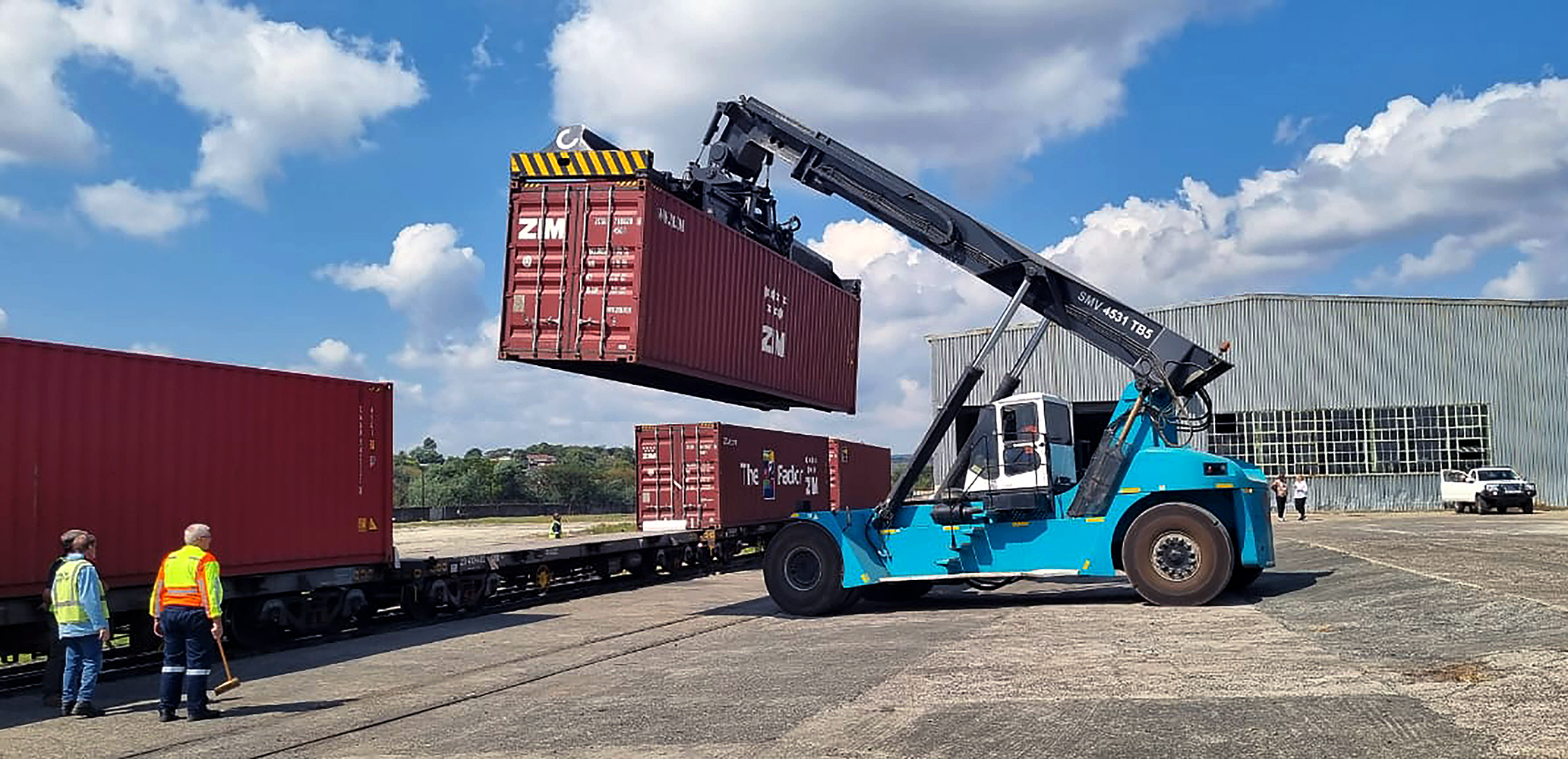
 A reach stacker transfers a loaded shipping container from rail to road transport during cargo handling operations at the EIT Freight Village in Estcourt.
(Photo: EIT Freight Village at Estcourt)
A reach stacker transfers a loaded shipping container from rail to road transport during cargo handling operations at the EIT Freight Village in Estcourt.
(Photo: EIT Freight Village at Estcourt) 
“The rail runs directly next to the road... exactly the same [number of] kilometres all the way [from the port] to here [Estcourt]. But from here [Estcourt] the rail goes around Ladysmith, all around the mountains into Joburg. And the road goes straight into Joburg up [Van Reenen’s] Pass. So the road on this last leg is about 180km shorter... But, between our village and the port, the rail cost is a lot cheaper.”
That is the geometry of South Africa’s logistics crisis, explained by EIT Group CEO Wessel Jacobs. It is a simple equation of physics versus finance that has somehow eluded state planners for decades.
Read more: South Africa’s rail revival: new operators, old problems
Jacobs is a former investment banker who specialised in rehabilitating bad businesses (business speak for cutting costs and carving up assets for sale). He admits the “negative environment” of retrenchments and distressed assets eventually wore him down.
Now, he has transformed a site he was originally meant to rehabilitate – the old Masonite board manufacturing plant – into a silver bullet for the N3 road freight congestion.
The Estcourt Intermodal Freight Village is an ambitious attempt to hack the logistically terrible topography of the country.
Finding profit in physics
The concept is deceptively simple. Rail is efficient at hauling heavy loads over flat terrain, but struggles with the steep, winding incline of the escarpment. Trucks destroy the road, and themselves, trying to haul heavy loads out of the port, but they are agile enough to handle the final vertical climb up Van Reenen’s Pass efficiently.
By placing an intermodal terminal at Estcourt – the exact point where the rail line detours wildly around the mountains while the N3 shoots straight up – Jacobs is arbitraging the geography.
/file/attachments/orphans/OO2607-EIT-WEBSITE-UPDATE-GRAPH-2-1536x617_162139.jpg "As this diagram shows, 75% of the elevation is on the last 180km of the route to the Durban Port. This last 180km is also where most trucks experience dwell time, and it is more cost-effective to run the last section of this route via rail rather than by road.
<br>(Source: EIT Freight Village at Estcourt)")
(Source: EIT Freight Village at Estcourt)
“If I run a vehicle from Joburg into a pack house close to the Durban port and back, I can run eight to 12 loads a month, per vehicle,” he explains.
“But if I run in and out of Estcourt, I run 25 to 30 loads per vehicle … which reduces the density of vehicles on the road substantially because your turnaround time is so much faster.”
It’s simple numbers, not Newtonian theory: A truck can currently wait up to two days just to get into the Durban port. By shuttling containers via rail to Estcourt, EIT effectively moves the port gate 180km inland.
“It’s much easier to manage 80km of rail than to manage 800km of rail straight up front,” says Jacobs.
Another part of the train set
This project isn’t happening in a vacuum. It is the physical manifestation of the long-awaited rail reform landscape (shout out to Tannie Barbara!). Vivien Chaplin, a director at Cliffe Dekker Hofmeyr, concurs with Daily Maverick reporting that the sector has finally moved from “diagnosis to delivery.”
The shift toward private sector participation means private operators like EIT can now own the sidings and lease slots from Transnet.
What this means for you
Safer holiday travel: The N3 is the jugular vein of South African tourism and trade, but it is notoriously dangerous due to the sheer volume of heavy trucks navigating the steep gradients of Van Reenen’s Pass. By shifting freight to rail for the flat leg and shortening truck trips to the final climb, this project could remove 1,400 trucks from the highway per day. That means fewer accidents, less congestion and a safer drive down to the coast.
Cheaper products: Logistics costs are a massive chunk of the price tag on everything from imported iPhones to your daily bread. South Africa’s logistics costs are significantly higher than the global average due to our reliance on expensive road freight. Rail is cheap, road is fast is the rule of thumb. By combining them intelligently, the cost of moving goods drops. Eventually, some of those savings should trickle down to the shelf price.
Economic stability: The port gridlock in Durban is a drag on the GDP. When ships can’t dock and trucks wait two days to enter the port, the economy bleeds. Fluid logistics mean businesses can hold less stock (saving money) and export more reliably, making Mzansi a more attractive investment destination.
Jacobs confirms EIT is already running three trains a week, with plans to scale to daily services, and is in the process of an unsolicited bid to run its own rolling stock.
“To get our own trains... We’re all on that train at the moment,” he quips about the current rail race.
Read more: Why Traxtion is sinking billions into Creecy’s freight rail reform project
Regulatory changes are greasing the wheels. The ratification of the Luxembourg Rail Protocol (an extension of the Cape Town convention), effective in SA since May 2025, creates a global registry for security interests in rolling stock.
Chaplin argues this could discount risk premiums by up to 20% for financiers, making it significantly cheaper for private operators to buy the trains needed to make these kinds of schemes work.
Midlands freight paradise, not a parking lot
Jacobs is at pains to differentiate the Estcourt facility from a “dry port” or a simple terminal. He calls it a freight village because it’s built on a European concept where logistics is the primary tenant.
/file/attachments/orphans/Screenshot_11-12-2025_16751_wwwgooglecom_848788.jpeg "Estcourt intermodal freight village, as seen on Google Maps.")
Unlike the Port of Gauteng – a competing/complementary vision led by Francois Nortjé, which Jacobs hopes will have the necessary scale – Estcourt is designed as a self-contained ecosystem. It includes container stacks, bond stores and distinct zones for stuffing and de-stuffing containers.
This allows for a crucial efficiency: handling empty containers. “South Africa is import positive into Joburg... So what happens is we run full 40s [40-foot containers] into Joburg, then we run empties back to the port,” he says.
Instead of shipping air back to Durban, empties are now packed at Estcourt with export goods, meaning trucks and trains are running full in both directions.
/file/attachments/orphans/unnamed61_497775.jpg)
Solutions at scale
The facility is already operational, repurposing the massive existing rail sidings of the old Masonite plant – a latent asset that Jacobs and his consortium realised was worth far more than the factory itself.
The potential impact on the national grid is immense. EIT estimates the project could remove up to 1,400 vehicles per day from the most congested portion of the N3.
For anyone who has navigated the truck-clogged arteries of KwaZulu-Natal during the holidays, that number represents not just economic efficiency, but a massive improvement in road safety.
It seems the investment bankers have finally found a way to make money that doesn’t involve firing people: they’re firing the inefficiency instead. DM