



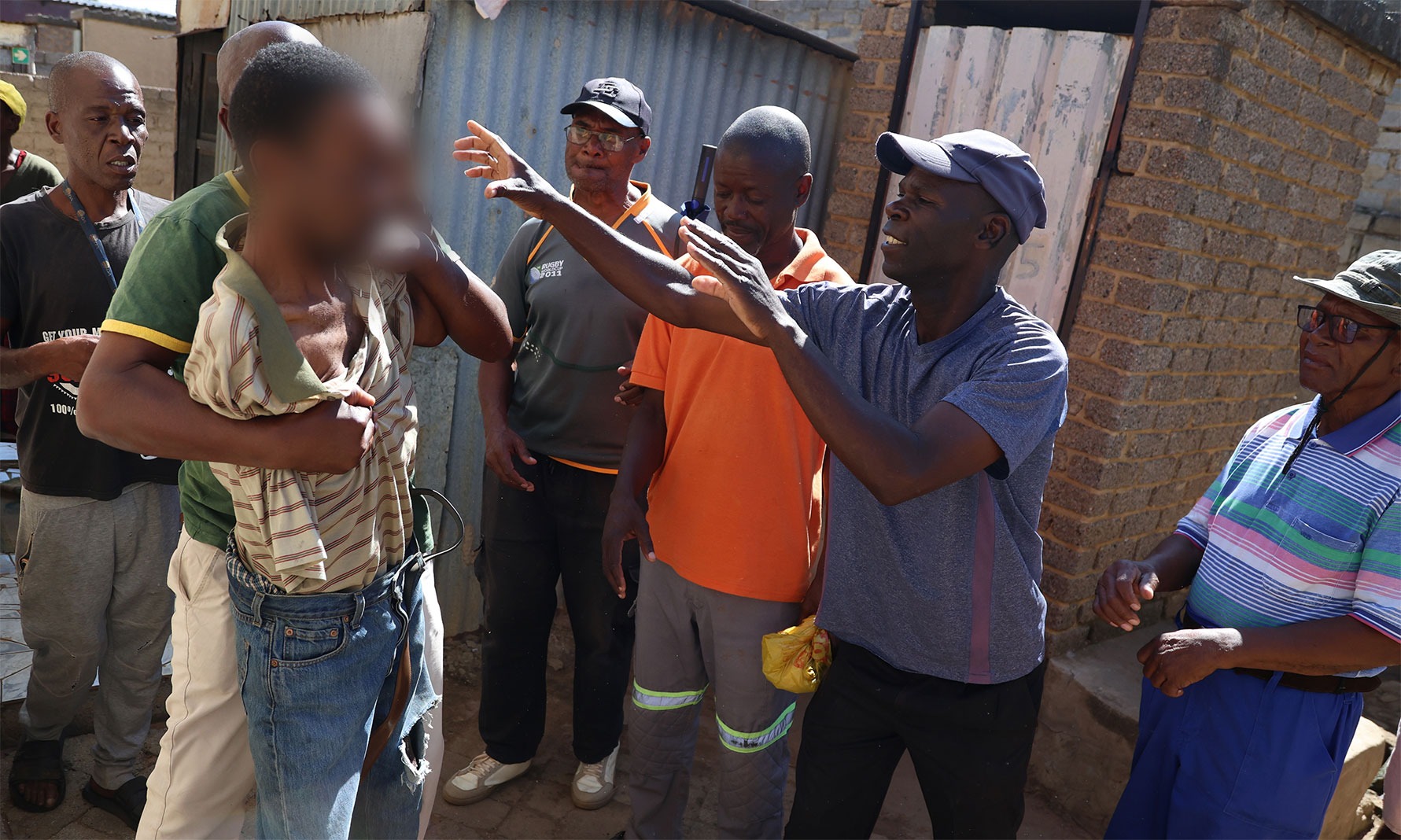
 Community crime prevention organisation members escort an alleged drug addict from his home after he swore at his mother in Palm Springs. (Photo: Felix Dlangamandla)
Last Friday, a middle-aged man approached a group of men in Orange Farm, Johannesburg, claiming he knew of a plot by two men to rob a woman who had recently settled in the area, believing she might have betweenR20,000 and 30,000.
The group, known as Amadoda Emizi, located one of the alleged conspirators and brought him face-to-face with the whistleblower and the targeted woman, who was shocked. In a tense exchange, the complainant said, “I became aware of their plan when I went to see the absent suspect who tried to recruit me for the job.”
The suspect denied any involvement. Unmoved, Amadoda Emizi instructed him to locate his alleged accomplice to establish the truth. He wasn’t home, and the operation was temporarily shelved.
Not all the vigilante group’s suspects are so lucky.
Amadoda Emizi loosely translates from isiZulu to “men of the homesteads”. It’s a collective of Orange Farm community members who say they’re committed to restoring justice where formal policing systems fall short.
After receiving community complaints, they try to pursue alleged wrongdoers, establish the truth and secure redress while delivering accountability and imposing punishment on their own terms.
Their actions are often illegal, and some members face their own criminal cases, but they’ve won over community members who feel let down by the police.
‘Blood on the pavement’
“The formation of Amadoda Emizi was not sparked by ideology. Rather, it was sparked by urgency,” the group’s chairperson, Sphiwe Hadebe, told Daily Maverick.
It was formed in April 2025 “by accident”, said Hadebe.
He said a group of young men returned home from their initiation ceremony not as men, but as gangsters.
“They did not approach the initiation custom the right way. They just go without any reflection on whether it aligns with their specific cultures or not, and culturally, that can be a problem. They come back with pangas, knives, guns and other dangerous weapons and terrorise and rob communities,” said Hadebe.
“There was blood on the pavement, and we could not sit and fold our arms as men.”
Amadoda Emizi secretary Bob Dlamini said, “At that time, gangs such as Indondo and the 50s were brazen and very dangerous. They were hacking people with pangas.
“They had no mercy, and we could not sit and fold our arms as men when things were clearly falling apart.”
/file/attachments/orphans/6I1A2375_184779.jpg "Amadoda Emizi members stand outside the home of an alleged abuser following a reported incident. (Photo: Felix Dlangamandla)")
/file/attachments/orphans/6I1A2377_208044.jpg "Thembelihle Khumalo called Amadoda Emizi members to her home regarding an alleged case of abuse in Orange Farm. (Photo: Felix Dlangamandla)")
The group launched after a meeting with a former councillor. Daily Maverick was unable to reach the councillor for comment. At the end of that meeting, Hadebe reached out to local men on social media.
“Luckily, local men responded positively, and they were happy with the initiative. And that is when we began.”
Amadoda Emizi respond only to “cases” that have been reported to them by community members.
“Our aim is, one: to fix our children, fix our neighbourhood and to fix our environment,” the group says in a Facebook post. “We are not under any political party. We are not working for any organisation. We are on our own.”
Amadoda Emizi, also known in the community as Abobaba, started as an all-men group, but women have recently joined. According to Hadebe, they felt they needed women to effectively deal with matters that directly involved women and children.
Its reach has also expanded outside Orange Farm. Spurred by the community’s enthusiasm and the ripple effect of their impact, the group has expanded its reach across Johannesburg, and even to far-flung areas such as Dennilton in Mpumalanga.
Social media presence
Amadoda Emizi has a vibrant social media presence and post videos on Facebook and TikTok of alleged suspects confessing to their crimes under duress, as well as the group returning stolen items.
Once a case has been logged, the group tracks down the suspects, brings in the complainant, and then tries to establish what happened in a “disciplinary proceeding”. The alleged criminal is punished by being lashed with sjamboks or sometimes just with stern words.
“We were reckless at first,” Hadebe admitted. “But we’ve since developed a system. Not every criminal deserves a beating. But a gangster with a firearm? That’s another story.”
After just nine months, the group boasts 93,000 followers on Facebook and 14,000 on TikTok. It has posted dozens of videos. People also use social media to contact the group and alert them to alleged crimes.
/file/attachments/orphans/Screenshot-2026-01-25-at-1548_388642.jpg "Posts on Amadoda Emizi’s Facebook page. (Photos: Facebook)")
In its most-watched video on Facebook, with 4.4 million views, a woman who appears to be a traditional healer is lashed with a sjambok for allegedly insulting members of the group. She can be seen twisting and crying on the floor.
In another, an elderly man confesses to selling the contents of his family house, such as furniture, to feed his drug addiction.
“I sold the furniture to a Mozambican man named Andries,” he says, explaining that he picked up a crystal meth habit in prison. “And, I sold the sewing machine to the boy down the road.”
In yet another video, a young man sweats as he confesses to stealing a phone. He says he will point out the person to whom he sold the phone for R400.
Police resistance
Due to his work with Amadoda Emizi, Hadebe has his own rap sheet, a long one.
“The police said they’ll fetch us on Thursdays,” he shrugged, “so that we spend the weekend in the cells. It’s strategic.”
The group, however, also say they have support from SAPS.
“Some police say they can finally breathe,” said Neo, another Amadoda Emizi member, who didn’t want his surname reported. “There aren’t as many cases any more. They know we’re doing what they can’t.”
SAPS did not respond to Daily Maverick’s requests for comment.
/file/attachments/orphans/6I1A2269_162226.jpg "Amadoda Emizi members Thabo Hlape (38), Lefa Mei (61), Tsietsi Matshabisa (44), Andries Ndonoane (59), Sifiso Nhleko (54), Thabang Mofokeng (62), Sphiwe Hadebe, Elias Magwaza (53) and Samuel Bob Dlamini (50). (Photo: Felix Dlangamandla)")
/file/attachments/orphans/6I1A2364_963329.jpg "Community elder Victor Matshoba delivers a stern, but caring, warning to an alleged offeder in Palm Springs, Orange Farm. (Photo: Felix Dlangamandla)")
One case turned deadly and four members face murder charges after an accused person died.
“It wasn’t intentional,” Hadebe insisted. “Some people have thin skulls such that a very light blow can be fatal. This is what I think happened in this rare case.”
The case is pending in the Vereeniging Magistrates’ Court. The four have been charged with murder. Other Amadoda Emizi members have been arrested for assault or administering capital punishment to the suspects.
Residents thankful
The group has dozens of complaints waiting for its attention. Those who reported cases to Amadoda Emizi said it had made a difference in the community.
“My brother was very abusive, but since Abobaba came, we have not had any incident,’’ Lesang Legong from Orange Farm told Daily Maverick.
“Since that day when Abobaba came, it’s been very peaceful. The criminals no longer even hang around at the local park.”
“We tried several times to report at the police station, but we have never been helped. Abobaba solved the issue in one day, and I hope (her brother) remains like this,” she said.
“The police are not helpful,” Legong said.
Another community member, Joseph Motaung, told Daily Maverick that after his property was stolen, it had all been returned after the suspect became aware that the theft had been reported to Amadoda Emizi.
“I thank Abobaba for what they have done for me, and I wish they are always there for everyone. I’d lost a computer, lights, laptop, speaker and music system.”
Kgomotso Kokonyane from Orange Farm Extension 9 said, “There was a burglary at home, and they stole my make-up kit, installation kit, speaker box, shoes and iron last year July.”
She didn’t bother to report the case to the police, assuming, like most other residents who spoke to Daily Maverick, that they wouldn’t do much about the case. She reported it to Amadoda Emizi.
“Police are not helping. They would have taken me around the township in their van without any help, but Abobaba recovered everything.”
Orange Farm resident Thomas Mkhithiya described the problems in the community.
“Crime is rife in this area, and it’s being committed by very young people,” said the 69-year-old.
“If I wasn’t limping from sickness and old age, I would be part of Amadoda Emizi.’’
Vigilantism
Vigilantism is widespread in South Africa owing to deep community distrust in the police, who, in many communities, are unable to deal with high levels of crime. But in the absence of due process, suspicion becomes a verdict, and often, vulnerable groups, such as migrants, become targets.
In the second quarter 2025/26 crime statistics, vigilantism and mob justice are listed as the fourth-highest cause of murder, after arguments and misunderstandings, robbery, and gang-related murders.
According to Lizette Lancaster, the Institute of Security Studies’ head of justice and violence prevention programme, vigilantism blurs the line between citizen and criminal. As communities take justice into their own hands, law-abiding individuals drift into illegality.
Lancaster said in the vacuum left by a sidelined state, private actors such as gangs, militias and even businesses step in to replace the law.
“They rule localities through often arbitrary use of violence and fear. People in these situations, particularly children exposed to violence often meted out on the whim of local warlords, experience severe insecurity and trauma,” Lancaster said.
Lancaster said that with vigilantism, the accused’s rights were automatically dispensed with.
“Importantly, [in criminal proceedings] the accused is allowed the opportunity to respond to the allegations and face the accusers in a safe environment. Most, if not all, of these principles fall away when an emotional crowd takes the law into their own hands.”
Lancaster warned that mobs or vigilante groups ran the risk of targeting innocent people.
“This trend reflects an erosion of trust in formal law enforcement, leading communities to take the law into their own hands,” Lancaster said.
On its Facebook page, Amadoda Emizi says: “Yes, the law stands, and taking it into your own hands is not good, but what do you do when all hope is lost and you have nowhere to turn to?” DM