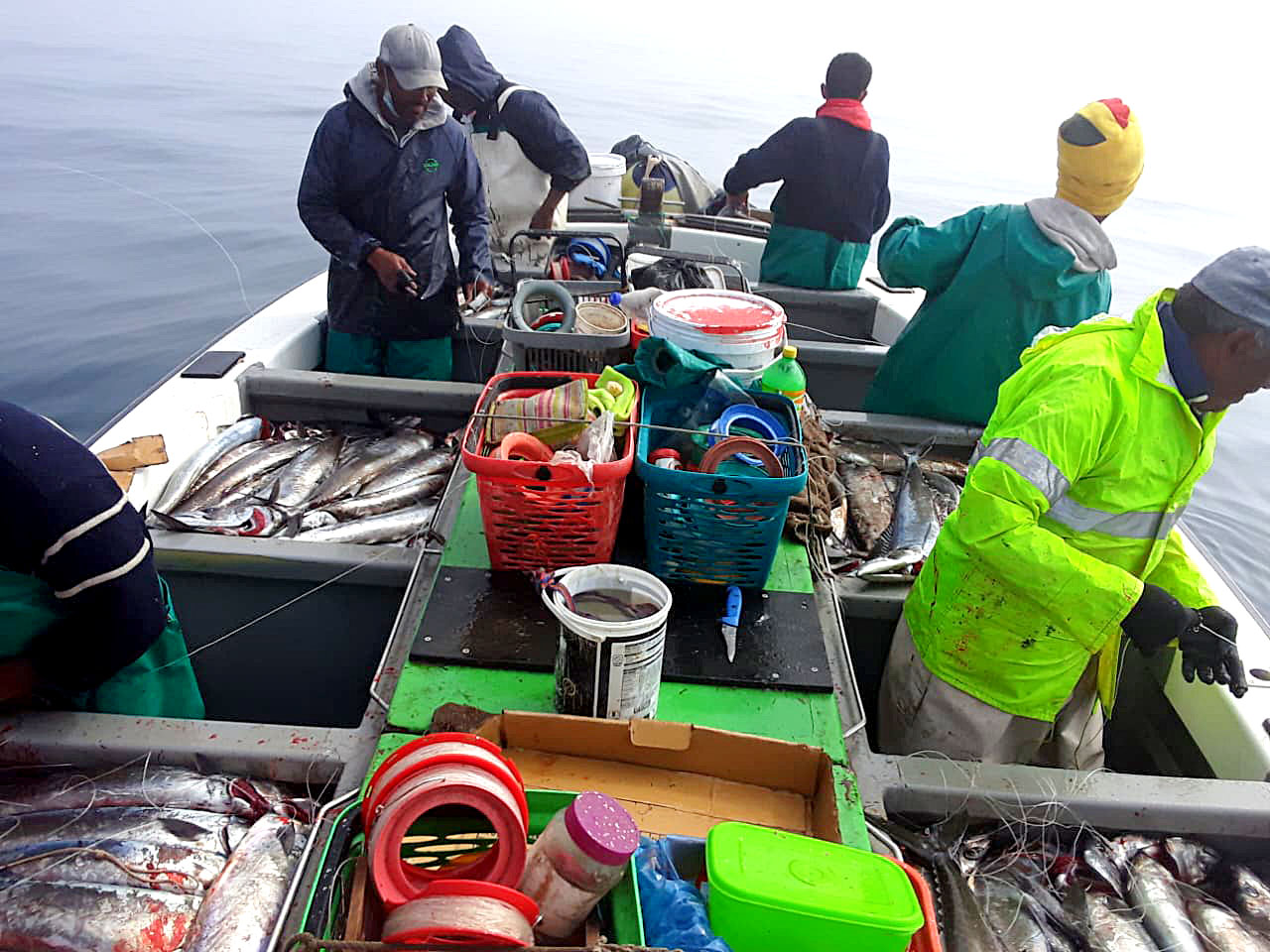
 A handline boat and crew. (Photo: Travis Daniels)
/file/attachments/2985/TroubledWaters_405609.jpg)
For as long as he can remember, the sea has been in Travis Daniels’ blood. Born and raised in Kalk Bay, he grew up with the harbour and the beach at his doorstep, roaming freely between the rocks, catching guppies and abalone and swimming with friends under the watchful eye of a close-knit community. Gathering was allowed, and you could feed a family that way. His grandfather was a fisherman, a skipper of a wooden chukkie, and though none of his sons followed him to sea, Travis – his eldest grandson – did.
As a boy, he learned the rhythms of fishing on the harbour wall, catching mackerel and stonkies for bait. When he became a teenager and wanted takkies and nice clothes, his grandfather gave him a choice: come to sea, catch fish and earn the money himself. It was a deal that sealed his future. “Once I got the taste of being able to catch fish and make money, I was hooked,” he remembers. “It was a done deal.”
After leaving school and briefly studying panel beating, he walked away from the trade without a second thought. The next day, he was on a boat – and he has been fishing ever since. Now in his late forties, Travis has spent four decades at sea, building a lifetime of knowledge, resilience and respect for the waters of False Bay and beyond. His story is one of inheritance, survival and devotion to a way of life that is increasingly under threat.
****
“When you leave you don’t know that you’re going to earn. You also don’t know that you’re going to return. To get yourself psychologically stable, to go on that boat and to know that you might not earn and you might not return – that’s massive.”
****
You started young – what was it that first pulled you into fishing?
I grew up around the harbour. After school, we’d go down to the wall and catch little fish – mackerel, stonkies, whatever we could. If we had plenty, we’d bring them home, and my grandfather would use them for bait. That’s how it started. Later, when I wanted things as a teenager – clothes, shoes – he told me, “If you want takkies, come to sea with me. You catch fish, make money, and I’ll pay half their cost.” That’s how he hooked me. Once I felt the rush of catching and earning, I was done.
Was your grandfather the one who truly set you on this path?
Yes. He was a skipper, worked his sister’s boat. He taught me not just how to fish, but how to think about fishing – as a lifestyle, not just a job. He used to say fishing is about being in sync with the sea, knowing when to fight and when to let go. His kids never became fishermen. He didn’t want them to because he saw the decline of the industry. But I was different. I was always at the beach, always at the rocks. It was in me.
/file/attachments/2985/TravisDaniels_702682_0b574e1f875ed6849afade8ec0ff1727.jpg "Travis Daniels grew up around Kalk Bay harbour. (Photo: Supplied)")
What’s the excitement of fishing for you?
It’s the adrenaline. You’ve got a shoal running, fish biting, 10 men on the boat shouting, laughing, arguing – “Hey, you got my line!” And suddenly it all just flows. Everyone’s pulling fish, the boat’s filling and you know: today’s payday. You feel the wild animal pulling against your hands, because we use hand lines, not rods. That fight travels up through your body and it’s addictive.
Take us back to that storm off Gansbaai. What happened?
That was hectic. We were trawling sardines on the Anjeri, a green wooden boat, and we got caught in a northwest storm with 12 tons on board. That’s a heavy load for a small chukkie. Waves were smashing us, water flooding the deck. We threw anything we could overboard to make her lighter, but we couldn’t dump the fish. It took us hours just to inch from Gansbaai to Kleinmond.
My grandfather always told me, “When you’re in a storm, you need to become one with it. If you fight it, you sink. You welcome it, you stay calm, you use your knowledge to get through.” That’s what kept us alive – teamwork, calm, constant checks. One engine only. If it dies, you die. We made it back, but that lesson stayed with me: don’t fight the sea, flow with it.
That sounds terrifying. Have you ever thought: ‘This is it, I won’t make it back?’
Many times. And families at home don’t know either. They see the storm on the horizon and wait. Back then, no cellphones – only radio. Every trip, there’s risk. That’s why I said earlier: you don’t know if you’ll earn, and you don’t know if you’ll return.
/file/attachments/2985/FishersmeetTravisDaniels_316889_2b2f418e5ed315c97aac3cc85bfecb34.jpg "When fishers meet. (Photo: Travis Daniels)")
What’s the hardest part of fishing today?
Survival. The quotas, the trawlers, the big companies – Sea Harvest, Oceana – they hammer us small-scale fishers. We see them dump tons of snoek at sea when they’ve overcaught, silver for miles. Meanwhile, our boats rot at the moorings because rights were stripped away. Kids don’t want to fish any more; all they hear is moaning. They don’t see a future.
But you believe there’s still a future?
If things change, yes. We’ve got unemployed youngsters everywhere. Not everyone’s good at books, but many are good with their hands. Government could create schemes where older fishermen like me train them on the wooden chukkies, pay us to pass on the knowledge. That’s how I learnt – from my grandfather taking me to sea. Without that, the knowledge dies with us.
You’ve spoken about knowledge the scientists don’t have. What do you mean?
They don’t fish. They look at averages, do surveys at the wrong time of year and say there’s no fish. But locals know when the runs happen. I’ve been fishing since 1994 full-time and before that, from childhood. That’s my university. Thirty years at sea. Who’s the best scientist? It’s the man who spends every day on the water.
/file/attachments/2985/WhenfishingwasgreatofftheKalkBaypierTonyTrimmel_871652_dd165bff2ca75818e3be3baa9c499b3d.jpg "When fishing was great off the Kalk Bay pier. (Photo: Tony Trimmel)")
Do you think there are fewer fish, or is it mismanagement?
Both. Deep-sea trawlers target species that were meant for us. Crayfish is depleted badly – back then, we’d land a ton in a day, now boats struggle for a hundred kilos in two days. But there’s also waste and illegal fishing, undersized crayfish dumped on the black market. It destroys the grounds.
Also, there are fewer fish, not only because we’re fishing them but, for example, they closed the mouth of Sandvlei as seawater was contaminating people’s boreholes. But vleis and wetlands are where the sea fish spawn, and they need a mix of fresh and sea water to do that. Whole species of fish have disappeared in False Bay as a result. Then you have things like the Strandfontein sewage facility polluting the sea. At the outflow, the reefs are dead, poisoned. No fish.
How do you know where to fish?
It’s traditional. I have a map of False Bay and areas around the Western Cape in my head. When we get to the spot we know the fish are, we can hold the boat in one place, because we’re in that spot. We use landmarks. We use the mountains and markings on the mountains. This was never written down. It’s just in people’s heads. Back then, we never had GPS. Just a compass, an echo sounder and a watch.
Scientists don’t really know specifically what’s under the water. We know the seasons, where the fish will be and when. We know where they gather. There are more fish than the scientists think.
How do you see the community changing?
We’re proud people. We don’t beg at robots. We fish to feed our families and live honestly. But if quotas keep going to processing plants and inland companies instead of fishers, it will be the end of the line for fishing communities. The knowledge, the culture, the pride – it will vanish.
What does the sea mean to you, personally?
It’s my life. I can’t picture myself with a pick and shovel, at a Pick n Pay till or on a building site. I grew up on the water; I’m still on the water. Fishing is an honourable living. You bring home food, you earn your keep. It’s dangerous, yes. It’s unpredictable. But it’s also beautiful.
/file/attachments/2985/SnoekonthehookTravisDaniels_152383_40b233d10af516f15097c2fc6dff5e9b.jpg "Snoek on the hook. (Photo: Travis Daniels)")
If you had the power, what would you do now?
Give the quotas to people who live and fish on the coast, not to processing plants and upcountry people. Why should processing plants have quotas? And then get youngsters to learn to be fishers. If they can earn a decent living, it will attract them.
There are still a lot of fishermen like myself and others who can train them. And you start encouraging these youngsters to go fishing, and you take them out on the chukkies, and you show them. Because that’s what’s lost.
If I were paid to teach youngsters by the government, I would do it, pass on the old skills. Then the kids wouldn’t become gangsters and land up in jail.
Handline fishing is one of the most sustainable, low-impact ways of harvesting from the sea – but that tradition is threatened by policy, quotas and industrial competition.
Do you have any rituals before you go out?
We pray. Always. I’m Catholic, went to St James Catholic Primary. Our community is half Muslim, half Christian, living side by side peacefully for generations. On the boats, faith is what keeps you steady. If you don’t believe, you won’t come back. DM
Tomorrow:
Aunty Val: being a woman trek netter on the Cape coast
Previously:
Setting up the series: Untangling South Africa’s fishing industry
Mark Wiley: South Africa’s vanishing fish
Tim Reddell: Steering Viking Fishing through South Africa’s troubled waters
Deon van Zyl: ‘We’re crippled by government inefficiency’
Doug Butterworth: Seafood’s balancing act and the science of sustainable catch limits
Colin Attwood: Counting the uncountable and the science of tracking fish
Kobus Poggenpoel: ‘These traditions will die with my generation’