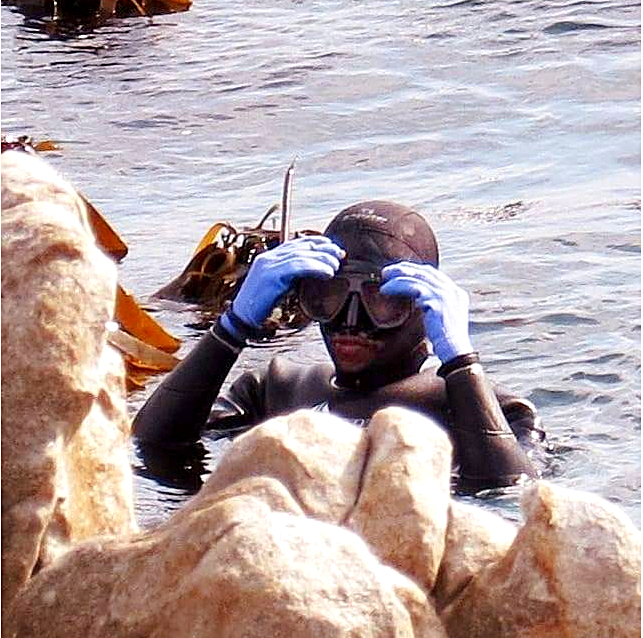
 A poacher at work. (Photo: Community Against Abalone Poaching)
 /file/attachments/2985/TroubledWaters_405609.jpg)
Neels Loff was born in Hawston near Hermanus in 1976, raised in a fishing family that lived from the sea. His father worked on the big trawlers – catching fish, making fishmeal on board, gone for weeks at a time. Neels and his brothers were brought up to fish. By six years old, he was hand-lining beside his father, saving his first earnings to buy a pair of North Star sneakers.
Fishing was their way of life, until the quota system changed everything. Neels qualified as a skipper but was never granted a quota. Shut out of the official system, he turned to what the authorities call poaching. “I must live,” he says. “I am sitting with a skipper’s licence, but no quota. What else must I do?”
Now in his late forties, Neels describes himself not as a poacher, but as an indigenous fisherman criminalised by a broken system. His story is one of danger – night dives, sharks, guns, drugs, police bribes – and of deep injustice.
***
You started with your father. What was that like?
I began at six years old. On weekends, when we were not at school, we went to sea. I can still remember that – 44 years back. I earned my own pair of North Stars with my weekend money. My father’s whole life was fishing, gardening, making our own livestock. We had nothing else.
My father always told us stories from the trawlers. He said the ships were so big. They would haul in the catch, process it right there at sea, bag it and offload only the fishmeal when they returned to port. That was the life he knew – long weeks on the ocean, hard work and the pride of making something out of nothing. Those stories gave me the idea of life at sea long before I ever set foot on a boat.
/file/attachments/2985/NeelsLoff_519551_732cd0f849dd242f5e654e1a4874c393.jpeg "Neels Loff, a poacher by necessity.")
Did you follow him into fishing?
Yes. I left school in Grade 7. At first I hand-lined with my father on his own boat. Then he had to sell the boat, because he worked on the big trawlers. They told our fathers they couldn’t have a fishing boat if they worked on a trawler. So he sold it, and I went to work on other boats. I worked in Port Elizabeth on sardine trawlers.
I travelled the coast many times – Hawston, Struisbaai, right up to Port Nolloth. But the government put restrictions everywhere. At Alexander Bay there was no harbour for our fishermen. The nearest harbour was Port Nolloth, far away. We were forced to serve other harbours, other bosses, while our own communities were left with nothing. That was the system: we could not fish freely on our own coastline, but had to work for others, often for very little return.
When did things turn towards poaching?
After the black market came in. In 2002, I already had my skipper’s licence. They told us if we didn’t do the skipper’s course, we couldn’t get numbers. But it was empty promises. I got my licence but never got a quota. They said we didn’t have enough points in this or that section. Fishermen are not skilled in paperwork, and this made it very difficult. So how else must I survive?
/file/attachments/2985/Abalonetakenfrompoachers_453202_5693497420fe286eeaec3b6065cac8b2.png "Police inspect abalone confiscated from poachers. (Photo: Daily Maverick)")
/file/attachments/2985/AbaloneconfiscatedfrompoachersDailyMaverick_883961_ea683c0ff1eadf29b673cd7d618825f6.jpg "Abalone confiscated from poachers. (Photo: Daily Maverick)")
How do you prepare for a night dive?
In the beginning, it was a wetsuit, flippers, goggles. Then came the cylinders, underwater lights. You dive at night. You make sure you’ve got your phone sealed up in a condom so it can go in your wetsuit. That’s how we worked.
It is heavy work. You drop into the water and the sea is completely black. Your torch makes a narrow path through the kelp. You must work quickly, always listening for the sound of a boat above you, always aware of the risk of sharks. It is silence and fear mixed together. But it’s work. That’s what people don’t see. For us it is the way to live, the only way left.
Is it dangerous?
Very. There are great whites. There are boats riding over you. Many things can happen. But nobody cares. All they say is we are destroying. But why? If they left us to do what our fathers taught us, nothing would be harmed.
You told me once about nearly drowning…
That was Cape Point. Four of us went in, heavy seas, two cylinders each. We told the boat to wait just ahead. Then suddenly, my brother shouted: another boat coming, cops maybe. Our skipper panicked. He pulled away. When I surfaced, the boat was gone. Just gone.
We were left there – flippers, wetsuits, 300–400 metres offshore in the dark. That night I swam for my life, five hours in the dark. I’ll never forget it. I thought of my daughter, still a baby then, calling me home. That gave me the last strength. I collapsed in the bush until people fetched us.
Who buys the abalone?
The Chinamen. Always the Chinamen. It goes through South Africans, who arrange the paperwork. They bribe people to let it through. The police are not a problem – they’re involved. On every officer’s head there was an amount. They got big money to let everything run smooth.
So the police are in on it?
Yes. I saw it myself. The police were running things so that everything could go without problems.
And the syndicates – how do they work?
At first it was cash. Then they began to pay with drugs – heroin, tik. Abalone became currency. After that it turned ugly. People shooting at each other, fighting for turf. That’s when I stepped back. I don’t do drugs. I only smoke dagga. But the heroin, the guns, that destroyed many.
Are the syndicates local gangs or Chinese?
The bosses are Chinese. The local guys must do the dirty job. The gang bosses are behind it, but they get their power from the politicians.
Politicians? At what level?
If they wanted to stop it, they could. But they don’t. It is big money for them. Even Fisheries inspectors, they confiscate abalone, they sell it back into the same market.
We are still living under Dutch law, criminalised on our own soil. I was beaten by police for holding two bags of dagga, even though today dagga is legal. In 2023, I stood in court, and the prosecutor told me directly that our indigenous people must go back and take our resources. He said we have the right. But outside the courtroom, nothing changes. The police still treat us like criminals. That is the pain we carry every day.
Have you been to jail?
Yes, two or three times. Locked up for my own food. My father taught me how to fish, how to catch an octopus with my hands. But now I am called a poacher.
/file/attachments/2985/PolicehaulofpoacherabaloneCommunityAgainstAbalonePoaching_589504_244216895bc2568e1f4975ca86b6f725.jpg "A police haul of abalone confiscated from poachers. (Photo: Community Against Abalone Poaching)")
What do you feel about the word ‘poacher’?
For me it is indigenous. Aboriginal law. It is our right. The government calls us poachers, but we are fishermen, the real living members of our land.
If you could fish legally, would you?
Yes. Tomorrow. I am preparing for that. But I will also fish without a permit, under native law. Because the court already told me once – our indigenous people must go back and take our resources. That is my right.
If you could speak to the Minister of Environment, what would you say?
I don’t want to speak to him. I would show him. I would go into the sea without a permit and bring out abalone in my hands. That is my proof. He can go to hell. I just want to fish. DM
Tomorrow: Marine Protected Areas: The sea’s second chance
Previously
Setting up the series: Untangling SA’s fishing industry
Mark Wiley: South Africa’s vanishing fish
Tim Reddell: Steering Viking Fishing through SA’s troubled waters
Deon van Zyl: ‘We’re crippled by government inefficiency’
Doug Butterworth: Seafood’s balancing act and the science of sustainable catch limits
Colin Attwood: Counting the uncountable and the science of tracking fish
Kobus Poggenpoel: ‘These traditions will die with my generation’