




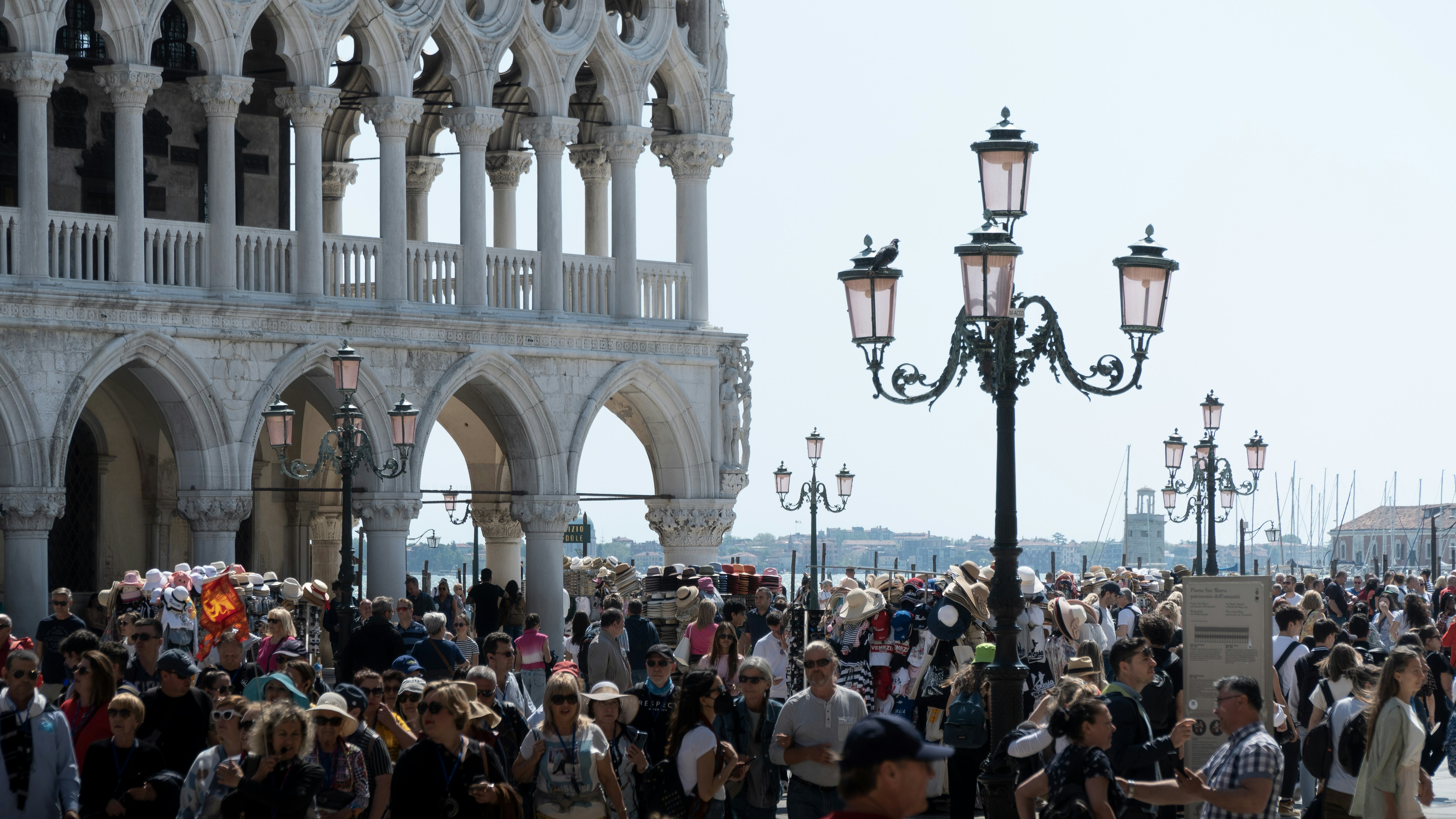
 A throng of tourists in Venice, Italy. (Photo: Unsplash)
 'Tis the season to be jolly … and to travel if you can. Only everyone else seems to have exactly the same idea, and often, the same itinerary. Want to know why? Because you blabbed about your favourite destination and shared details of that tiny hole-in-the-wall restaurant in that secluded spot above that deserted beach. Well, deserted no more.
I’m sitting in my favourite Tuesday writing spot, escaping my helper’s tuneless humming, which competes with the machine sound of tumbling washing and the whirr of the vacuum cleaner as it bashes against furniture legs.
My deli café, where the coffee is delicious, the pancetta crisp and the layered strips of egg covered in a rich, long-cooked tomato sauce, is usually a safe haven from the outside world: quiet and welcoming.
Not today. Today someone has taken my favourite table and I am forced to sit in a draft next to the open door. And my lovely waiter has avoided my gaze, twice, as he moves hurriedly between tables, taking other people’s orders and placing steaming bowls of napolitana-covered egg on tables that are not mine.
The secret of my favourite place is out. I spot the old woman with a lazy eye and a Nanny McPhee wart on her forehead. Each morning, we ask after our mutual health then politely return to our book, newspaper or laptop.
Now I shrug as I spread my hands to indicate my displeasure at the full café. She rolls her eyes, and the black hair growing from her carbuncle quivers.
The two women who work quietly in one corner, often my only other companions, shake their heads and point to the table next to them where a man is talking loudly into his headphones as he takes a meeting. In a crowded restaurant.
We’ve told too many people about our favourite peaceful spot where the WiFi is steady, the staff friendly and the food consistently good. Now it’s everybody’s favourite place – no longer peaceful, but Paris café busy with loud chatter, voices raised in laughter and ringing mobiles that I can hear through my noise-cancelling headphones.
Boast spaces
It’s human nature to want to tell others about things you’ve done and loved doing, places you’ve been, meals you’ve eaten. In these easy-to-share times, it’s simple and often obligatory to share on Facebook, Instagram or TikTok – whatever social media platform is your favourite boast space.
Pictures of the décor, the food, the art on the walls, the delectable goods on offer in the deli section. Your laptop on the table is often a giveaway that this place you’re at has WiFi and allows you to work as you sip coffee or eat a poached egg with crispy bacon and a slice of gluten-free protein bread.
We think it’s a new phenomenon, sharing where we are and what we think about it, but it’s not. In fact, travel and its subsequent gloat to those who remain at home goes back to the early Romans.
Apparently, Baiae on the coast of the Bay of Naples was an ancient Roman luxury holiday resort, renowned for its thermal baths and opulent villas to which rich Romans retreated to unwind from the stresses and strains of city life. Travellers included emperors, Julius Caesar, Nero and Hadrian.
Then it became overcrowded and people used water pistols to deter tourists.
No, hang on – that’s 21st-century Europe, Barcelona! Baiae gradually sank into the sea because of volcanic activity.
Travel got so popular that people needed to be informed of the best places to stay and eat, the most striking landmarks of the area to see, and so the travel guide was born.
When I turned 21, one of my presents from my lovely mom and dad was a trip to Europe. In 1979, my ticket cost R75 and R300 spending money lasted almost two months. To navigate my way across this strange territory, I used Let’s Go Europe, which was aimed at budget travel.
My accommodation was mostly, but not always, backpacker youth hostels. Every 10 or so days, I checked into a fancy hotel for two nights, where the water was hot, the shower mine alone and the bed comfortable.
As I travelled more and more, I relied on the most recommended, reliable and authoritative guidebook for tourists, The Baedeker (published by German publisher Kark Baedeker), which truly set the standard.
Of course, travel guides such as the Lonely Planet, Rough Guides, Fodor’s, Rick Steves and Frommer’s became equally popular – each competing for a niche market. That was before the internet and apps like the e-sim service for travellers, Saily, which allows you to download data to your phone; or City Mapper, which literally gives you the yards or metres to walk before turning left to the place you’re going. It even told me which car to get into on the London tube so I would be nearest the correct exit.
Where everybody goes
Since travel has become more affordable and middle-class people can go on holiday wherever they choose, those hidden gems of days gone by are hidden no longer. Those wonderful little bistros where you could get a table without having to book three months in advance have lost their charm.
Stopping into a small church in Lisbon to pray is a thing of the past; fighting through hordes vomited from cruise ships is more the norm. Beaches are packed. Tourist attractions are crowded.
The Spanish government is cracking down on unlicensed short-term rentals in Madrid and other tourist-heavy cities – read Airbnb. Why? There is a housing shortage for residents and rising rents caused by unregulated tourism and overtourism.
/file/attachments/2985/ennio-berti-AynbLSXLPHY-unsplash_505638.jpg "Tourists in Rome. (Photo: Unsplash)")
It’s the season to be jolly, and middle-class South Africans will take their annual holiday, heading for our glorious beaches, taking skiing holidays in Europe, visiting famous Christmas markets in Germany…
Many will have consulted the travel oracles to determine “the bests” where they will be going. Others will rely on recommendations from friends who urge them to … go to Van Stapele Koekmakerij cookie shop in Amsterdam, only there’s a queue that snakes around three city blocks, in the rain, and the cookies are meh.
You can see why there is such conflicting emotion from residents of cities overrun with tourists: Venice, Barcelona, Dubrovnik and Rome. On the one hand, there’s the strain of the influx on local resources and infrastructure causing enormous congestion and social challenges; on the other, there is the lifeblood injection of cash that tourism brings as it feeds, houses, transports and amuses visitors.
I’m a Sagittarian – I love travel. So here is my tip for people heading off on holiday. Don’t plan so that your every minute is filled with what other people have done.
Some of my favourite moments have come from discovering a little café on the side of a steep hill in Lisbon where the Bacalhau à Brás was so good I went back twice.
Or when I happened upon a woman cooking the best green curry I’ve ever eaten, under a shady mangrove in an unfashionable part of Nai Harn beach in Phuket, Thailand. Not a tourist in sight.
It’s the unplanned moments that are memorable and provide that wonderful sense of discovery – not fighting for an unobstructed selfie view at the top of the Parthenon or sidestepping in a quickly moving line in front of the Mona Lisa or The Night Watch. DM
This story first appeared in our weekly DM168 newspaper, available countrywide for R35.
/file/attachments/2985/DM-12122025-001_849341.jpg)