




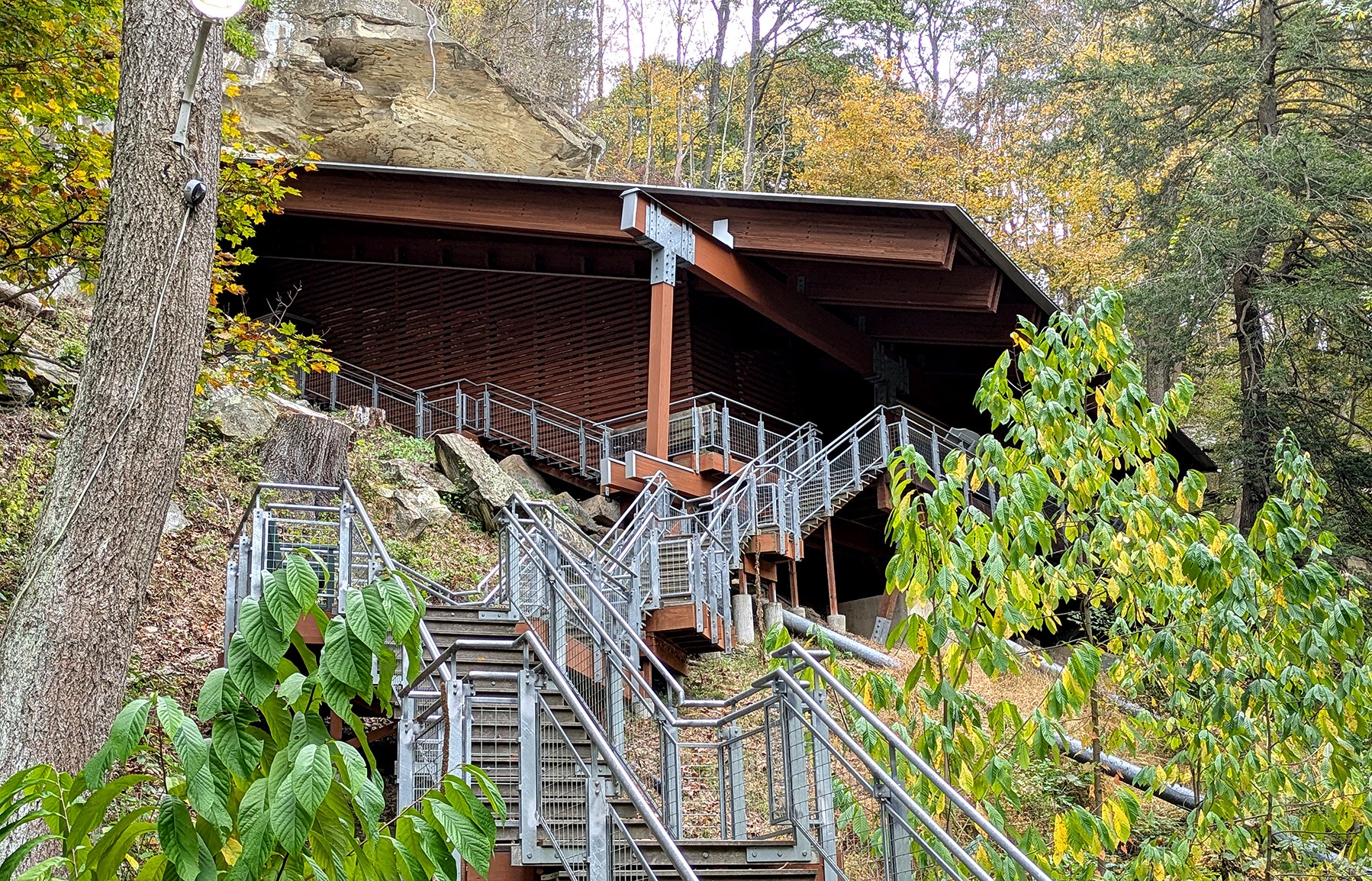
 Meadowcroft Rockshelter, just west of today’s Pittsburgh in the US. To reach the site today, visitors ascend a wide staircase. (Photo: Glen Retief)
 /file/dailymaverick/wp-content/uploads/2025/10/label-Op-Ed.jpg)
South Africans live down the road from some of the oldest human ancestors. Mrs Ples strode around the Gauteng hills almost three million years ago. A few hundred years before that, Lucy sharpened rocks on the Ethiopian highlands.
In the Americas, by contrast, no early hominin remains have ever been discovered. The first intelligent apes to make it here were modern humans. Exactly when and how, though, has long been contentious.
Until recently, if you were an archaeology student, your professors might tell you that about 13,000 years ago so much water was locked up in Ice Age glaciers that a land bridge opened up between Siberia and Alaska. The first Americans followed mastodons and mammoths over the tundra, navigated gaps between the ice sheets, and then, within a few hundred years, fanned out over two continents.
Everywhere, they left their distinctive fluted arrowheads, called Clovis points. Supposedly, they also used these to hunt to extinction the Ice Age megafauna.
Longer settlement timeline
Today we know this to be false. While Native Americans are certainly descended from Siberians, genetic and linguistic research supports a much longer settlement timeline. Climate change, not humans, was the chief culprit in the extinctions. And most recently, fossilised human footsteps in New Mexico have been carbon dated to about 23,000 years before the present.
In fact, nowadays archaeologists guess that ancient humans first entered the Americas as long as 24,000 years ago, perhaps via a sea ice bridge, or perhaps sailing south along the so-called “kelp highway”, the Pacific coastal current rich in seaweed, fish, and birds.
This new narrative happens to also cleave closer to many indigenous Americans’ oral histories. For example, the Tlingit people maintain that their ancestors were a seafaring people, who came to today’s Alaska by boat.
/file/attachments/orphans/cavefromabove_105239.jpg "From the upper portion of the Meadowcroft Rockshelter cave, the geological seams are particularly striking. (Photo: Glen Retief)")
/file/attachments/orphans/andrewdonovan_415903.jpg "Andrew Donovan, education and programmes manager for Meadowcroft Rockshelter, points to a detail in a slide showing nearby vegetation. (Photo: Glen Retief)")
But in 1973, when a young archaeologist named James Adovasio led a dig at Meadowcroft Rockshelter, just west of today’s Pittsburgh, the “Clovis First” theory still reigned supreme. While it took archaeology a decade or two, and several confirmatory finds, to fully accept the data that Adovasio and his team unearthed, it nevertheless remains true that Meadowcroft single-handedly changed archaeology’s sense of the human story.
I grew up in South Africa but now live in Pennsylvania. So, one recent autumn morning I drove four hours west to meet Andrew Donovan, education and programmes manager for Meadowcroft Rockshelter.
Donovan is a tall, slender, tanned man in his forties, with a grey, bushy moustache. Replace his green baseball cap with a fedora, and he could pass for Indiana Jones’ younger brother: hands-on, sharp-witted and passionate about the past.
Donovan grew up in Pittsburgh, then studied history at Arizona State. It was there, next to the 1,500-year-old irrigation canals of the ancient Hohokam, that the past first sunk its teeth into him.
Returning to Pennsylvania in 2010, he first got a job as a blacksmith in the nearby recreated colonial village. Then he got promoted.
In 2022, 2023 and 2025, Donovan also helped with ongoing excavations at the rock shelter, and it was here that he met James Adovasio, whom Donovan considers “one of the most brilliant people I’ve ever met”.
“I credit him and Albert Miller with all this,” he says, gesturing at the visitors’ centre exhibit about the archaeological findings.
In his book The First Americans, Adovasio also praises Albert Miller, the owner of the farm on which the rock shelter was located. As a young man, Miller found arrowheads there and presciently decided to preserve it.
A prime place for a temporary camp
Years later, when Adovasio put out the word that he was looking for an archaeological site to train University of Pittsburgh students, Miller got in touch, and: “[A]s soon as I saw the Meadowcroft Rockshelter, perched among the trees about forty feet up from Cross Creek… I knew that generations of people… would have seen in it the same thing I did. It was a prime place for a temporary camp.”
Donovan and I drive downhill. As we ascend a wooden staircase to the rock shelter proper, past golden-yellow maple trees and brilliant-scarlet oaks, I imagine I sense the same thing Adovasio did. Like Golden Gate Highlands National Park or the Augrabies River, this place just has an air of antiquity, something about the bubbling stream, the looming sandstone boulders, the birds and trees.
Later, too, I will learn that, like Magoebaskloof, Meadowcroft sits in a pleasantly mild, well-watered, equator-facing microclimate, which is why the great glaciers never covered this spot with 2km of ice.
“We think,” Donovan tells me, “this spot has actually looked much the same, for as long as anyone can imagine.” And on this still Sunday, with a faint sun dappling the forest floor, this isn’t hard to believe.
What surprises me, though, is how much Meadowcroft looks like the active archaeological dig it is. Sure, for the tourists they have mounted a large television projecting a slide show of artefacts.
Then, too, information boards along the railing discuss what scientists guess about life here. I learn that the first Pennsylvanians ate small creatures like hellbender lizards, and plenty of woodland fruit like blackberries, raspberries and cherries.
/file/attachments/orphans/tag_912828.jpg "A tag at the site marking where and artefact was found. (Photo: Glen Retief)")
/file/attachments/orphans/millerpoint_870151.jpg "The Miller spear point, a famous artefact found at the site. (Photo: Glen Retief)")
/file/attachments/orphans/carbonizedbasketry_784553.jpg "Charred basketry provides some of the oldest carbon-dated artefacts from the shelter. (Photo: Glen Retief)")
But the cave itself contains a cluster of tags, tape lines and land surveying instruments. Donovan explains that each tag flags either a geological stratum or the spot where a particular artefact was found.
The whole scene looks intensely professional, and indeed, Adovasio writes that, sensing the potential importance of Meadowcroft, “I had wanted this excavation to be a model.”
Donovan leaves, and Lindy Holmes, a tour guide, takes over. Holmes, with frizzy, blonde hair, radiates a down-to-earth warmth I associate with the American Midwest. Sure enough, she soon reveals she indeed has lived in nearby Ohio her whole life, except for a brief spell in the Redwoods area of California.
/file/attachments/orphans/lindywithmodelhellbenderjpg_212798.jpg "Lindy Holmes, a tour guide, holds a life-sized model of a hellbender lizard, a major food source for ancient peoples who lived at Meadowcroft. (Photo: Glen Retief)")
/file/attachments/orphans/landsurveyinginstrument_455263.jpg "A land surveying instrument. (Photo: Glen Retief)")
/file/attachments/orphans/meadowcroftfromabove_161680.jpg "An overview of the archeological site, from above. (Photo: Glen Retief)")
“It was very beautiful over there,” she explains, “but it wasn’t home, and truth was, I was a bit adrift,” without a stable job.
So she came back to Ohio. Soon, she also leveraged her BA in History into a job at Meadowcroft.
“I just love it here,” she says, when I ask. She showers me with a broad smile. “It’s a privilege to share such a unique place with the public.”
Meadowcroft’s singularity
Holmes now elaborates on Meadowcroft’s singularity. She points to the sandstone.
“The sun heats that from the south, and then it holds the warmth, just like a pizza stone.”
What would the two of us have heard here, when the first humans set up camp? Holmes explains that the cave would have had a different shape back then – in fact, one of the factors that so exquisitely preserved the artefacts at Meadowcroft were the rockfalls.
“But we believe people made fires in pretty much the same spot,” Holmes tells me. Earth filled in the gaps between the fresh stones, forming new prehistoric hearths.
So whatever sounds may have floated over the valley, the two of us would certainly have smelled wood smoke, that archetypal odour of human nomadism.
Holmes now projects a picture of two famous artefacts from Meadowcroft, first the sharp, skinny Miller spear point, named for the forward-looking owner.
Adovasio writes, amusingly, of this celebratory discovery: “It did not look like anything else we had ever seen in the New World… So we immediately decamped to our favourite bar.”
The second is what Holmes calls “carbonised basketry” – essentially a piece of charred, woven grass. When Adovasio’s students dug up the latter, they had to instantly inject it with polyethylene glycol to avoid its disintegration.
The precautions paid off, though, in that the basketry at the site provided some of its most definitive carbon-dating, with the oldest pieces 19,000 years old.
The tour ends with Holmes leading me up a final staircase to the top of the cave. From here, I get an appropriately broad overview of the site, with its tags, boulders and seams.
But what makes the biggest impression is the sheer enormity of these rock walls. Up here, they bulge like bread loaves – giant, hard baguettes. The different geological layers lie on top of each other like sandwich slices. In spots, water has puckered the sandstone, while along fragile-looking outcrops, archaeologists have spun wire to prevent further falls.
Dramatic geology
What, I wondered, did our earliest ancestors make of such dramatic geology? In ancient texts, praying to mountains is almost as common as worshipping the sun.
So did people hold shamanic dances? Did they, like San diviners, merge in their visions with the creatures they knew? Salamander man and bear-cub woman; soaring eagle and passenger pigeon.
We will probably never know. Yet as I bid Holmes goodbye and descend the staircase back to my car, I can’t help imagining 19,000 years of ghosts looking down on me from the treetops. In my fantasy they shake their heads
“So predictable,” they say, “how you people are always shortening and oversimplifying our history.” Is that fair? The shrinking of Native American inhabitation of the continent, from 24,000 years to 13,000, was in response to archaeological evidence, not any kind of cynical political ploy.
And yet… There seem echoes. Metacom’s throne, without so much as a plaque to identify it. American soldiers, apparently unaware that they live on the grounds of the Indian boarding school that served as a continental template. The common thread is a quickness to erase Native American experience, whether that be the suffering in boarding schools or 11,000 years of settling the hemisphere.
Now I imagine the spirits hearing my questions. They nod and reply: “All good and well. But still – how excited you people all get about our rubbish!” Which is surely true. To us, these baskets and spear heads may be revelatory. But to the people who left them, they were mere detritus, casually discarded 20 millennia ago in a long-cooled fire. DM
Glen Retief’s The Jack Bank: A Memoir of a South African Childhood, won a Lambda Literary Award. He teaches creative nonfiction at Susquehanna University and recently spent a year in South Africa as Fulbright Scholar.