




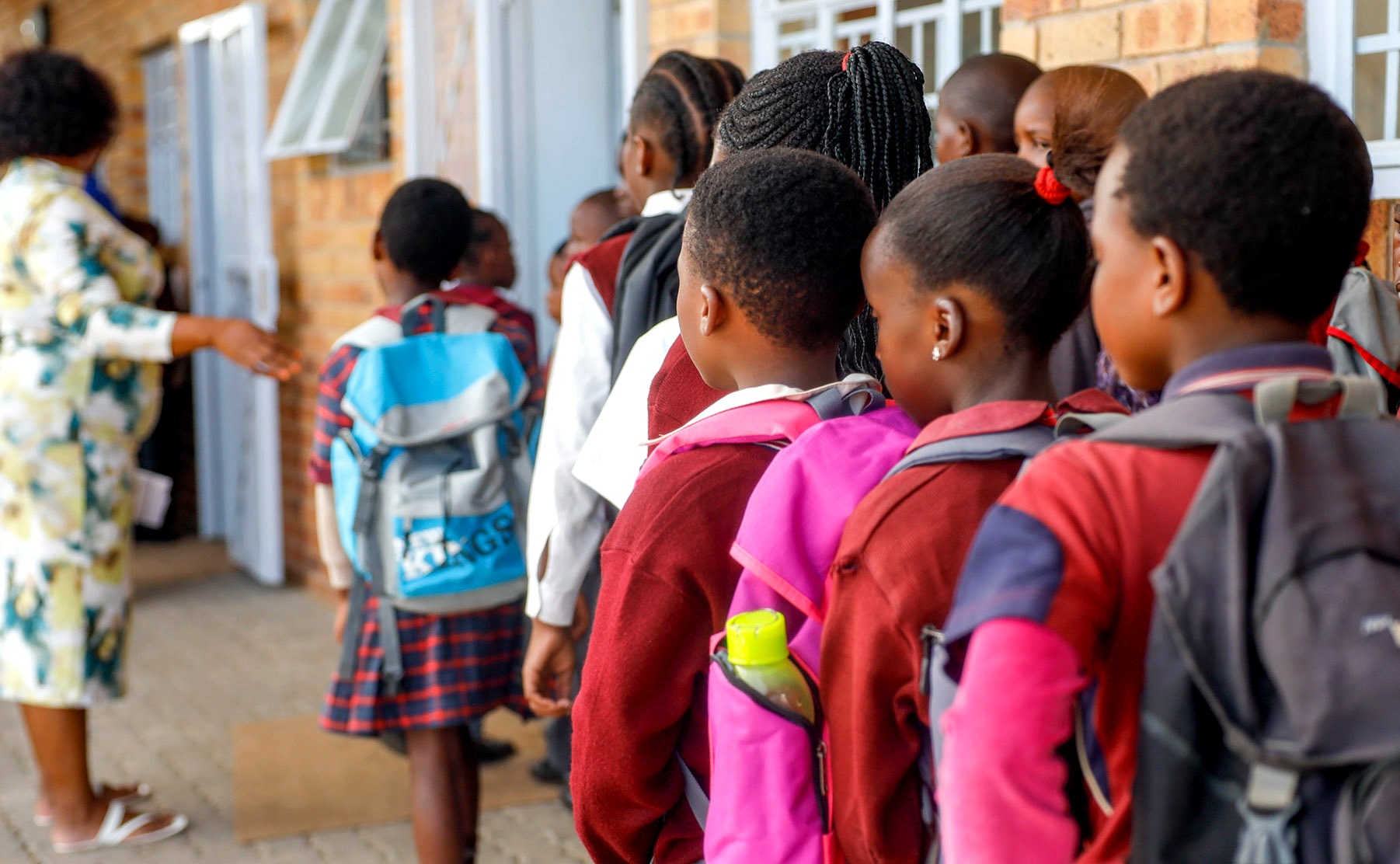
 Illustrative image: The Gauteng Department of Education reports that more than 10,000 learners remain unplaced, but daily placement and transfer offers continue as the department works to accommodate every learner (illustrative photo) (Photo: Sharon Seretlo / Gallo Images)
 With the 2026 academic year just weeks away, the Gauteng Department of Education (GDE) is facing mounting pressure to secure school places for more than 10,000 pupils still awaiting admission to Grade 1 and Grade 8.
This includes 2,848 Grade 1 pupils and 7,447 Grade 8 pupils.
“The department continues to work tirelessly to ensure that all students are placed,” read a statement from the department, adding that placement and transfer offers are released daily, especially in high-pressure areas such as Kempton Park, Thembisa, Alberton, Ivory Park and Centurion.
Read more: Learners in limbo as Gauteng schools face severe delays with no projects delivered
A decade of digital disaster
When the GDE introduced its online admissions application system in 2015, it was sold as a modern, efficient way to end long queues and bring transparency to school placements.
The primary aim was to develop a centralised database for planning and monitoring admissions processes across the province, while a secondary aim was to eradicate long queues at schools on the first day of applications.
The system was designed to ensure schools applied admissions regulations fairly and equitably, with objectives including creating a centralised database to inform resourcing needs across all line functions; eliminating long queues during the application period; placing all learners within set timeframes; ensuring schools placed learners according to capacity in line with infrastructure norms and standards; providing accurate data for proper planning; enabling efficient management and monitoring of admissions processes; and allowing parents to access departmental services with ease.
A decade later, the platform has become synonymous with technical glitches, such as websites crashing under peak traffic, login timeouts, failed document uploads, poor communication, including undelivered SMS notifications and vague status updates – resulting in anxious parents who still do not know where their children will go to school, sometimes even after the school year has started. These recurring problems with the Gauteng online admissions system have emerged almost every year since its launch, to the point where many parents now brace themselves for issues as a normal part of the process.
2016–2017: Launch and early glitches
- The system was introduced in 2016 to replace physical queues for Grade 1 and 8 admissions; from the start, it struggled with handling large numbers of simultaneous users and timing of communication to parents.
- Parents reported difficulty accessing the site, completing applications and getting timely placement feedback.
2018–2019
- The system continued to experience “hiccups”, including crashes under load, slow responses and persistent backlogs of unplaced learners at the start of the school year.
2020–2022: Persistent placement and communication problems
- Each admission cycle saw repeated complaints from parents that they had completed all the online steps but their children were either not placed or placed very late, leading to queues at district offices despite the “online” system.
- Common problems included incomplete applications stuck in the system, confusion over document uploads, and parents’ misunderstanding of status messages because of limited or unclear communication from the department.
2023–2024: Political and public criticism intensifies
- Opposition parties, especially the Democratic Alliance (DA) in Gauteng, publicly called out the online registration system, saying it “must be fixed” because ongoing technical and administrative problems were preventing parents from registering their children smoothly.
- Complaints highlighted system downtime, errors with document status and failure to place learners near their homes, with statements from opposition parties and media reports framing the system as unreliable and in need of urgent overhaul.
2025
- Parent groups and social media posts continued to describe problems such as status errors (“no documents submitted” despite uploads), confusion over application steps, and a sense that the admissions platform remains a “broken” or failing system that has not met its original promise.
Emotional toll of endless waiting
The 2025 cycle has proved no different, with parents across Gauteng voicing growing despair over placement delays, with many describing emotional exhaustion as they face uncertainty just weeks before the 2026 academic year begins. Families who have already invested in uniforms and supplies now grapple with explaining the delay to their children, while unwanted school transfers and unresponsive appeals compound the stress
“What exactly is going on? What do we say to our kids? Some families have already purchased school uniforms while waiting in uncertainty. I just have to look at my child each day with no answers while waiting for a system to place her where they think she should study.”
A mother, speaking to Daily Maverick on condition of anonymity, called the department’s handling of applications “not good at all”.
“Some have been transferred to schools we didn’t even apply for and the appeal process for these offers takes forever,” she said of her Grade 7 daughter’s situation.
“What exactly is going on? What do we say to our kids? Some families have already purchased school uniforms while waiting in uncertainty. I just have to look at my child each day with no answers while waiting for a system to place her where they think she should study,” she said.
Another parent labelled the online system outright as “evil”, recounting fruitless visits to department offices.
“Yesterday was the last time I logged on to GDE. I won’t bother myself because this system is not working, and they [GDE] are very aware, but they just want to stress and frustrate parents,” she shared.
A third parent shared his exasperation after multiple failed appeals. “I applied to three local schools in August, but my Grade 1 son got offered a place 35km away in a school we’ve never heard of – no transport, no family nearby and there is just radio silence when we ask questions. The department acts like we’re the problem for not jumping at bad options,” he said.
Chronic failures burden schools and families
AfriForum has issued an urgent demand to Gauteng Education MEC Matome Chiloane for a full, transparent progress report on all 2026 school placements, to be shared with the organisation and every school.
/file/attachments/orphans/ED_581807_458451.jpg "Gauteng Education MEC Matome Chiloane. (Photo: Sharon Seretlo / Gallo Images)")
Alana Bailey, AfriForum’s head of cultural affairs, highlighted the system’s chronic unreliability since its launch, which piles administrative burdens on schools and causes severe stress for families.
“Direct registration with schools was a much simpler system, and parents who enrolled their children in that manner completed the process with peace of mind. Now it is an annual process full of uncertainties, even with children who remain unplaced until late in the following school year,” she said.
The organisation sent a letter from their lawyers to Chiloane on 1 December, escalating its demands and calling for a comprehensive plan to permanently stabilise the beleaguered platform. The group had first written on 3 November seeking answers to emerging placement issues, and received assurances from Chiloane that all would be resolved by late November.
Carien Bloem, AfriForum’s head of education projects, decried the department's silence on affected families. “The fact that the Gauteng Education Department offers no communication or support to parents whose children have not yet been placed or have been incorrectly placed is unacceptable. Thousands of families are dependent on a system that has failed yet again. Parents are distraught while the department denies the problem,” she said.
“It’s not that parents are refusing placements, but rather that the system is not responding to parents’ needs.”
Criticism from opposition parties reflects growing concerns about the ongoing crisis. Sergio Isa dos Santos, DA Gauteng’s spokesperson on education, called the fact that thousands of pupils remain unplaced in December “alarming” and indicative of “persistent weaknesses in the online admissions system”.
He challenged the MEC’s claim that parents are refusing offers, pointing instead to widespread complaints about a lack of communication or placement offers for distant or unfamiliar schools.
Dos Santos said: “It’s not that parents are refusing placements, but rather that the system is not responding to parents’ needs.” He criticised the GED’s repeated assurances of system improvements, noting the recurring annual crises owing to inadequate planning and transparency.
“No parent should be left in limbo in December,” he said and called for the department to urgently resolve outstanding placements and appeals and communicate directly with affected families, rather than shifting blame to parents.
Late applications and appeals
The 2026 online admissions system opened on Wednesday, 17 December, for late applications for Grade 1 and Grade 8, targeting parents who missed the main application period or had incomplete submissions. Families must apply via the official online portal, where only schools with available space will appear during this phase. The department stressed that parents and guardians can select just one school, resulting in a final placement that cannot be refused, with no objections or appeals permitted once chosen.
The department has confirmed that it has received 5,199 appeals, which it says are now at an advanced stage of processing. Parents who receive a transfer offer to a school they did not initially apply to have seven days to accept or decline it. If the transfer offer is accepted, the pupil is placed at that school and the placement is final, but if it is declined the parent may submit an objection within seven days.
According to the department, objection outcomes are communicated within 14 days, while appeals serve as a final adjudication step. No alternative placement will be offered after and appeal outcome, with MEC Chiloane urging families to use the late-application period responsibly and to remain patient as the department works to place every pupil fairly and within available capacity.
Regarding the online admissions system, the department has repeatedly acknowledged “teething problems” and has, over the years, promised a series of technical and operational fixes – from adding more servers and boosting bandwidth to redesigning the user interface and extending help‑desk capacity.
Officials regularly brief the media to stress that, despite early glitches, the majority of learners are ultimately placed, arguing that the digital platform processes far more applications, more quickly, than the old paper‑based queues ever could. At media briefings and in statements, the department often frames each new round of problems as an isolated setback on a long-term modernisation journey, assuring parents that upgrades, staff training and “lessons learnt” will prevent a repeat in the next cycle. DM