




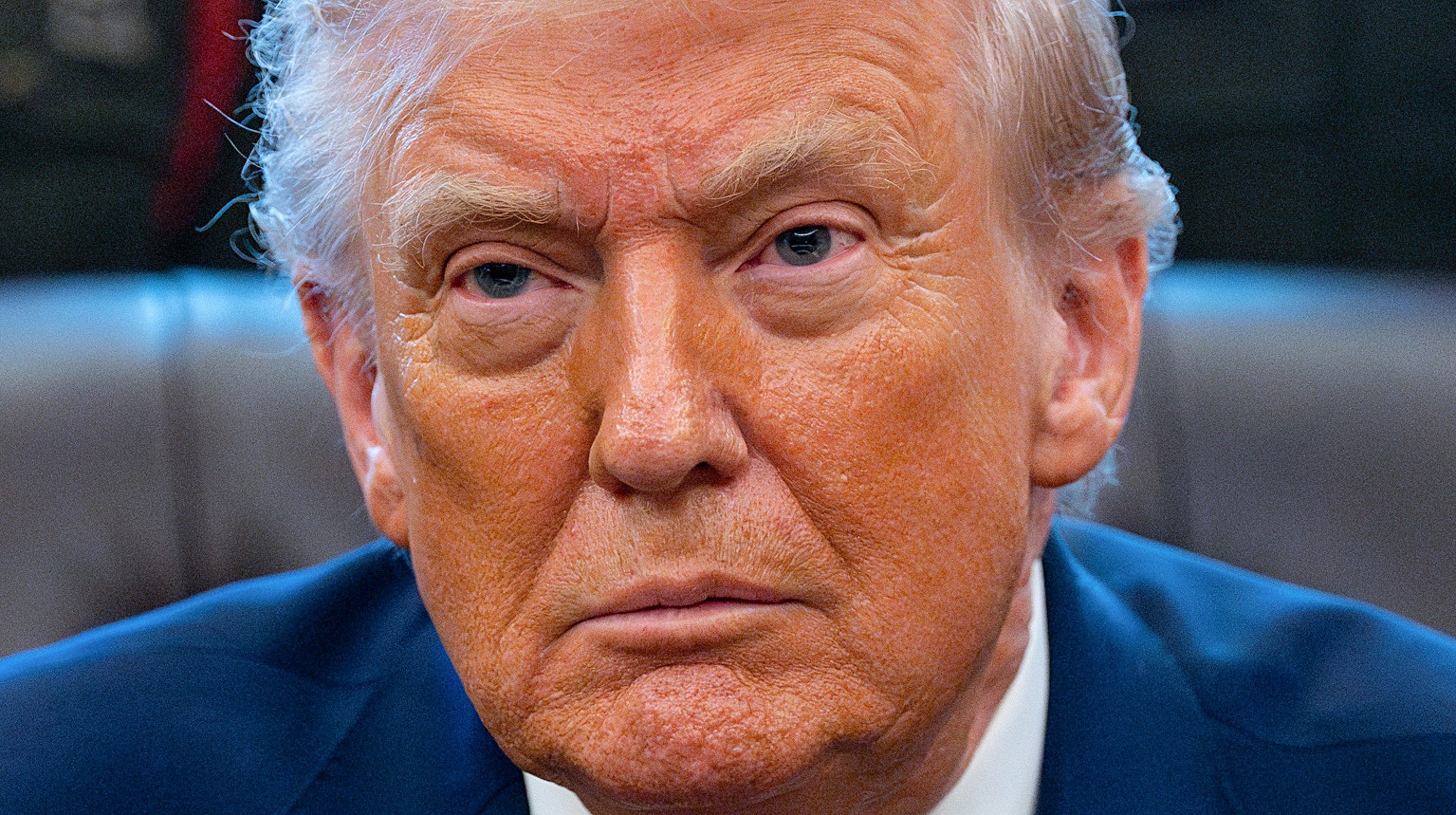
 US President Donald Trump during a Mexican Border Defense medal presentation in the Oval Office of the White House in Washington, DC, on 15 December 2025. (Photo: Bonnie Cash / UPI / Bloomberg via Getty Images
 /file/dailymaverick/wp-content/uploads/2025/10/label-Op-Ed.jpg)
The G20 has ended and the would-be recipient, the US president, snubbed the function. South Africa is faced with the dilemma of who should be the recipient of the gavel. But a bigger question is whether this is the end of the G20 because the next host walked away from it and may decide who should, or should not, attend and thereby scupper the entire effort as a party pooper. Professor Jeffrey Sachs has a more profound and important interpretation – that the end of US hegemony has been long coming. The seeds of the end dramatically germinated and became visible in South Africa with the characteristic Trump tantrum.
To understand this, a book by ambassador to Brazil Vusi Mavimbela is very revealing. The Africa in Brazil provides a deeper meaning of the whitening dilemma that the slavery, colonial and the neocolonial project by the imperialists faces today, and what Africa and Brazil should do. While Donald Trump represents a more vulgar in-your-face manifestation of this socioeconomic expression of domination, Captain Ibrahim Traoré of Burkina Faso forced French President Emmanuel Macron to deliver its shameless retaliatory but fading dimension – reminding us that the empire, despite the Nato crisis, will continue to view Africa as the place where whitening should be preserved, and as its hunting ground.
South Africa as a host continues to be the epicentre of the whitening project based on the evidence of extremities between white and black, thus displaying the success in whitening. The evidence from Statistics South Africa illustrates the point that Mavimbela’s brilliant research reveals. In his book is a Traoré and Sahel thesis on the solution to this whitening problem. Thus, the absence of Traoré from the G20 suggests to us the distance we have to traverse since the first United Nations Declaration of the Development Decade in 1961. Three vintages of decadal development were declared and by the fourth the decadal had transformed into 15 years, and were renamed after extending this decadal agenda to the Millennium Development Goals that transformed into the Sustainable Development Goals – Agenda 2030. Africa has its Agenda 2063 and the Seven Aspirations of:
- A prosperous Africa based on inclusive growth and sustainable development;
- An integrated continent, politically united and based on the ideals of pan-Africanism and the vision of Africa’s Renaissance;
- An Africa of good governance, democracy, respect for human rights, justice and the rule of law;
- A peaceful and secure Africa;
- An Africa with a strong cultural identity, common heritage, shared values and ethics;
- An Africa, whose development is people-driven, relying on the potential of African people, especially its women and young people, and caring for children; and
- Africa as a strong, united, resilient and influential global player and partner.
In all these attempts Africa bears the burden of underdevelopment because of the Whitening Agenda. That the G20 is hosted in South Africa, which became the epicentre and most successful project of whitening, is not only ironic but awakening. It is awakening against the mirror of the Sahel and Captain Traoré that has declared war against whitening and Macron’s protestations have been met with equal if not better force.
Trump’s tantrum makes him a useful idiot, because this tantrum throws the rickety Nato asunder on its Ukraine stance. The expansion of Nato instigated by the US – after it pulled wool over Mikhail Gorbachev by promising that it would not move one inch eastward – is faltering and Ukraine is paying the price. Deal-making Trump cannot be a trusted partner in Nato. So, whether Trump is present or absent, the presence of Macron and his disbelief that Captain Traoré and the Sahel can dutifully say no to exploitation of Africa, represent the same view.
/file/attachments/orphans/GettyImages-2155836547_314014.jpg "Jeffrey Sachs, a professor at Columbia University, during the Asobancaria Banking Conference in Cartagena, Colombia, on 7 June 2024. (Photo: Charlie Cordero / Bloomberg via Getty Images)")
Mavimbela’s book on whitening posits two dimensions of it, which deliver the same intention even though the routes were different. In Brazil, the elite tried to “whiten” the population biologically and culturally to erase the African footprint. They created a myth of “racial democracy” to mask this. In South Africa, Mavimbela argues, white colonisers “came and stayed”, creating “colonialism of a special type”. Instead of trying to breed out the Black population, they enforced rigid separation (apartheid) to maintain economic dominance.
Crucially, what is playing out can be understood in Mavimbela’s script to argue that both systems achieved the same result in Brazil and South Africa despite their differing geographic spaces: the preservation of white economic power and land ownership. The text notes that even today, “In South Africa, as it is also the case in Brazil, inequality is correlated to a very large extent with race”. So, the absence of Trump and the presence of Macron is the same difference. This context is revealed in the G20 Trump absence, Traoré’s explicit stance against colonialism and Macron’s presence in a future-seeking G20.
Trump’s refusal to attend the G20 Summit in Johannesburg, explicitly citing the “persecution of white Afrikaner farmers” and calling the summit a “disgrace”, is the ultimate geopolitical manifestation of the whitening ideology. Mavimbela, in his book, correctly argues that South Africa represents “colonialism of a special type”, where the coloniser “came and stayed”. By boycotting the first G20 on African soil to defend a white minority (who, as the text notes, still own the majority of the land), Trump is enforcing a global “whitening” solidarity. He is signalling that the Global North’s relationship with South Africa is still contingent on the comfort and safety of the colonial descendant, rather than the sovereignty of the Black majority. As Mavimbela’s book asserts, the West views African sovereignty as conditional. Trump represents the “slap-in-the-face” racism described by Robert Stam as an overt rejection of Black governance in favour of white colonial kinship.
/file/attachments/orphans/GettyImages-2246757767_555583.jpg "Emmanuel Macron, France's president, during a news conference with Friedrich Merz, Germany's chancellor, at the digital sovereignty summit in Berlin, Germany, on Tuesday, Nov. 18, 2025. European politicians are pushing for regulators to loosen the reins on the region's banks as their economies contend with massive needs to invest in defense, digital technology and the prevention of climate change. (Photo: Krisztian Bocsi / Bloomberg via Getty Images)")
While Trump represents the “slap”, Mavimbela would correctly argue that Macron’s role was the “suffocating, paternalistic embrace” at the G20. This is because his role at the G20 livens up the “vexed” relationship between the coloniser and the colonised. The fracture in Françafrique is a critique of the “liberal” West that claims to support democracy while maintaining economic strangleholds. Macron represents the neocolonial status quo – willing to sit at the table (“the embrace”) but furiously hostile toward leaders like Traoré who threaten French extraction.
Traoré at the table would be presenting the “counter-postulation”. Mavimbela’s illustrious book would postulate that Traoré’s conflict with Macron (accusing him of “insulting all Africans”) parallels the resistance of the Quilombos. Just as the Quilombos (maroon communities) withdrew from the slave system to create autonomous zones, Traoré’s rejection of French military pacts is a withdrawal from the “colonial pact”. What arises out of this as the meaning of the tension is that Macron would be “vexed” because Traoré exposes the lie of the “partnership”. Mavimbela notes that true liberation requires breaking the psychological and economic chains; Traoré’s defiance – and the West’s subsequent attempt to isolate him – is the modern struggle against the “paternalistic embrace”.
A G20 programme must understand that true liberation will not come from this G20 stage. It will come from the counter-postulation that argues for an alliance between the radical African leadership (Traoré’s stance) and the African diaspora (Brazil/Lula’s stance) to build a new power block that does not need Trump’s approval or permission from Macron or any colonial system or power to exist. DM
Dr Pali Lehohla is a professor of practice at the University of Johannesburg, a research associate at Oxford University and a distinguished alumnus of the University of Ghana. He is the former statistician-general of South Africa. DM