




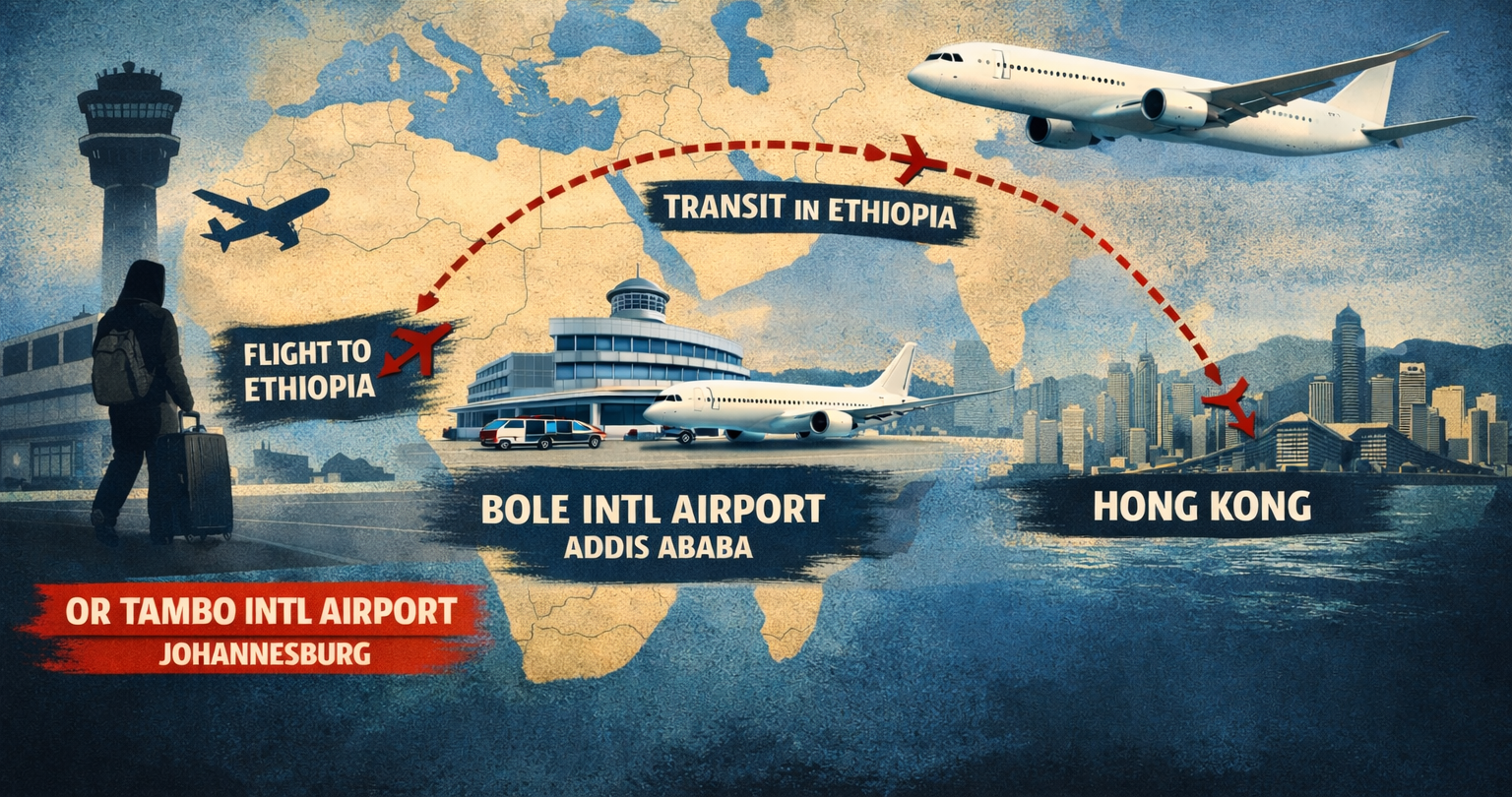
 Illustration: ChatGPT
 On 24 November 2025, Hong Kong customs officials unzipped five suitcases and uncovered a cargo that beggared belief: 125kg of cocaine, compressed into neat bricks, with an estimated street value of at least R177-million
The courier was a 42-year-old Ugandan national. In a prison interview after his arrest, he said he had travelled from Uganda via Burundi and Nairobi to South Africa, checking into a guesthouse somewhere in Ekurhuleni – Johannesburg’s East Rand metro, whose name translates as “place of peace”. There, he said, the cocaine was delivered by men he insisted he could not identify. He claimed he was issued forged diplomatic travel documents. At OR Tambo International Airport, he passed through customs without resistance.
From Johannesburg, he flew to Addis Ababa, transiting through Ethiopia’s Bole International Airport, before boarding an Ethiopian Airlines flight bound for Hong Kong. Only after landing did suspicion fall on his luggage. Customs officials initially let him proceed, shadowing him to a hotel in Hong Kong’s Tsim Sha Tsui district before arresting him.
Five suitcases. One man. A journey tracing a drug pipeline from Johannesburg to Addis Ababa, Addis to Hong Kong – Africa to Asia – with Ekurhuleni as the launchpad.
Ten days earlier, in Pretoria, another narrative was unfolding – one that, at first glance, appeared unrelated.
Death by design
On 14 November 2025, the Madlanga Commission of Inquiry into police corruption and organised crime heard testimony exposing a thriving ecosystem of complicity between law enforcement and criminal syndicates. Parts of Ekurhuleni, the commission was told, had become a sprawling crime scene – a labyrinth of fear, drugs and death.
A former police officer took the stand. For his safety, he was known only as Witness D.
His real name was Marius “Vlam” van der Merwe.
/file/attachments/2985/MariusvMervwe_987828_521731_5a9ddd1f85e5f7fe74329f6cec021c60.png "Marius \"Vlam\" van der Merwe. (Photo: X)")
Van der Merwe had served in the Ekurhuleni Metropolitan Police Department (EMPD) until 2022. Under oath, he implicated elements within the EMPD, including the now-suspended deputy police chief, Julius Mkhwanazi. He described a rogue unit allegedly involved in crimes ranging from giving the green light to quasi-VIP cartels, ferried through Ekurhuleni in blue-light brigades; extortion; truck hijackings; and murder cover-ups. Mkhwanazi denies any links to these allegations.
Van der Merwe’s testimony scratched the surface of Ekurhuleni’s criminal underworld. But it pointed to something more corrosive than corruption: the connective tissue between compromised law enforcement, local criminal enterprises and international trafficking networks. In Ekurhuleni, organised crime does not merely coexist with law enforcement. According to multiple sources, it is often allegedly protected by it.
On 5 December 2025 – less than three weeks after his testimony – Van der Merwe was murdered outside his home in Brakpan.
/file/attachments/orphans/ShiraazWitDMain_272135.jpg "Forensic investigators work around the body of Witness D - Marius van der Merwe - as he lay covered in a space blanket after he was gunned down on 05 December 2025. (Photo: Shiraaz Mohamed)")
Cracking the Brakpan pipeline
Nine months earlier, in February 2025, a source connected this journalist with Van der Merwe to investigate drug syndicates terrorising Ekurhuleni, dealing drugs openly and coercing desperate men and women into smuggling consignments to Hong Kong – the gateway to Asia’s lucrative narcotics markets.
At the time, Van der Merwe was heading the QRF Task Team, a private security outfit specialising in mining security and operations against illegal miners – zama zamas – along the East Rand. We planned a visit to an informal settlement in Brakpan then known as Plastic City (now demolished): a nexus for zama zamas, narcotics laboratories and street-level drug trade.
“There’s a Nigerian big shot who sends his lieutenants there,” he said. “Probably to exchange drugs for gold. His name is Bham. They call him the King of Lagos Street.”
He said another senior figure, related to Bham and regarded by some as the real kingpin, lived barely two kilometres from his own home, in Brenthurst, Brakpan.
Without naming individuals, Van der Merwe alleged that several senior law enforcement officials were in close cahoots with the syndicate. “Everyone knows about these guys. They’re untouchable,” he said.
Van der Merwe mapped the architecture of how underground mine tunnels feed street-level markets; how street-level dealers supply international routes; how protection flows upwards through compromised law enforcement; and how silence is enforced.
At the time, I did not fully grasp the scale of what he was describing. Our planned meeting never took place. But much of what he shared telephonically would soon be corroborated by journalistic investigation, crime intelligence sources, informants and drug couriers themselves.
Lagos Street
In March 2025, at the request of a Hong Kong-based NGO, I visited Brakpan to interview families of several drug couriers incarcerated in Hong Kong. I also observed the engineering of the Brakpan drug pipeline from the derelict fringes of Plastic City, through Prince George Avenue and Voortrekker Road, to Wenden Avenue.
A mixed strip of commercial, industrial and residential properties, Wenden Avenue is one of Brakpan’s main thoroughfares. It is also known locally as Lagos Street.
/file/attachments/orphans/2aStreetviewofWendenAveakaLagosStreet_526102.jpg "Street view of Wenden Avenue, AKA Lagos Street. (Photo: Supplied)")
Here, the architecture of the drug system becomes visible: a network that years of policing have failed – or refused – to dismantle. Recruitment is local. Profits are global. The syndicate operates in plain sight, with the efficiency of a fast-food outlet.
But who was “Bham”?
Although the moniker “King” or “President” of Lagos Street, was frequently used by Crime Intelligence sources, Bham remained elusive. Attempts to make contact with the man identified as Bham were unsuccessful. On at least one occasion, several men approached this journalist in a threatening manner, including exclaiming: “Junkie, whore, what do you want?”
Bham is notorious among couriers, informants and police, yet he has so far not faced any charges or arrest.
One Crime Intelligence source cited a shortage of personnel. Another spoke of intimidation and protection by senior EMPD officials.
“There’s also a trade-off,” the source said. “The syndicates serve as informants with certain drug busts.”
Small crystal meth laboratories are sprouting across Ekurhuleni, integrated into distribution networks. More powerful syndicates provide occasional tip-offs about these operations, bumping up arrest statistics and sustaining the optics of a functioning war on drugs. In exchange, the bigger fish are left alone.
Those networks, according to intelligence sources, are involved in global financial scams linked to Nigerian secret societies such as Black Axe, which operate in Johannesburg and Cape Town.
“They are equal opportunity criminals,” one source said. “If it’s sex, gold, drugs or finance, they’re game for it.”
Battered buildings, dingy hotels, bars, pawn, porn and printing stores serve as recruitment and sales points. In a vacant lot outside the old Brakpan Mall, hollow-eyed addicts drift back and forth, hungry for a hit.
/file/attachments/orphans/7_201969.jpg "Outside a mall in Brakpan, drug dealers openly ply their illicit wares. (Photo: Supplied)")
Cocaine and heroin reach Ekurhuleni as commodities already in circulation. Nigerian syndicates enter as intermediaries – selling in limited supply at street level, while providing finance, coordination and access to routes.
A gram of cocaine costs between R400 and R600 – often more than methamphetamine or heroin. An ecstasy pill fetches around sixty bucks. Fifty rand buys a crack rock. A tik lolly costs around R130, depending on the crystal quantities. When payment falls short, debts are renegotiated. Dependency replaces cash. In drug parlance, the user must “take a trip”.
Decentralised transnational trade
Ekurhuleni’s proximity to OR Tambo makes it a suitable staging hub. This trafficking route functions through loosely linked cells and networks, rather than a single rigid chain-of-command, cartel-style organisations seen in Latin America. Syndicate kingpins do not handle the merchandise. Handlers package drugs while recruiters source couriers. Profits are aggregated via informal value transfer systems, cash couriers and front businesses; funds are then repatriated or recycled into other crimes.
Fixers arrange travel and logistics. Transit hubs such as Addis Ababa allow for rapid rerouting. In Hong Kong, a separate receiving cell collects and redistributes the drugs. If consignments are intercepted at the destination, the upstream structure has been engineered to disappear. The courier becomes the focal point of prosecution.
This partially explains why racketeering charges rarely stick. The networks lack fixed hierarchy, stable membership or a single identifiable enterprise. Functions are divided; affiliations fluid; communication transient. Financial flows move outside formal systems. What reaches court are individual cases, not provable criminal organisations.
Couriers rarely know the kingpins. Seduced, persuaded or coerced, their immediate contacts are the recruiter and the enforcer, who maintain constant surveillance. Drugs are stitched into luggage, strapped to bodies or forced down throats in safe-house “training rooms”, where grapes are used to simulate swallowing “bullets”. The word “drugs” is never used. It is about travel. About taking a trip.
Once recruited, opting out is not an option. Destinations are usually in Asia. Routes are circuitous: sometimes via Dubai or São Paulo, increasingly through Addis Ababa. From Ekurhuleni to Addis Ababa, from Addis to Hong Kong, the system is engineered. And those mandated to stop it – airport security, police, regulators – too often look away, collude or are intimidated into silence.
Profits flow upwards. Arrests accumulate at the bottom, where they are meant to – on the mules. Some might make one or two successful runs. Others are arrested due to airport controls. An increasing number, especially those reluctant to carry the illicit cargo, are deemed liabilities and deliberately sacrificed as decoys to draw attention away from professional mules carrying larger consignments. This is known as “the softer way”. The alternative is death.
An unlikely sleuth
/file/attachments/orphans/4bFatherJohnWotherspoonrepresentsaHongKong-basedNGOcalledVoiceForPrisoners_153292.jpg "Father John Wotherspoon represents a Hong Kong-based NGO called Voice For Prisoners. (Photo: Supplied)")
“Some mules are in it for quick money,” says Father John Wotherspoon, an Australian Catholic priest based in Hong Kong. “But many are tricked or coerced.”
For decades, Wotherspoon has supported foreign inmates imprisoned in Hong Kong on drug charges, and their families. Most are African; increasingly, South African. Between 2009 and 2025, he compiled a detailed database of drug arrests involving passengers departing from OR Tambo International Airport. Quantities range from a few kilograms to the gargantuan 125kg seizure of 24 November.
The Ugandan courier had previously worked in tourism but was unemployed at the time of his arrest. A father of three, he had been promised a whopping $40,000 to deliver the cocaine.
“He was probably desperate for that kind of money,” Wotherspoon said. “But even with a forged diplomat’s passport, how on earth do five heavy bags pass through two major international airports? There must be collusion.”
In response to questions regarding security breaches at OR Tambo International Airport, the Airports Company South Africa insists that “statistics do not bear out an increase. SARS [ South African Revenue Services], in collaboration with other agencies [such as SAPS, the Border Management Authority and the Department of Home Affairs], has successfully intercepted cross-border organised crime activities at OR Tambo International Airport, both on arrival (inbound) and departure (outbound), using technology, sniffer-canine units and ‘risk management capability’ , as part of an inter-agency strategy to combat drug trafficking.”
Most recently, on 13 December, as the result of a successful Crime Intelligence operation, a Brakpan resident, 44-year-old Jacqueline Erasmus was apprehended at OR Tambo International Airport with 4kg of cocaine hidden in her suitcase, valued at R1.5-million. She was due to fly to Hong Kong on Cathay Pacific Airlines. After appearing in the Kempton Park Regional Court on Monday, 15 December, she was released on bail of R20,000 and her case has been postponed to 13 February for further investigation.
Such arrests, Wotherspoon argues, are usually driven by informants rather than airport controls. “Every day,” he says, “couriers are slipping through.”
Porous departure points
For years, Wotherspoon has exposed security lapses at airports and mapped syndicate networks. While his advocacy has helped reduce narcotics flows from Tanzania, Kenya and Uganda, two airports remain notoriously porous: Addis Ababa’s Bole and Johannesburg’s OR Tambo International Airport.
Together with Voice for Prisoners chief operating officer Jane Chow, Wotherspoon has travelled extensively to South Africa, Tanzania, Kenya, Uganda and Ethiopia to urge authorities to tighten airport security. They have held media briefings, pressed for action against drug kingpins and called for compassion towards mules and their families.
“Their loved ones are in prison too,” Chow says. “Emotionally. Financially. Especially when vulnerable people are manipulated with false promises of jobs and paid travel.”
The International Organization for Migration argues that many such individuals should be recognised as victims of human trafficking – coerced, transported and exploited for criminal purposes.
“And for every person arrested overseas,” Wotherspoon says, “there is a recruiter operating with impunity at the source.”
The recruiters
/file/attachments/orphans/2_417945.jpg "Bham’s alleged accomplice is convicted drug smuggler and mule recruiter Primrose Nozuko Samane, filmed here in a 2017 SABC investigation. (Photo: Supplied)")
Since 2016, Wotherspoon has been on the trail of a convicted drug smuggler turned recruiter: Primrose Nozuko Ugwa Samane – also known as Pinky, Precious, Tanya or Memory. A resident of Tsakane, Springs, Samane was arrested in April 2016 at OR Tambo International Airport, returning from Dubai with 77 heroin pellets – about 1 kilogram – hidden in her luggage.
The Hawks have confirmed her arrest, conviction and sentence. Trafficking in heroin, regardless of quantity, carries a maximum sentence of 25 years’ imprisonment. Despite the amount placing her within a commercial trafficking tier, Samane received three years’ correctional supervision and house arrest.
A 2017 investigations by Wotherspoon and the SABC’s Special Assignment exposed Samane’s continued recruitment of young women into the trade, including her own niece, who was later arrested in Hong Kong.
When confronted, Samane confessed to coercing her niece into smuggling drugs.
“But she was supposed to be protected by our people in the police,” she said on camera, “not arrested in Hong Kong”.
Samane also described card scams and forex fraud allegedly involving an airport bank teller and SAPS members. She declined to name them but claimed to have friends within the Ekurhuleni municipality and EMPD who “look after her”. This information was forwarded to the Hawks in 2017. No subsequent action is recorded.
Despite repeated requests, the Hawks have not responded to current questions about Samane’s case. This journalist has, however, located her 2016 correctional supervision warrant, which lists conditions she is alleged to have breached.
In March 2025, Samane did not respond to repeated attempts to contact her for right of reply. Sources claim that she regularly travels between Gauteng, Zimbabwe, Addis Ababa, Dubai, Brazil and Hong Kong, using multiple passports.
Wotherspoon estimates that between 10 and 15 South African women have been drawn into her network. One of her accomplices is allegedly Bham, the King of Lagos Street. Copious correspondence between Wotherspoon and law enforcement from 2017–2023/24 confirm both Bham and Samane’s dominant roles in the transnational drug trade.
Between January and June 2025, we interviewed several couriers who had been incarcerated in Hong Kong, and subsequently released. From photographs shown to family members and also sent to Wotherspoon and South Africans still detained, Samane was identified as Bham’s “wife”. They also report that she has bragged about being employed by the Ekurhuleni Municipality. These allegations were put to the municipality and the EMPD. The EMPD acknowledged receipt but did not respond. No acknowledgement or response was received from the municipality.
The couriers have undertaken to testify against both Samane and Bham, should they finally be arrested. Daily Maverick sent a copy of Samane’s photograph and ID number to the EMPD, as well as several questions regarding allegations against rogue senior members in the department. Although the EMPD acknowledged receipt, the department has failed to provided a formal response.
The syndicate’s reach also extends beyond Hong Kong. In 2022, Brakpan resident Marlese Badenhorst (30) was arrested in Nepal with 6 kilograms of heroin in her suitcase. Alongside six other South African women, she formed part of a 51 kilogram seizure – reportedly the largest in Nepal’s history – with a street value estimated between R30-million and R50-million.
/file/attachments/orphans/65_969179.jpg "Brakpan resident Marlese Badenhorst was allegedly recruited by Bham to smuggle heroin to Nepal. (Photo: Supplied)")
Her South African friends claim she was recruited by Bham at a food stall in Brakpan. Badenhorst was sentenced to 24 years in prison. In September 2025, she was among 13,500 inmates who escaped during a prison fire amid anti-corruption riots that toppled Nepal’s government. Family and friends have refused to disclose her whereabouts, citing fear of reprisal from the syndicate.
Wotherspoon notes a shift in recruitment patterns. Where young women were once targeted, syndicates increasingly prey on white, working-class men.
Brakpan resident Lee Roy Smith is one such case. In desperate letters penned from prison and statements provided to Wotherspoon, Smith says that he was unemployed when he was allegedly recruited by Bham under the guise of maintenance work in Brazil. On 4 September 2023, he flew to São Paulo, where his passport was confiscated
He was told refusal to “take a trip” would endanger his family.
Three kilograms of heroin were strapped to his body, like a crude homemade bomb. He passed through Hong Kong airport security but was arrested while attempting to depart the airport.
/file/attachments/orphans/5_366639.jpg "Heroin was crudely strapped to Lee Roy Smith’s body for a drug run to Hong Kong. (Photo: Supplied)")
The Ugandan courier. The young women. Lee Roy Smith. Marlese Badenhorst. They are the inventory of this trade – visible, expendable, replaceable. Above them sit recruiters who operate openly, kingpins who remain unnamed in charge sheets and protection structures that ensure continuity.
Ekurhuleni — the so-called place of peace — has become a crucial pipeline in a global narcotics economy that is organised, protected and profitable. Somewhere between Brakpan and Hong Kong, another suitcase is being packed, another body turned into a container for an illicit cargo.
This is not a failure of policing. As exposed by murdered former policeman Marius van der Merwe, it is by design. DM