



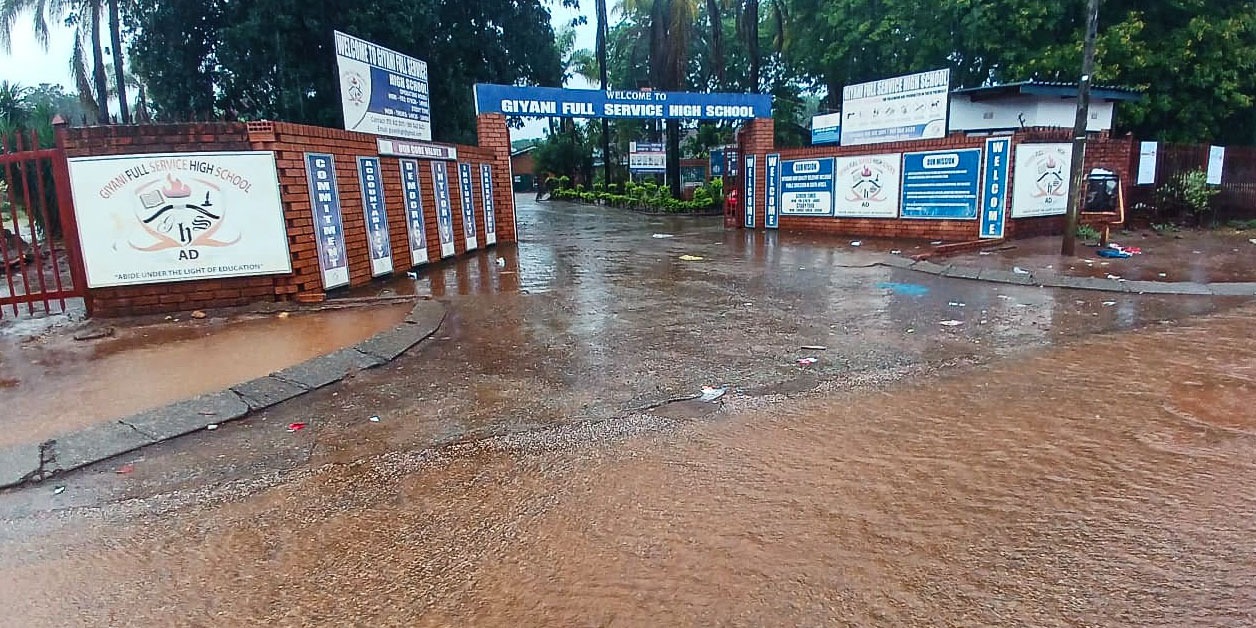
 The Limpopo Education Department announced that schools affected by floods would not reopen this week. (Photo: Facebook / SABC News / Avhapfani Munyai)
Over the past week, large swathes of Limpopo and Mpumalanga have been battered by relentless torrential rains, turning the highly anticipated launch of the 2026 academic year into a logistical nightmare.
Just as thousands of learners were preparing to return to class, the South African Weather Service issued a Level 10 warning for disruptive rain in Limpopo and Mpumalanga, specifically targeting the high-risk zones of Vhembe, Mopani and Bushbuckridge.
The severe weather, which has left roads waterlogged and bridges submerged, compelled the provincial departments of education to make the difficult last-minute decision to suspend schooling in these districts, prioritising the lives of students over the curriculum.
/file/attachments/orphans/Limpoporiver_227049.jpeg "Residents of GaMampa in the Sekhukhune district of Limpopo wade through the flooded Mohlapitsi river after returning from registering children at a primary school in neighbouring Mafefe village. The flooded river has cut off all transport connecting the two villages, rendering children unable to attend classes on the opening of the 2026 academic year. (Photo: Lucas Ledwaba / Mukurukuru Media)")
Official assessments paint a grim picture of the destruction, with authorities scrambling to quantify the extent of the infrastructure collapse. Limpopo Premier Phophi Ramathuba confirmed that early audits indicated at least 31 schools had already suffered significant structural damage, ranging from collapsed roofs to flooded classrooms, a figure she warned was likely to rise as accessibility improved.
Consequently, the reopening of about 1,400 schools in the affected Limpopo districts has been put on hold.
Following ongoing assessments, the Limpopo Department of Education provided a grim breakdown of the accessibility crisis:
- Mopani East: Ninety-one of 305 schools failed to open due to flooding.
- Mopani West: Eighteen schools remain closed; residents are attempting to manually restore access routes.
- Vhembe East: While 378 schools opened, 172 remain inaccessible due to impassable roads.
- Vhembe West: Of 413 schools, 164 were inaccessible, delaying the start of the term.
- Sekhukhune East: Seven schools reported zero accessibility.
The department further warned that in these areas, the School Nutrition Service had been unable to deliver meals. Scholar transport could not cross washed-away bridges.
In Mpumalanga, while schools in the Nkangala and Gert Sibande districts managed to reopen smoothly, reports from the Bohlabela District painted a starkly different picture, with learners struggling to navigate waterlogged roads.
Consequently, the Mpumalanga Department of Education suspended all classes in the Bushbuckridge Local Municipality for Thursday, 15 January, and Friday, 16 January. At the time, officials noted that the sheer volume of rain made access impossible for many, while principals in the Ehlanzeni District were initially granted discretion to close, based on local risk assessments.
Recurring nightmare for rural families
On the ground, the mood among parents is one of frustration mixed with palpable fear. Learners at Ga-Mampa Village in Mafefe, outside Lebowakgomo in Limpopo, were unable to attend their first day of school due to the overflowing Mohlapitsi River.
One parent expressed frustration over this being a recurring incident and anxiety over the long-term impact on their children’s education.
“This is so painful. Every year, during this month when it rains and the schools reopen, the river is always flooded, and learners struggle to go to school. This might take two weeks for the water to subside, which means that learners will fall behind. It is always like this, every year. We have been talking to the municipality, but they do not take us seriously. We really need the government to help us fix this. Maybe a bridge or something will do, but we cannot send our children to die in the river,” said the father, who asked to remain anonymous.
Another parent described seeing buses, taxis and private cars stuck in floodwater, with no movement possible. Some vehicles lay abandoned mid-road, while learners were forced to turn back home as classrooms stood empty.
/file/attachments/orphans/G-ti7B_WkAAIssZ_235859.jpeg "Floodwaters pour through roads and communities in Limpopo. (Photo: SA Police Service / X)")
“This is not a once-off incident. Every year, when it rains in the Waterberg district, the same tragedy unfolds. Gravel roads disappear under water, low bridges overflow and entire communities are cut off. Scholar transport cannot pass, emergency services struggle and education comes to a standstill,” the parent said.
“It is deeply concerning that in 2026, rural learners are still denied access to school simply because it rains. This is a repeating crisis and our children deserve safe, reliable access to education, not flooded roads that block their future,” she said.
On 19 January, Limpopo Education MEC Mavhungu Lerule-Ramakhanya announced the tentative reopening of schools in the flood-stricken Vhembe and Mopani districts, instituting a “safety-first’ phased return to the classroom.
While the rains have begun to subside, the department has mandated that only educators report for duty on Monday to conduct critical on-site risk assessments of infrastructure and accessibility. Learners were expected to return on Tuesday, 20 January, but officials stressed that this was not a blanket directive. The final decision rested on local safety conditions.
The department has also explicitly warned parents and school governing bodies to exercise extreme caution, urging that no child should be forced to cross dangerous rivers or traverse damaged bridges, acknowledging that while the academic year had to proceed, the floods still posed a very real threat to life.
SGB laments lost learning
Phambanisa Primary School in the Nkomazi region, in Mangweni village, remains closed, leaving children sidelined by a perfect storm of damaged infrastructure and impassable roads. Elter Nkuna, the school’s SGB chairperson, described a multifaceted crisis exacerbated by recent heavy rains.
“The kids cannot access school because the roads are not good, and some of the teachers are not staying in our area, so they have to cross these small, makeshift bridges, which are now submerged or washed out entirely,” she said.
On-site, the damage is extensive. Nkuna said the school had Enviro Loo toilets that were brimming with murky floodwater, rendering them unusable and a health hazard for any child. The paths leading to these facilities have shallow ponds, slick with mud and debris. Compounding the chaos, three classrooms that had already been battered by ferocious storms last year, now have leaking roofs.
“We tried to do some patchwork repairs, but it is a very old school. It was built in the 70s and needs some serious renovation. Whenever big storms come, the roof is … taken off,” she explained.
Nkuna said the emotional toll weighed heavily on parents. Children returned excitedly for one day last week, only to be sent home by noon. “It is very frustrating because now our children are going to be behind. They’re not going to have time to cover for the time that has been lost annd it is worrying for us as parents,” she said.
Nkuna said the annual storms wreaked havoc without adequate government support.
“It keeps on happening. The department inspected the schools, but dismissed the issues, leaving the SGB to fund repairs through donations. There is no assistance. We have to do it as SGB... They just went to our school and looked at our school and said, 'Nothing is wrong. Teaching and learning, it's back.' We have a letter from them that tells us that we must do it ourselves,” she said.
"We always plead to the department, please check those schools, those old schools, check the road access to the schools. They don't do that”.
Nkuna said the reopening of the school hinged on the weather and logistics.
“We hope to reopen this week, but we also need those honey sucker trucks to clear the road, and Eskom needs to repair a fallen transformer pole because there is no electricity at the school.”
/file/attachments/orphans/WhatsAppImage2026-01-19at171319_399667.jpeg "President Cyril Ramaphosa visits flood-affected areas in Mpumalanga’s Nkomazi Local Municipality, including Mjejana and Orlando villages, on Monday, 19 January 2026. (Photo: Elmond Jiyane/GCIS)")
On Monday, 19 January, the Mpumalanga Department of Education noted that although rainfall had weakened compared with the deluge witnessed last week, the aftermath remained dangerous.
Large volumes of runoff water continued to flow through low-lying areas, creating deceptive hazards despite the lighter skies.
In light of these improving, but still precarious conditions, the blanket suspension in Bushbuckridge has been lifted in favour of a localised approach. Schools in both Bushbuckridge and the Ehlanzeni District are operating under a “principal discretion” directive.
School principals, in consultation with their governing bodies, may now suspend classes if specific local conditions, such as damaged bridges or flooded access routes, remain unsafe.
Mpumalanga Education MEC Lindi Masina confirmed the extent of the infrastructure collapse, revealing that 56 schools across the province were significantly damaged.
“The scope of damage varies,” Masina said. “Some roofs have been blown off, while other classrooms have collapsed entirely. In other cases, the schools themselves are intact, but there is simply no access due to roads that have been completely worn away by the rains.”
The department strongly cautioned school communities, learners and staff against crossing overflowing bridges, rivers, streams, or any risky areas, as these dangers persisted despite the improving weather. The department said it would monitor the situation closely and issue further guidance as needed. DM