



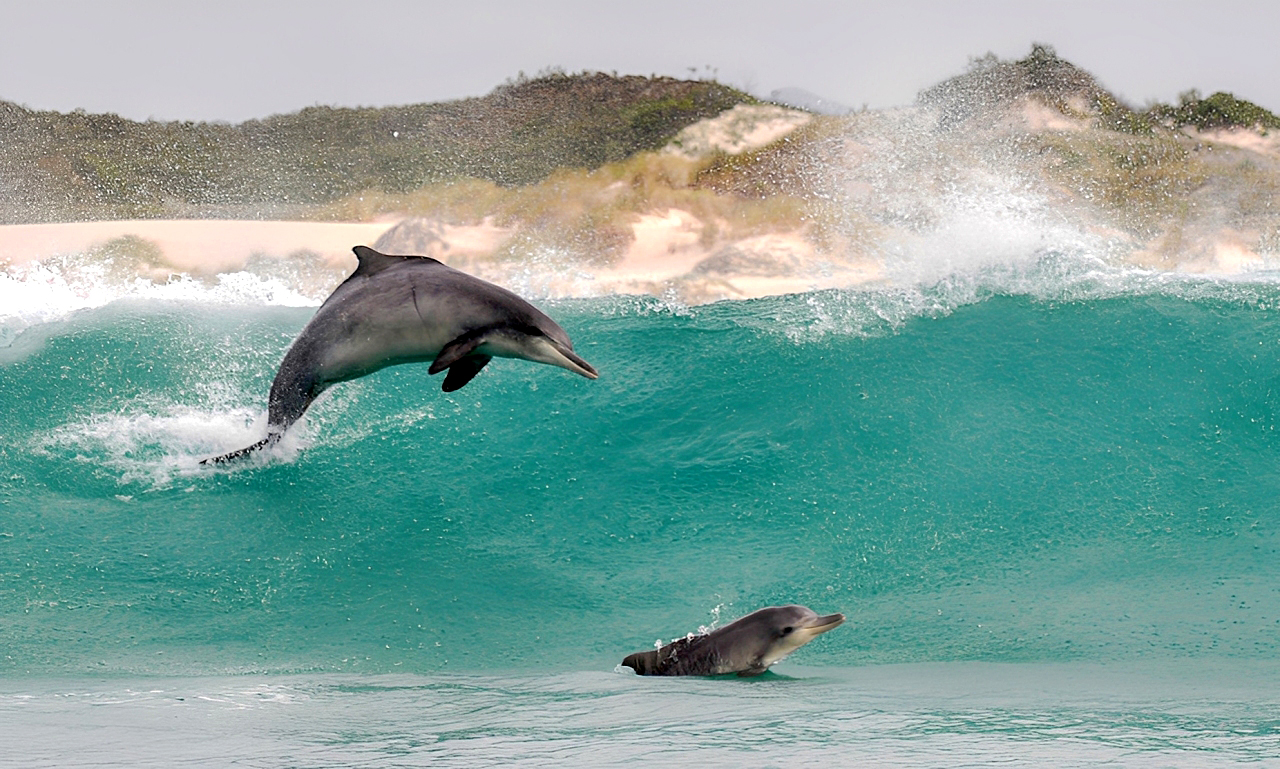
 Endangered humpback dolphins. (Photo:Sea Search Research and Conservation)
A shy dolphin species is giving scientists a peek into the health of South Africa’s coastal waters, and what it reveals is disturbing.
The Indian Ocean humpback dolphin is rare and hardly seen but research is showing that in recent years it is likely that the species has undergone a diet shift and, as a result, a decline in body condition.
A reason for this could be the depletion of their traditional prey species and this is adding pressure to an endangered species that could number fewer than 500 individuals in South African waters.
The study involved examining data collected over half a century from humpback dolphins that were incidentally caught in shark nets (or bather protection nets, as they are now known) off the South African coast.
These humpback dolphins were considered collateral damage in the early days of these nets, in which they became entangled, along with other dolphin species and turtles.
It was these species, collected from the nets, that were dissected and have provided scientists with the data sets needed to understand the feeding habits of the humpback dolphin.
“This started in the late Seventies, early Eighties where the Port Elizabeth Museum had an agreement with the KwaZulu sharks board where they started this programme of doing dissections of these dead dolphins from the nets and all the data and samples were accessioned to the Port Elizabeth marine mammal collection,” explains Associate Professor Stephanie Plön of BioConsult SH in Germany, who was part of the study that appeared in the journal Ecological Indicators.
“We had this historical data to draw on. In this case, it was mainly the stomach contents and the teeth and the blubber measurements that allowed us to look at this long-term data set.”
/file/attachments/orphans/0000273663_270746.jpg "People and rescue workers on the scene of a stranded whale at Yzerfontein, about 90km from Cape Town, on 5 November 2018. The 9m whale was put down with the help of SAPS bomb squad after failed efforts to rescue it. (Photo: Gallo Images / Netwerk24 / Jaco Marais)")
What makes humpback dolphins different from their relatives the bottlenose and common dolphins is that they hug the shoreline, moving into estuaries and hunting in shallow water. They are not known to occur in waters deeper than 25m.
The problem that humpbacks face, explains Plön, is that they live and feed in a habitat that has been highly impacted by humans. This marine zone is facing the brunt of overfishing, pollution runoff from the land and the destruction of natural habitat from the building of harbours.
“So, in the coastal zone, we see most small cetaceans being endangered globally, 60% [of them], and the humpback dolphin is one of them, unfortunately, in South African waters,” she says.
From the teeth the scientists were able to extract nitrogen and carbon isotopes that provided a further indication of what these individual mammals were feeding on. These measurable amounts of the isotopes vary for species and can be traced through the food chain.
The isotope analysis and the examination of the dolphins’ stomach contents showed this shift in diet.
“What we were seeing was that some of the fish species they were feeding on earlier on, in the Seventies, Eighties, were kind of disappearing from their diet, and other species were coming in,” Plön explains.
Between 2001 and 2010 two new prey species began appearing in the dolphin’s diet – the kelee shad and a species of squid.
Through the next decade, from 2011 to 2020, data revealed three new prey species, including the robust and bluespot mullet and the goldstripe sardine.
The researchers suspect that the targeting of these new species reflects a switch in diet brought on by an absence of their prey previously found in inshore waters.
Not alone
Humpbacks are not the only South African dolphins to have experienced a recent diet change. Sardines in the annual sardine run along the South African coast are now swimming deeper.
Plön explains: “From around 2000, because of the warming of the oceans the sardines are going deep and probably are not as available to all the predators feeding on them. We found that common dolphins switched to mackerel but it didn’t have an effect on their isotopic signature or their blubber thickness.”
However, unlike the common dolphin, the humpback might not be getting the same nutritional benefit from its new prey species and this is causing a decrease in its blubber thickness.
“This indicator species is telling us a bigger story about the bigger picture of the marine environment,” Plön adds.
Other cetaceans are also undergoing changes in feeding strategies, likely brought on by human action.
Southern right whales, which are often seen off the South African coast, have been found to be travelling longer distances in search of krill, on which these 20-tonne giants feed. These tiny, shrimp-like crustaceans have changed their distribution and it is believed this has been caused by climate change.
Like humpback dolphins, research has found that southern rights have lost body conditioning, while their birth rate has dropped as well.
“I think in general, we can say that the increase in human impact on ocean life is having an effect on the top predators. I think that’s a very fair statement,” says Dr Els Vermeulen, research manager of the Mammal Research Institute’s Whale Unit at the University of Pretoria. Vermeulen is part of a global effort to study southern right whales.
The problem, says Vermeulen, is trying to get a handle on the status of the more than 90 species of sea mammals found globally.
“A lot of species are unknown just because of logistics. Don’t forget that animals like beaked whales spend 90% of their time underwater. They are deep divers and go to 3km or 4km deep.”
But there is some good news for the humpback dolphin and other smaller marine mammals found along the South African coast.
/file/attachments/orphans/00002736671_581207.jpg "A whale at Yzerfontein in the Western Cape on 5 November 2018. (Photo: Gallo Images / Netwerk24 / Jaco Marais)")
To the relief of Plön and colleagues, the nets that once inadvertently netted so many dolphins and other marine species are no longer as deadly.
Better management of the shark protection system in recent decades, including lifting the nets during the sardine run, has reduced the number of deaths caused by entanglement.
“We had years in the Eighties where they caught up to 80 dolphins a year, and that’s the three different species of humpback dolphin and bottlenose dolphin and common dolphins,” Plön says. That was down to about 15 a year, but for some species like the humpback dolphin “even one or two animals per year is too many”.
Now Plön and her colleagues would like to find out just why this endangered dolphin has over the past couple of decades changed what it eats. Plön suspects that there is likely to be no single smoking gun.
“We are probably seeing what we call a cumulative impact. So it’s not just overfishing or climate change or pollution, it’s all of them together. That makes it even more complex. And time is running away and their numbers are dwindling.” DM