



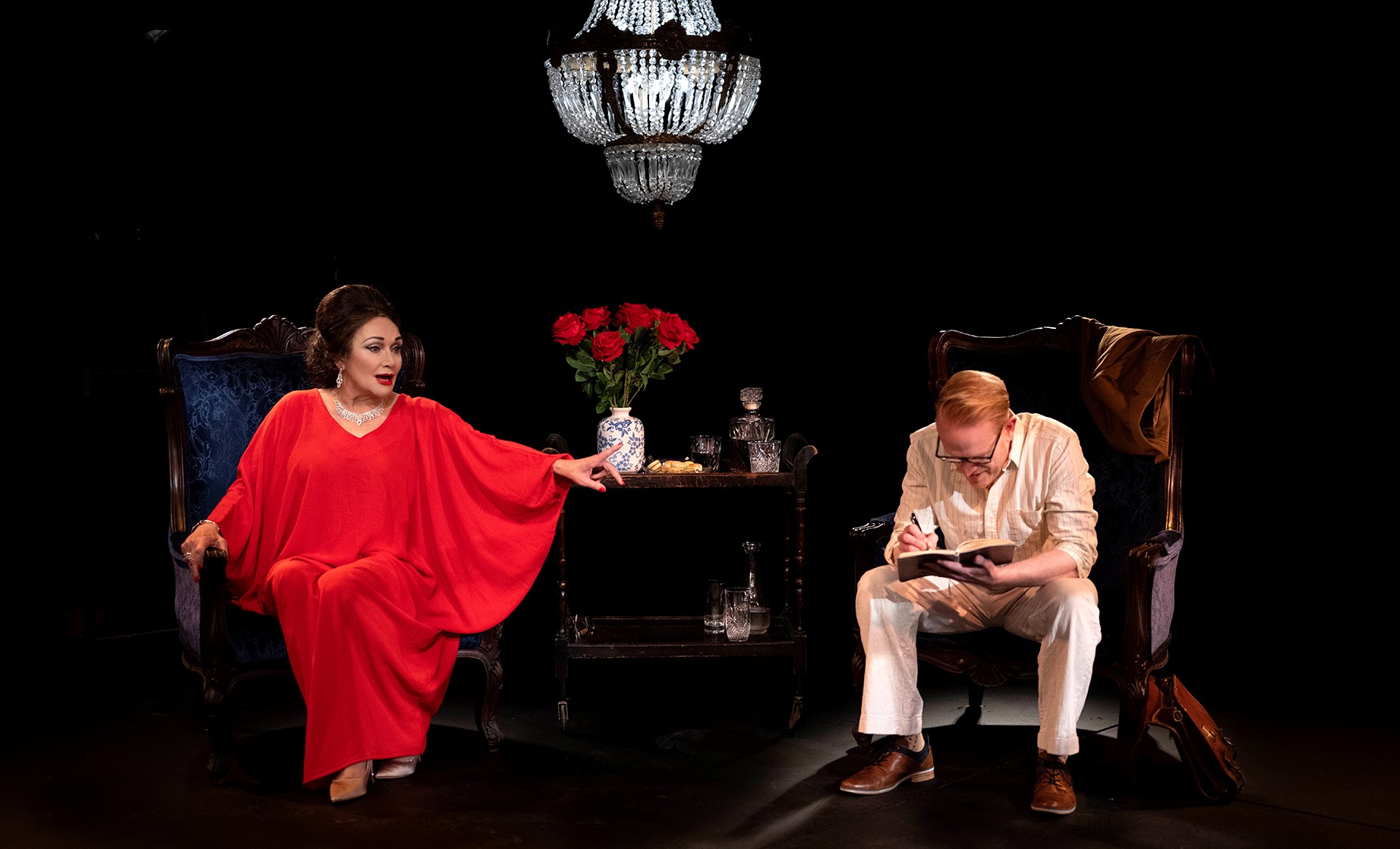
 Fiona Ramsay and Owain Rhys-Davies in The Opera Singer. (Photo: Supplied / Fiona MacPherson)
 In an IndieWire podcast interview about his film, Dune: Part Two, director Denis Villeneuve spoke about having witnessed Timothée Chalamet’s transformation over the years spent working with him into a full-blown movie star. He said he’d noticed that the young actor had made a choice very early in his career, essentially to forsake a “normal life” in order to be an artist of a certain calibre. It’s a decision, Villeneuve noted, that requires extraordinary sacrifice.
The Opera Singer, a play that opened recently at the Baxter’s intimate upstairs Studio theatre, to large extent examines the nature of such sacrifice, grappling with the idea that great artists are – for better or worse – called to their craft and must in many ways lay down their lives at the altar of success.
The play is a clever, resourceful two-hander, most of which takes place in a single room in the home of an opera diva, in many ways modelled on Maria Callas.
Its action revolves around a conversation between herself and a young, ineffectual journalist who had fallen in love with her as a boy, perhaps even harboured hopes of becoming an opera singer just like her. But the journalist is not there to sing her praise, but rather to interview her and – he hopes – extract her secrets, get to the real person beneath the famous exterior.
It’s an unfair match, really, and the perfect conceit for a fun, funny and ultimately bittersweet punch-up between a superstar artist at the end of her career and a bitterly inept journalist getting his first real break as someone with a professional interest in writing about people.
/file/attachments/orphans/FionaRamsayandOwainRhys-DaviesinTheOperaSinger_FionaMacPherson2_240814.jpg "Fiona Ramsay (the diva) being interviewed by Owain Rhys Davies (the journalist) in The Opera Singer. (Photo: Supplied / Fiona MacPherson)")
Writer-director Janna Ramos-Violante has hinted that her intention with The Opera Singer was to some extent to look at the nature of journalism as a kind of fundamentally exploitative activity, one in which the journalist is always to some extent preying upon the world and the people in it who actually make it go round.
As the battle of wits unfolds the diva reminds the journalist that she has led a hugely significant life that has made her supremely famous; the obituary journalist who has arrived at her home to interview her has accomplished nothing, which is one reason he promptly folds in the aura of her greatness.
What’s meant to be a dredging up of all this opera singer’s secrets in fact ends up revealing far more about the journalist: he reveals everything from the sad circumstances of his birth to the reasons he keeps mentioning his grandmother, and as much as he knows he’s not there to talk about himself, he is almost unable to keep himself from opening up in the presence of this great force of nature.
And a force of nature she truly is, not only able to demonstrate in short shrift that she would probably make a better journalist than the one who has come to interview her, but repeatedly driving home another point that seems to underscore the play: those who can, do; those who can’t, write.
/file/attachments/orphans/FionaRamsayinTheOperaSinger_FionaMacPherson_851736.jpg "Fiona Ramsay as the opera singer. The play is a clever, resourceful two-hander, most of which takes place in a single room in the diva’s home. (Photo: Supplied / Fiona MacPherson)")
Not only does she expose his failings as an interviewer, she early on gives him a dressing down for possessing the wrong name. Although he’s called Theo, she tells him he should have a more bookish name, just one of many (rather funny) moments in which she uses her biting tongue and ability to instantly assess a person, to summarily put the young man in his place. At the same time, of course, she shows him – and the audience – that she does not suffer fools lightly.
In this case, though, the young and foolish journalist, played with wide-eyed innocence and a serious dollop of breathless incompetence with absolutely spot-on accuracy by the perfectly cast Owain Rhys Davies, can barely get the basics of his profession straight. He’s not only terrible at his job (admittedly, it’s the first time he’s been assigned to write about a living person rather than dredge up facts about the deceased), but he commits the grievous sin of being a fawning devotee of the great personage he’s interviewing, and the even worse sin of hoping to be liked by her.
We live in a hyper-mediated era when – thanks to Instagram and similar fads – people too easily feel close to people they don’t know from a bar of soap. Which is part of the lesson being conveyed by the grand, delightfully funny diva played by the grand and delightfully funny Ramsay, and what she gets so right: nothing that’s ever been written about her has ever truly captured her essence. What journalists do get right, she boasts, are the numerous references to her greatness. What they fail to capture though, is her truth.
/file/attachments/orphans/OwainRhys-DaviesinTheOperaSinger_FionaMacPherson_279274.jpg "Owain Rhys Davies plays an inept journalist who commits the grievous sin of being a fawning devotee of the great personage he’s interviewing. (Photo: Supplied / Fiona MacPherson)")
While Ramsay’s diva prefers to imagine that the reasons for this lie in the overwhelming incompetence of journalists and their inability to ask the right questions, there’s plenty of herself that she reveals to suggest that the problem might lie in her own inability to let down her guard.
Although while she’s with Theo she has instances in which she allows her true emotions to shine through, Ramsay shows very clearly that even these honest moments that seem so completely from her heart might in fact be performances, bits and pieces of opera-worthy melodrama designed to convey the essence of an emotion.
Her reaction, for example, upon hearing about the terrible circumstances of her interviewer’s birth, is an extended display of exaggerated sorrow and pain, her clenched hands held tight against her face, a gesture executed with such gusto that those seated in the back row of an opera house might catch the depth of her emotion.
It’s these moments that Ramsay gives us insight into the ordeal of an artist who is always in character – they’re also where the play most tantalisingly conveys its meaning.
Equally satisfying in these moments is that we, in the audience, are unable to shake the sense that, while the diva might be incapable of stepping out of character, she is also clearly capable of experiencing and expressing emotion more deeply than mere mortals.
By the end of it all, the diva has quite thoroughly and exquisitely schooled Theo in his own profession, not only by testing his resolve but by questioning his moral compass, pointing out his faults and showing him – and the audience – without a shadow of a doubt that there is far more to being the world’s greatest opera singer that possessing the ability to enchant an audience with her superior talent and incomparable star quality.
She shows him that even the greatest stars and celebrities, no matter how far beyond the reach of mere mortals they might be, are simply people, too. DM
The Opera Singer is playing at the Baxter Studio in Cape Town until 7 February 2026. It will transfer to Johannesburg’s Theatre on the Square in March.