



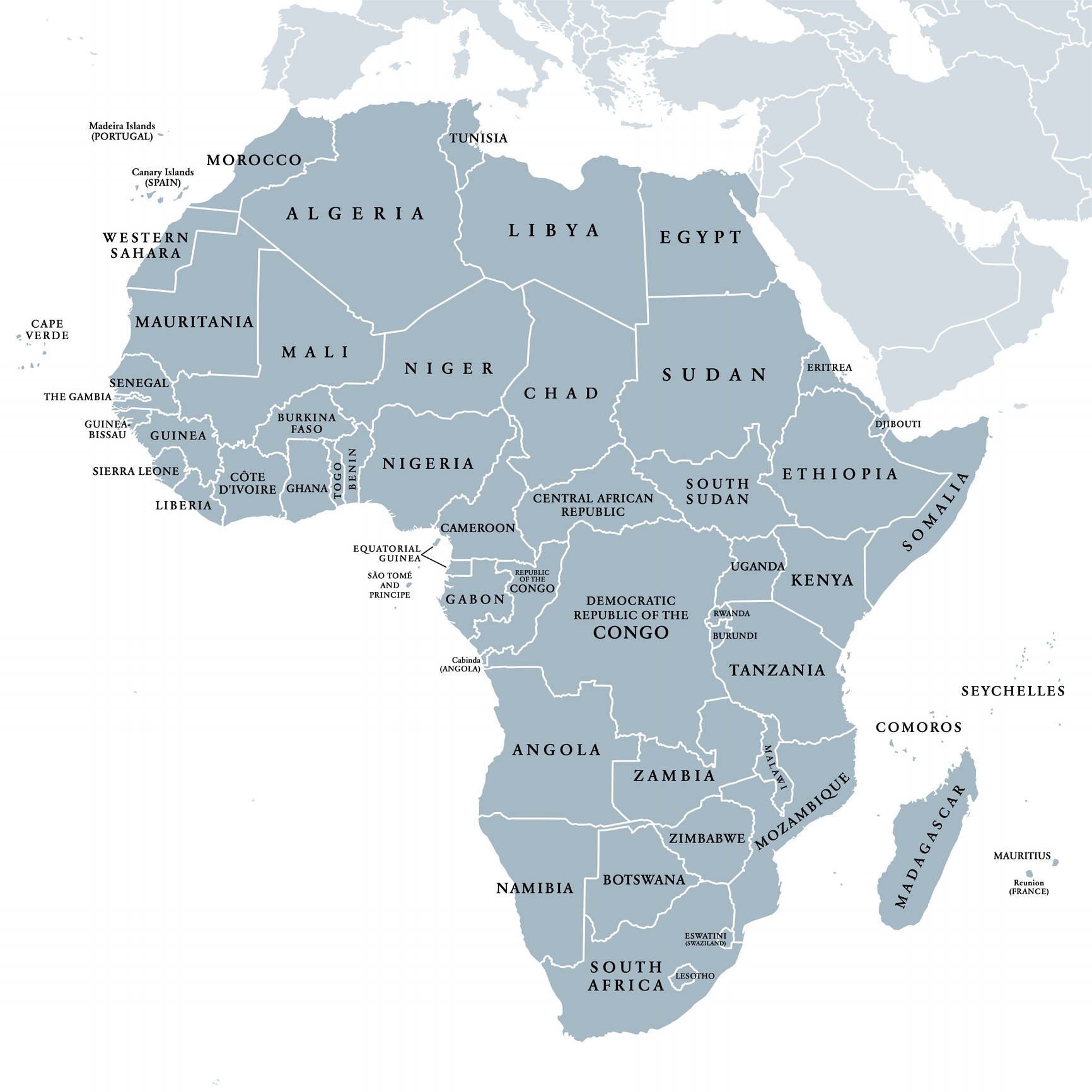
 Illustration | Africa. (Photo: iStock)
Africa’s startup market grew up in 2025. It stands secure in its own identity, shaped by quiet exits – market consolidation, as opposed to selling out to big business – and diversity.
If you go by the numbers presented in the Briter African Investment Report 2025, there was a 32% increase in volume of funding on the continent alongside an 8% rise in deal count over the previous year. Disclosed funding value? R60.98-billion or $3.8-billion.
Read more: Capitec has no mercy for fintech startups
This prompted Biter director Dario Giuliani to give this prognosis: “Africa’s investment market today is neither in worrying retreat nor in exuberant expansion, but rather in a phase of consolidation.”
And the investment elixir for Africa’s financial ailments is increasingly coming through the cleantech artery. Yes, fintech still leads on number of dollars, but investors are shifting toward infrastructure-heavy, asset-backed models rather than pure software plays. Solar energy was the top-funded category, representing 26% growth year over year.
Positive debt
For the first time in a decade, debt financing crossed the $1-billion (R16-billion) threshold. This, however, is a good thing. It shows that startups are maturing into revenue-generating, asset-backed businesses capable of supporting structured financing, moving away from a reliance on equity alone.
But perhaps the most counterintuitive takeaway from the 2025 data is that the African market is no longer (finally) just catching up to Silicon Valley, it is decoupling from it. That 32% rise in funding volume happened despite a global venture retreat, suggesting the ecosystem has developed its own internal logic.
/file/attachments/2987/Gemini_Generated_Image_3py4i93py4i93py4_538533.png "Infographic: Lindsey Schutters using Nano Banana Pro")
Wale Ayeni, managing partner at Helios Digital Ventures, argues that investors looking for a carbon copy of Western trajectories will miss the point.
“Frontier markets are often described as ‘catching up’, but in reality they are not early, they are different,” Ayeni says. “It’s a nuanced distinction, but one that explains the different drivers of returns.”
The geopolitical pivot
But this difference is visible when you look as who is writing the cheques. While Western capital remains a staple, 2025 was a defined shift toward the global East and the Gulf. The Briter report shows a surge in non-Western capital, with Japan and the Gulf Cooperation Council (GCC) emerging as critical new hubs.
Riki Yamauchi, director at Novastar Ventures, pointed out that Japanese corporations have moved past the exploration phase.
“The year 2025 marked a clear shift for Japanese investment in Africa, moving from dipping our toes to formalising partnerships,” he explains. “After years of learning, Japanese investors are now engaging more deliberately with both startups and funds.”
/file/attachments/2987/Untitleddesign_190870.png "Infographic: Lindsey Schutters using Nano Banana Pro")
Pragmatic AI
Technology remains the vehicle for this capital, but the hype has been cooled by reality. Artificial Intelligence (AI) has moved to the centre of the innovation economy, with 15% of deal activity now coming from AI-enabled companies.
However, this isn’t a deep tech or Large Language Model arms race; it is overwhelmingly focused on practical application layers like credit scoring and logistics.
Samantha Pokroy, CEO of Sanari Capital, warns that while technology lowers barriers, it raises the stakes for adoption.
“Failure for any business to prepare for both the opportunity and disruptive threat of technology and artificial intelligence risks going the way of the dinosaurs,” she says.
What this means for your IPO-ready business
If you were eyeing a listing this year, the JSE’s simplification project is great news. Africa’s premier board is cutting the volume of listing requirements by over 50%. By adopting plain language and removing ambiguity, the exchange has transformed the pre-listing process from a dense administrative burden into a streamlined, clearer path to market.
Key changes include lowering the shareholder voting threshold for share issues and buy-backs from 75% to 50%, and reducing historical financial reporting requirements for major transactions from three years to two.
Specific sectors benefit further, with the removal of mandatory valuation reports for most property entities and competent person’s reports for mining firms.
The reforms also aggressively target international and secondary listings, expanding the fast-track route to cover 18 approved exchanges and reducing the eligibility period to just 12 months.
The governance ceiling
Despite the liquidity recovery, the market outlook remains tempered by structural realities. The legacy “growth at all costs” mantra has been replaced by a focus on governance and productive capacity. There is a growing recognition that funding alone cannot fix systemic inefficiencies.
Justin Barnes, an industrial policy specialist, offers a realignment to the idea that skills or capital are the only missing links.
“I don’t think it’s a skills problem in Africa,” Barnes observed in an Rand Merchant Bank white paper produced for the B20 summit last year. “It’s a lack of productive opportunity problem... You first need to create an incentive to create skills.”
The hidden challenge
Taking that idea further, the benefits of this mature investment landscape are not yet evenly shared. Tanya Dos Santos-Ford, a sustainability and climate specialist, points out that without strict governance, capital inflows can exacerbate divides.
Read more: Rise of the Machines: 2025 ‘genesis’ year for humanoid robot production with 16,000 installed
“Africa is becoming more unequal. It comes back to corruption – money is going into the hands of a few people,” she is quoted as saying in the same white paper, echoing the growing chorus of questions around South African ownership policy. “If we could stop corruption, it would be a completely different continent.”
Ultimately, the 2025 landscape is defined by this tension between opportunity and structural friction. The market is not shrinking; it is de-risking and diversifying. As Isaah Mhlanga, chief economist at RMB, puts it: “Ignoring Africa is like ignoring the future of where the world’s going. That much is true. The rest is up to us.” DM