



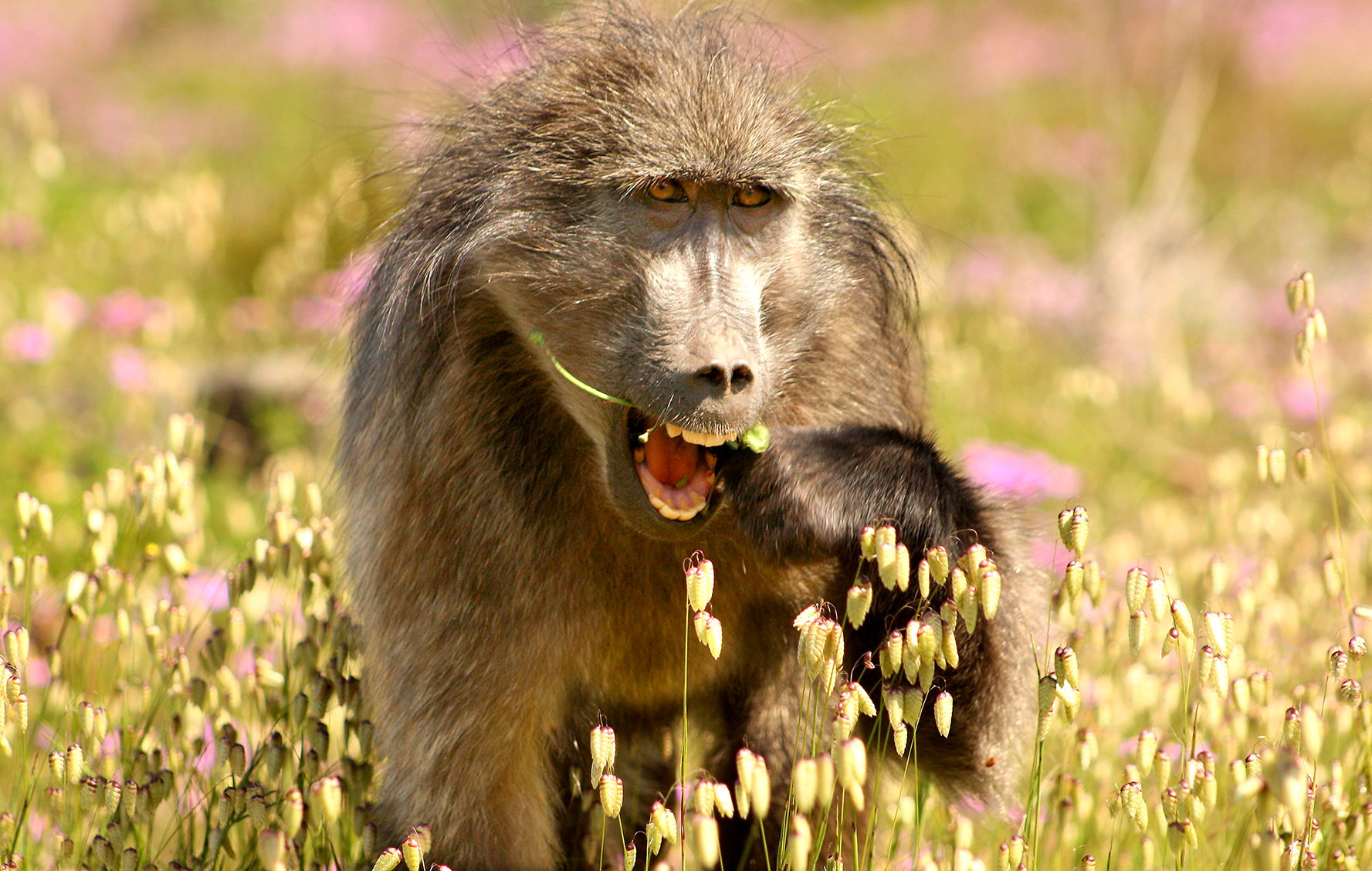
 The Cape Peninsula Baboon Management Action Plan has been finalised. However, the debate continues to rage. (Photo: Gallo Images / Foto24 / Taryn Carr)
- Correction: In an earlier version of this article, it was stated that the facility must then become self-sustaining through tourist entry fees, with revenue going to the landowner." This is incorrect and the article now reflects that "revenue generated (from multiple revenue streams, not solely "tourist entrance fees"), will go back into sustaining the wider baboon management programme." Daily Maverick apologises to the landowner and Cape Baboon Partnership for the error in the reporting.
The Cape Peninsula Baboon Management Joint Task Team (joint task team) has finalised the Final Cape Peninsula Baboon Management Action Plan to manage the region’s baboon population. However, the 20 November announcement has triggered debate over consultation processes, scientific methodology, financial sustainability and the fundamental disagreement persists over whether humans and baboons can coexist in urban areas.
The joint task team, which includes representatives from SANParks, CapeNature, and the City of Cape Town, adopted a strategy that includes relocating multiple baboon troops, constructing R27-million worth of fencing and sanctuary infrastructure, and imposing strict population caps.
The task team claims the plan addresses an “untenable situation” where they say the baboon population has nearly doubled since 2000, while the natural habitat has shrunk. Animal welfare organisations counter that the plan treats symptoms rather than addressing root causes such as waste management and human behaviour.
/file/attachments/orphans/0000270952_979024.jpg "A Cape Point Nature Reserve baboon grooms a member of its troop. (Photo: Gallo Images / Bateleur Publishing / Mark Skinner)")
The action plan’s core elements
Four baboon troops will be removed from urban areas. The Seaforth troop, with about 16 baboons, according to the 2024 population census, will be captured and relocated to a newly established sanctuary by February 2026, with all healthy males vasectomised.
The plan lists the alpha male of the Seaforth troop as a “concern” and says that “humane euthanasia of this male has been supported”; however, concrete decisions on the fate of the male have not been made. “At present, the plan leaves his fate ambiguous,” says Luana Pasanisi, a member of Green Group Simon’s Town and the Wildlife Animal Protection Forum South Africa (WAPFSA).
If successful, the Waterfall troop, with about 42 baboons, according to the 2024 population census, will be followed by September 2026.
The R10-million sanctuary that will be built on privately owned land includes 12 months of operational funding.
The sanctuary will comprise two 1.5ha enclosures, which would be the size of one-and-a-half rugby fields, built on a 10.45ha piece of privately owned land along Plateau Road, which is less than 2km from the Cape Point Nature Reserve gate.
/file/attachments/orphans/WhatsApp-Image-2025-11-27-at-1229_157805.jpg "A map showing the proposed baboon sanctuary borders. (Graphic: Daniella Lee Ming Yesca)")
This is according to information provided in the meeting between the joint task team and the Cape Peninsula Baboon Action Group on 20 November, after the release of the Action Plan.
The plan states that the facility must then become self-sustaining.
Further information supplied to Daily Maverick stated that revenue generated (from multiple revenue streams, not solely "tourist entrance fees") will go back into sustaining the wider baboon management programme. A separate NGO is being established to ensure this very process is transparent and, above all, not-for-profit.
The information reveals that the landowner is legally entitled to pursue their own revenue sources on their property, such as a coffee shop (already established on the property), or merchandising, and that revenue via these sources they may keep should they so wish (which they have already stated they will put into trust for the benefit of the baboons).
If that fails, animals may be euthanised.
For the Constantia troops CT1 and CT2, which comprise about 61 baboons, an estimated R17-million of electrified fencing will be built to separate natural habitat from urban areas by July 2026, funded jointly by the city and landowners. Both troops will be released behind the fence. Any baboons breaching it will be euthanised.
Additional measures are the rolling out of long-awaited 3,000 baboon-proof household bins in high-impact areas during the 2025/2026 financial year, and another 3,000 in the next year, an Urban Wildlife Management by-law by November 2028 and enhanced enforcement against those harming or feeding baboons.
The Action Plan notes that research on contraception and genetic enrichment will be completed for the 2030 review of the plan.
Task team defends consultation process
Members of WAPFSA walked out of the 20 November meeting. According to Stefania Falcon of Future for Wildlife, the joint task team announced final decisions to the media before the community meeting began. “This is not a consultation, it’s a press conference disguised as engagement,” she says
The joint task team said that it engaged stakeholders at multiple stages before finalising the plan.
On 20 November, the joint task team met with the Baboon Advisory Group. The meeting took place at 9am. The final Action Plan, which was presented to advisory group members at the meeting, was released just before 8.30am and embargoed until 9.30am.
“There was a very constructive engagement about the finer details during which members asked questions for clarification,” according to the task team.
“It is important to mention that the [joint task team] consulted with the (advisory group) in August 2025 about the draft Action Plan, and members had the opportunity to also submit their written comments to the [joint task team]. The [joint task team] took all of these comments into consideration, including the comments emanating from the review that was undertaken by an independent expert panel before the Action Plan was finalised.”
/file/attachments/orphans/map1_310680.jpg "Estimated ranges of the northern and southern baboon troops. (Graphic: Daniella Lee Ming Yesca)")
Coexistence vs control
“I am happy that we’re not killing 120, but it’s very sad that we’re actually putting the baboons in cages and having them on display next to the most beautiful tourist site in the world,” said Megan Carr, an administrator for WAPFSA.
Many baboons die in urban areas, according to Falcon. “The city’s response? Trap more baboons, build more fences, plan more culling,” she says. “They’re treating symptoms with lethal force while ignoring the disease: unmanaged human behaviour.”
Carr says the core issue remains unaddressed: “From our perspective, we believe that the humans are the problem and not the baboons.” She argues that management of the baboons has been an ongoing attempt for decades, and that “they should realise that these are wild animals and they cannot be managed”.
Carr argues that lifestyle changes, not removal, offer solutions. “It really is imperative that when you are purchasing a house in one of the hotspot areas that you are made aware of the fact that you’re moving into a baboon area and that you need to change your lifestyle,” she says.
The WAPFSA public statement cited research by Dr Bentley Kaplan, a sustainability analyst, showing that baboon presence in urban areas was driven by food availability rather than population size. Green Group Simon’s Town, a WAPFSA member, claims a 17-month pilot project successfully kept the Seaforth troop in natural areas using improved waste management.
Critics argue that waste management should precede removal. “They’ve made these fantastic plans for the baboons, but they haven’t addressed the waste issue, which is what attracts the baboons,” Carr says. “They’re looking at maybe addressing it in the latter part of 2026. I think that’s a little bit too late. Why was that not done first before the eradication of the baboons?”
/file/attachments/orphans/JK07650_524484.jpg "A juvenile baboon from the Seaforth troop, with False Bay in the background. (Photo: Joyrene Kramer)")
WAPFSA demands an independent review, a moratorium on the Action Plan, recognition of community-generated evidence, compliance with biodiversity law, cessation of paintballing and killing and implementation of waste-management and habitat rehabilitation first.
Jenni Trethowan of Baboon Matters said: "Like so many of my colleagues I too have concerns about aspects of the plan, in particular the ever present threat of killing so called “problem” baboons for all sorts of reasons. And, at this critical time of decision making, the absence of the annual census is problematic. The population numbers are critical to the decisions made so why do we not have updated data? It is unacceptable."
Trethowan said after meeting with the Cape Baboon Partnership "I can see why the sanctuary option is the only viable options for these troops, who are on a knife edge with culling as the only alternative."
"For the first time in years I feel that there is a vision for the baboons; it is not my vision, but there is a vision. When I proposed moving troops off the peninsula (in 2016) I had ideas of huge space and free roaming troops. But in reality there are more restrictions than options and my vision was only an ideal; the plan on the table is, however, a real option.
"I feel that the CBP team have applied themselves fully to this initiative, they have investigated potential scenarios, travelled to various sites and have really thought this through and the result of their efforts is a plan that I think will work. (To be clear we are talking specifically about the sanctuary here.)
"Having walked over the area designated to the first troop, I think the Seaforth baboons will adapt – provided their family structure is intact. In fact, I think the troop might actually find it somewhat of a relief to live a life of safety and food security in an area away from cars, dogs and shooters.
"Is this the ideal option – probably not. But remember all we had at the start of this was the option of a cull."
The plan sets out for the construction of the first sanctuary enclosure to begin mid-January 2026, with the Seaforth troop being relocated and the construction of the northern fence commencing in February 2026.
The joint task team recently released a statement announcing that two baboons were lethally removed in November 2025 under existing management guidelines – an adult male from the Mountain One troop on 13 November after repeatedly entering occupied homes and shops, and an adult male who recently separated from the Seaforth troop and moved to the Waterfall troop on 19 November after exhibiting a pattern of breaking sliding doors to access residential properties.
Both were classified by authorities as high-risk individuals under the BTTG03 guidelines, which recommend lethal removal when such behaviours persist and risk being transmitted to other troop members.
The Cape Baboon Partnership confirmed in the statement that no other baboons were being considered for lethal removal. DM