




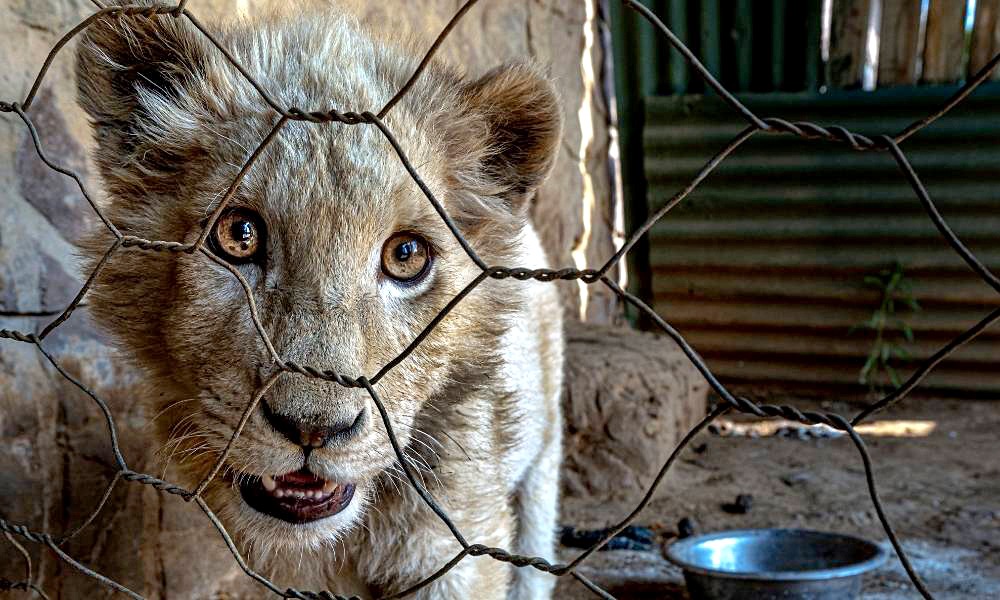
 Cub petting is widespread, seemingly undimmed by parliamentary demands to shut down captive lion breeding. (Photo: Lady Freethinker)
 ‘I think this industry is horrific,” says Nina Jackel “It’s incredibly cruel, completely needless and driven purely by human entertainment and profit. There is absolutely no justification for the suffering inflicted on these animals. None.”
We’re flipping through photographs from a research expedition into cub petting in South Africa. They were taken during an undercover investigation by Lady Freethinker, the organisation Jackel founded more than a decade ago and which focuses on animal cruelty.
Cub petting is widespread, seemingly undimmed by parliamentary demands to shut down captive lion breeding. Under the impression that it’s wildlife conservation or education, tourists are encouraged to bottle-feed, stroke and pose with lion and tiger cubs for photographs.
In reality, the practice is the entry point into a tightly controlled system of exploitation, one that begins within days of birth and ends, for many animals, in death.
/file/attachments/orphans/6DoncubsLadyFreethinker_396389.jpg "Eventually, many are sold into canned hunting operations. (Photo: Lady Freethinker)")
DP: When you describe this industry as horrific, what are you responding to most strongly?
NJ: The fact that it’s entirely unnecessary. We’re talking about animals enduring stress, separation, confinement and ultimately death purely for human entertainment. There’s no conservation value here. There’s no educational value that couldn’t be achieved in other ways.
What really stays with me is that these animals never get a chance. From birth to death, every stage of their lives is about how they can be used.
/file/attachments/orphans/10DoncubsLadyFreethinker_229507.jpg "What you’re seeing is just one moment in a longer cycle. (Photo: Lady Freethinker)")
/file/attachments/orphans/8DoncubsLadyFreethinker_619985.jpg "From birth to death, every stage of their lives is about how they can be used. (Photo: Lady Freethinker)</p>
<p>")
DP: For people encountering these images for the first time, what’s important to understand about cub petting?
NJ: That what you’re seeing is just one moment in a longer cycle. Cubs are usually taken from their mothers when they’re only days old, because that’s when they’re easiest to handle. They’re passed from person to person, day after day.
Once they get too big or too unpredictable, they’re moved on. Sometimes that means “walking with” experiences, sometimes it means being sold to another facility and very often it means canned hunting or the bone trade. The cute moment tourists pay for is just the beginning.
/file/attachments/orphans/9DoncubsLadyFreethinker_878378.jpg "Cubs are usually taken from their mothers when they’re only days old. (Photo: Lady Freethinker)</p>
<p>")
DP: Lady Freethinker has investigated animal exploitation around the world. How did South Africa compare?
NJ: This was our first investigation in South Africa, and the scale of it was shocking. We’ve looked at elephant tourism in Thailand and facilities in Indonesia, but the sheer number of lions and tigers being bred and handled here was deeply disturbing.
What stood out was how openly it all operates. These places aren’t hidden. They’re marketed, reviewed and promoted to tourists in the language of conservation and education.
/file/attachments/orphans/11DoncubsLadyFreethinker_975060.jpg "What stood out was how openly it all operates. (Photo: Lady Freethinker)")
/file/attachments/orphans/7DoncubsLadyFreethinker_839645.jpg "Tourists are encouraged to bottle-feed, stroke and pose with lion and tiger cubs for photographs. (Photo: Lady Freethinker)")
DP: How did your team gain access to these facilities?
NJ: It wasn’t especially difficult, which is part of the problem. Photojournalist Aaron Gekoski, who led the investigation and photography, did careful research and identified facilities that were still operating openly.
In most cases, what he documented is exactly what any visitor could have seen. Aside from a few restricted back areas, this wasn’t secret cruelty. It was happening in plain sight.
DP: Why do you think so many visitors don’t recognise what they’re witnessing as cruelty?
NJ: Most people don’t want to believe they’re harming animals. They go in trusting the story they’re being told – that this is conservation, that it’s helping the animals in some way.
There’s also a very human desire to be close to wild animals, especially babies. People want to feel that connection. What they aren’t shown is the cost of making that interaction possible, or what happens to the animal afterwards.
/file/attachments/orphans/1DoncubsLadyFreethinker_780111.jpg "Tigers feature heavily in cub petting. (Photo: Lady Freethinker)")
/file/attachments/orphans/13DoncubsLadyFreethinker_514521.jpg "There were multiple facilities where tourists could pet and feed tiger cubs. (Photo: Lady Freethinker)")
DP: Tigers feature heavily in these images, despite not being native to South Africa. What did your team observe?
NJ: They were everywhere. From what we documented, there were multiple facilities where tourists could pet and feed tiger cubs. Often there was very little supervision.
The animals were clearly distressed – pacing, showing aggression, displaying signs of zoochosis. And there’s a real danger to humans that’s rarely acknowledged. Two of our investigators were attacked – one scratched by a tiger, one bitten by a lion. These are wild animals under extreme stress.
The conditions were bleak: overcrowded cages, minimal enrichment, environments that bore no resemblance to anything a tiger needs to thrive. The animals were also treated roughly by workers, sometimes manhandled and pulled around.
/file/attachments/orphans/3DoncubsLadyFreethinker_244378.jpg "The animals were treated roughly by workers, sometimes manhandled and pulled around.
<br> (Photo: Lady Freethinker)")
(Photo: Lady Freethinker)
DP: What typically happens to these animals as they grow older?
NJ: There’s a very clear progression. Cubs are used for petting. As they grow, they may be used for walking experiences or sold to other facilities. Eventually, many are sold into canned hunting operations.
After that, their bodies can still be used – the bones extracted and sold into international markets for products like tiger bone wine. It’s a short life and every stage of it is transactional.
/file/attachments/orphans/12DoncubsLadyFreethinker_658988.jpg "It’s a short life and every stage of it is transactional.<br>(Photo: Lady Freethinker)")
(Photo: Lady Freethinker)
DP: How many facilities did your team visit?
NJ: They visited four facilities around the Free State and close to Johannesburg. They varied in how they presented themselves – from zoo-like environments to places described as educational or conservation centres. Some housed multiple species, others focused only on big cats.
We’ve debated naming the facilities publicly. In general, we don’t. The issue isn’t one bad operator – it’s an industry that exists because it’s allowed to.
/file/attachments/orphans/15DoncubsLadyFreethinker_967829.jpg "This is an industry that exists because it’s allowed to.<br>(Photo: Lady Freethinker)")
(Photo: Lady Freethinker)
DP: Can you tell us a bit about Lady Freethinker and how this investigation fits into your broader work?
NJ: Lady Freethinker started as a blog about 13 years ago. I come from a journalism background and wanted to write about animal issues that weren’t getting enough attention.
Over time, it grew into a nonprofit organisation based in California. Today, we conduct investigations, support rescuers through grants and work on both individual abuse cases and systemic cruelty. Campaigns like this – focused on captive wildlife – are central to what we do because of the scale of suffering involved.
DP: In South Africa, political momentum to end captive breeding has stalled. What does that mean now?
NJ: It means documentation matters more than ever. As long as tourists keep coming and money keeps flowing, the industry will continue.
Awareness is important, but it isn’t enough on its own. The time for promises and discussions is over. What’s needed now is real legislation that bans this industry outright.
/file/attachments/orphans/14DoncubsLadyFreethinker_539292.jpg "The time for promises and discussions is over. (Photo: Lady Freethinker)")
DP: After years of witnessing this kind of cruelty, how do you keep going?
NJ: It’s difficult. Anyone doing this work feels that weight. But every investigation, every rescued animal, every person who changes their mind – it all matters.
You keep going because the alternative is to look away. And that’s not acceptable. DM
Comments
Scroll down to load comments...