



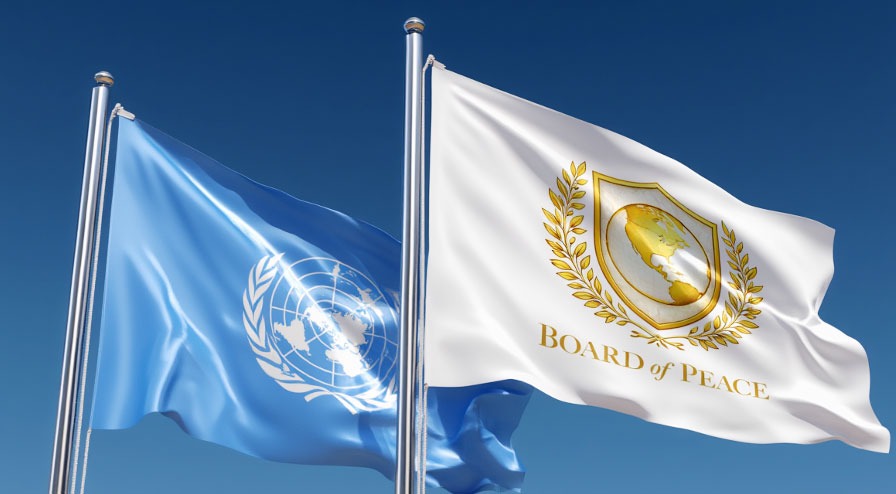
 The logo for Trump's Board of Peace is remarkably similar to that of the UN, and likely not an accidental coincidence. (Image: reve.art)
I don’t usually watch Donald Trump’s speeches, they tend to be too rambling and unfocused for me.
I prefer to read about them after the fact. But I did watch Trump at Davos because the venue and the platform sort of demanded it – a global stage of the rich and powerful and often a harbinger of things to come for economies, businesses and global cooperation.
And the speech was indeed rambling, but as conservative commentator and writer Rian Malan remarked to me, “fascinating to watch – bulldozer, hero, idiot, mafioso”.
Did Trump say anything new? Yes, he said one, and only one, new thing. He said he wouldn’t use force in Greenland. The markets recovered immediately from a panic crash. Almost everyone else sighed in relief. But really, this was not a new tactic; this is core Trump DNA.
Go in with an over-the-top negotiating position and then settle for something less, but more than you would have got if you had started off with a rational offer. This is a strategy he has repeated many times, in both his political life and private businesses. He did announce a new deal on Greenland, presumably something better than the US has now (probably more troops or bases or something similar), but details are still sketchy.
The rest of the speech was old territory – America in the best shape it has ever been.
Due to me. The rest of the world relies on us for protection. They don’t pay us and they don’t even say thank you. They are ungrateful. I am the best president ever. Biden is the worst. I ended eight wars. Europe is failing – they are all a bunch of weak wussies. That “woman” who leads Switzerland rubbed me up the wrong way, so I tariffed her (it was ex-president of the Swiss Federation Karin Keller-Sutter). No one is smarter than me. No one is stupider than everyone else.
And, of course, a large smattering of insults – “you’d all be speaking German if it weren’t for the US”, which, unsurprisingly, put Germany’s back up. It should be mentioned that Howard Lutnick, Trump’s commerce secretary, had reportedly also gone full Trump at a private dinner a few days earlier, being undiplomatic enough to cause European Central Bank president Christine Lagarde to walk out before dessert.
In a discussion I had with a friend after Trump’s speech, we wondered whether, if you stripped away the Trump’s breathtaking narcissism and bluster and ramble, and put some of his ideas and observations into the mouth of a rational, articulate and quietly confident speaker, they would be taken more seriously, even to the point of making a convincing case.
I think that they might have.
His views on Europe, while impolitic, are not out of bounds. The entire union (plus the UK) has been reeling for decades from own goals, ranging from energy policy incoherence (including the catastrophic shutdown of nuclear energy in Germany), to the social friction of near-unchecked immigration policies that have allowed millions of immigrants to arrive with unfamiliar and inflexible cultures in tow, to complacency bordering on neglect in building a coherent EU defence capability. To say nothing of overregulation, decision-making sludge and innovation-crushing financial risk aversion.
Did Trump lie or exaggerate in his speech? Yes. As Isaac Saul of the centrist news site Tangle concisely reports: “He claimed China makes all of the world’s wind turbines but never uses them, proof they’re ripping everyone off by selling wind energy (China is the world leader in wind power, and it accounted for 70% of new global wind power in 2024); he claimed we never get anything out of Nato, when the only time Nato’s article 5 clause was ever exercised was after September 11; he claimed the US has brought in $18-trillion of new investment – double his own administration’s tally, which itself is based on broad pledges; he claimed again that he has ended eight wars, which he has not; he claimed the prices of drugs have fallen ‘5, 6, 7, 800 percent’, or even ‘2,000 percent’, all of which are mathematically impossible (also, drug prices have gone up).”
But this, too, is nothing new; it has been a staple technique of the president for a decade. He knows that the average listener is not moved to check facts.
It is also repeatedly reported that Trump is in cognitive decline of some sort. This is poppycock. He was completely in command of what he was saying, often stopping to extemporise, admittedly in his own very Trumpian way. That cognitive decline narrative should be consigned to the dump, notwithstanding his confusing Iceland and Greenland a few times; this sort of thing is par for the course for most presidents of a certain age, including Biden.
Which brings us to Mark Carney, the other big news story. His speech, as widely reported, was (at least on paper) a magisterial and articulate call to action amid an unprecedented and sudden reshuffling of power centres and the entire concept of a rules-based international order.
In person it was somewhat less impactful – he is not a great orator, but let’s forgive him that. The speech attracted wide praise, and even more than that.
Carney never mentioned Trump. But it certainly pissed Trump off, probably less for its content than for the fact that Carney’s was the speech that garnered the big thumbs-up. And so, in true Trump form, Canada was immediately and petulantly kicked out of Trump’s ambitious Board of Peace (he had been invited, but had not yet accepted).
Let me end with this new organisation. It was started by Trump. It reputedly has 35 country members and counting (although the Europeans are not on board, and are now rightly pissed off enough to stay away). Reuters reports that Trump “made it clear” that the board’s remit would be expanded beyond Gaza to tackle other conflicts worldwide. Its logo is very close to that of the United Nations. This is clearly not a coincidence.
And then there is this, from the BBC: “In leaked details of the draft charter (Trump) is the board’s chairman for life even when he leaves office. Under that charter his powers would be vast: authority to invite member states or not; to create or dissolve subsidiary bodies; and the mandate to appoint his successor whenever he decides to step down, or if he is incapacitated.”
What could be more Trumpian than for him to withdraw the US from the UN to start a competitor, to be run by him, forever? DM
Steven Boykey Sidley is a professor of practice at JBS, University of Johannesburg and a partner at Bridge Capital and a columnist-at-large at Daily Maverick. His new book, Mine: How the Crypto Industry is Redefining Ownership, is published by Maverick 451 in South Africa and the Legend Times Group in the UK/EU, available now.