




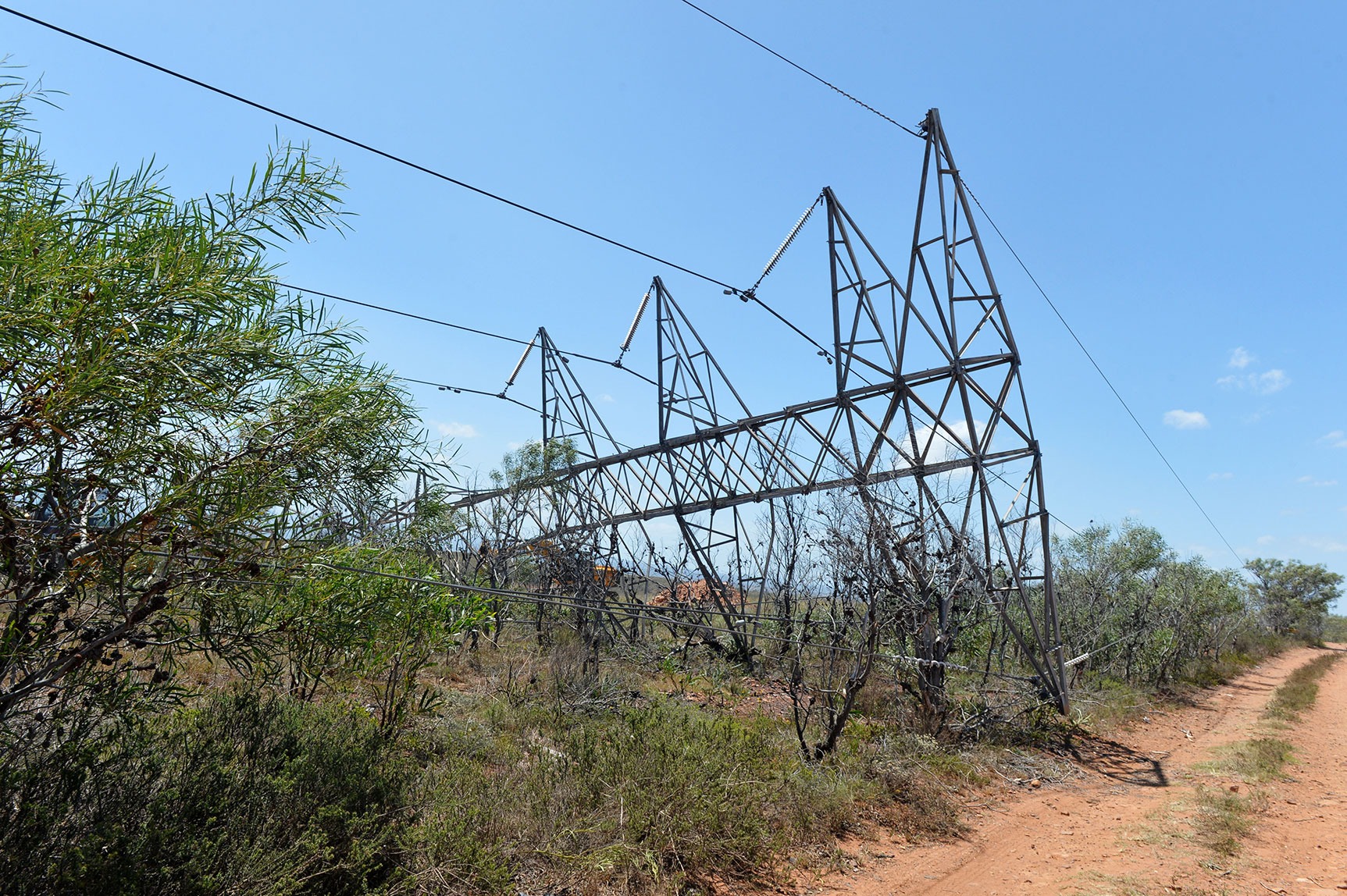
 The Nelson Mandela Bay municipality is working toward the restoration of the 132Kv Bethelsdorp–Greenbushes line that collapsed on Thursday.
(Photo: Deon Ferreira)
The Nelson Mandela Bay municipality is working toward the restoration of the 132Kv Bethelsdorp–Greenbushes line that collapsed on Thursday.
(Photo: Deon Ferreira) On 18 December, Nersa called its inaugural tribunal sitting to deal with municipalities not in compliance with their electricity distribution licence conditions. Not having a maintenance plan or not complying with a maintenance plan was among the reasons provided by Nersa that could lead to steps being taken against a municipality.
Municipalities can be fined up to R2-million a day for continuing transgressions.
Last week Thursday, in Nelson Mandela Bay, two 132 kV electricity transmission towers collapsed due to what the metro described as “infrastructure vandalism, compounded by adverse weather conditions”.
Visuals of the remaining structures, however, clearly showed that the pylons were badly rusted – on Friday, during a briefing, the municipality admitted that rust was a “contributing factor”. Over the weekend, the metro’s executive mayor Babalwa Lobishe said an Eskom team was checking the stability of the rest of the pylons.
/file/attachments/orphans/DSC_3042-copy_815566.jpg "The Nelson Mandela Bay municipality said it would take about 10 days to complete the restoration of the 132Kv Bethelsdorp–Greenbushes line that collapsed on Thursday. (Photo: Deon Ferreira)")
In September last year, then acting executive director of Nelson Mandela Bay’s electricity and energy directorate, Tholi Biyela, announced that he was leaving the metro to pursue opportunities elsewhere.
His departure followed the submission of a detailed turnaround strategy for the troubled directorate – a document that, in hindsight, reads as a warning about failures now playing out.
Besides flagging deteriorating infrastructure, poor maintenance practices, budgetary pressure and weak revenue collection, the plan also warned of corruption, political interference and internal instability within the directorate – factors Biyela said undermined accountability and placed critical electricity infrastructure at risk.
Read more: From plan to prophecy – how exiting boss foresaw chaos in NMB’s energy directorate
This is the second set of high-voltage cables to collapse in the city. The first incident took place in August 2024. After that incident, former executive director of electricity in the metro Luvuyo Magalela resigned.
Was there money for maintenance?
In the current financial year, the 2025/26 budget explicitly addresses the maintenance of electrical infrastructure through both operating expenditure (for repairs) and capital expenditure (for renewal and upgrades). The budget said the “rehabilitation and maintenance of infrastructure” was a “key challenge facing the municipality”.
The 2025/26 budget specifically provided R146.7-million to the electricity service for repairs and maintenance. The budget further allocates R105.6-million for repairs and maintenance specifically classified under “Electrical Infrastructure”.
Capital budget: Renewal and upgrades
- The capital budget set aside for the renewal of existing assets: R59.77-million.
- For the upgrading of existing assets, R22.85-million was allocated for upgrading electrical infrastructure.
- New infrastructure: While distinct from maintenance, R118.33-million is allocated for new electrical infrastructure assets which support the expansion of the grid.
The maintenance of infrastructure is a primary driver for the electricity tariffs charged to consumers.
/file/attachments/orphans/Photo-3-1_736053.jpg "City officials are busy repairing a 132 kV transmission tower that collapsed. (Photo: Facebook / Nelson Mandela Bay Municipality)")
Last year, the National Treasury noted that service declines in trading services (such as electricity) were often caused by “long-term and systemic underinvestment in maintaining, rehabilitating and expanding infrastructure assets”.
A statement by Nersa’s Charles Hlabela said the regulator’s tribunal, in its inaugural sitting, heard non-compliance matters against licencees that breached their licence conditions.
“This milestone marks a decisive step in operationalising Nersa’s enhanced enforcement powers. It signals Nersa’s zero tolerance for non-compliance by electricity licencees, including municipalities,” he said.
The tribunal sitting dealt with matters arising from systemic non-compliance uncovered through Nersa’s compliance audits, including breaches of licence conditions. This included the absence or non-implementation of maintenance plans and non-compliance with quality of supply and quality of service standards.
On 18 December, eight matters were heard. Default orders were granted against the following municipalities: Saldanha Bay Local Municipality, Rustenburg Local Municipality and Ekurhuleni Metropolitan Municipality.
“Licencees are cautioned that failure to comply with tribunal directives may result in escalation to adjudication. Nersa may impose administrative penalties of up to R2-million a day for each day a contravention persists, until the violation is remedied, as provided in the Act,” Hlabela said.
Complaints can be submitted through Nersa’s customer complaint process. DM