




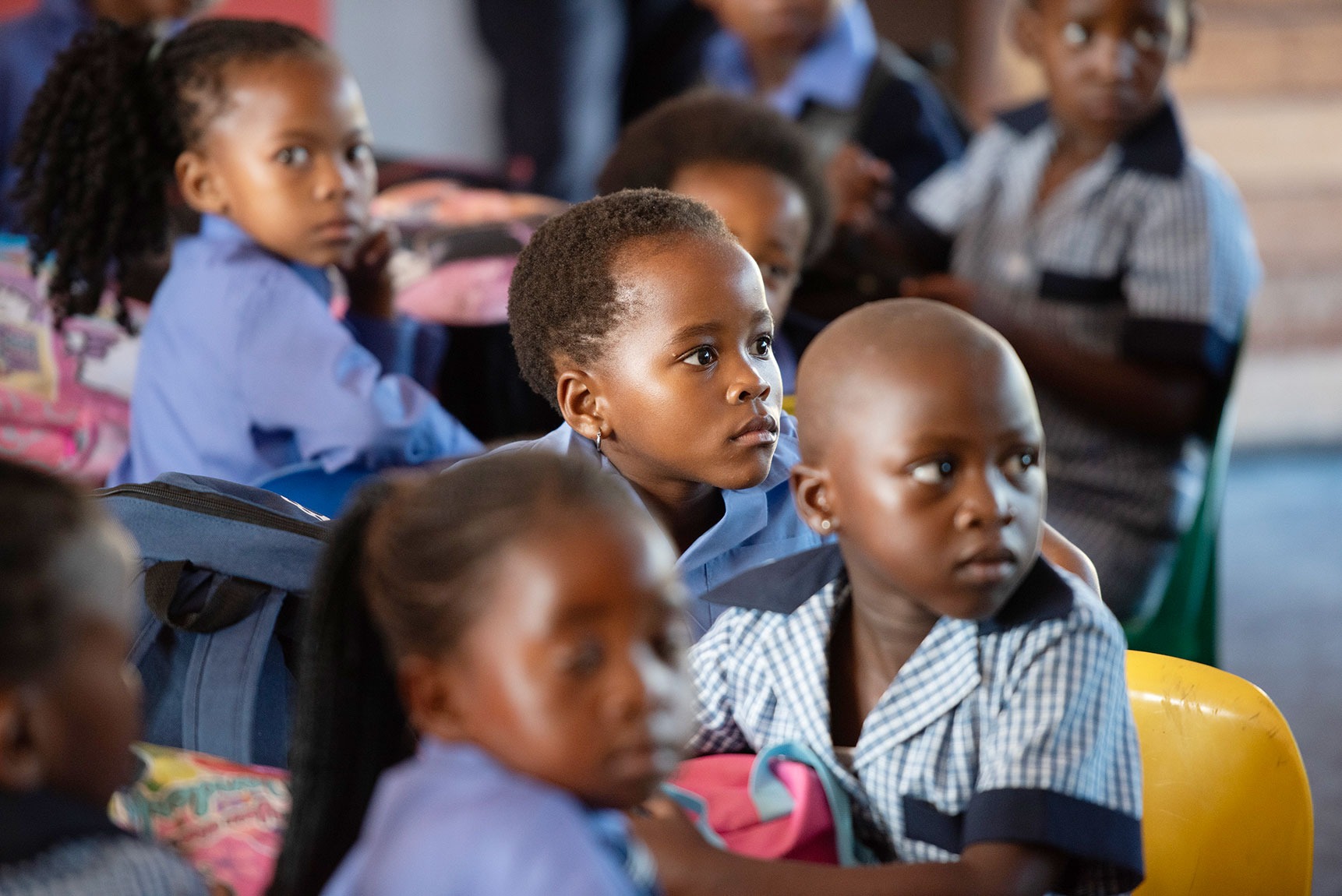
 First day for new Grade R pupils at Thembani Primary School in Langa, 14 January 2025. (Photo: David Harrison)
 The implementation in South Africa of a compulsory Grade R year has the potential to boost access to quality education for thousands of children, allowing them to build strong foundations that will serve them throughout their school careers. However, many questions about the roll-out remain, including how funding, human resources and the role of early childhood development centres tie into the new legislation.
Daily Maverick takes a look at some of the pressing worries here.
When did Grade R become compulsory?
In 2024, the Basic Education Laws Amendment (Bela) Act was signed into law, amending the South African Schools Act and making Grade R compulsory for five-year-olds from 2025 onwards. The legislation had been in development for seven years, going through multiple rounds of public participation.
Since then, provincial education departments have been ramping up efforts to ensure universal access to Grade R as the first formal year of Foundation-Phase learning in primary schools.
It didn’t all start in 2024, though. As any parent will know, Grade R has been around for a lot longer. The process of introducing it in schools and subsidising registered, community-based early childhood development (ECD) centres that provided it began after the publication of Education White Paper 5 of 2001, which framed Grade R as the first formal year of schooling, according to an Equal Education Law Centre report from November 2025.
/file/attachments/orphans/Thembani-Primary-School-First-Day-DH-2539-copy_936599.jpg "Young girls excited to find a toy corner in their classroom on the first day for Grade R pupils at Thembani Primary School in Langa, 14 January 2025.(Photo: David Harrison)")
Where can my child attend Grade R?
While a lot of focus has been placed on the roll-out of compulsory Grade R in public schools, parents can still choose to send their child to a registered private school or an independent, registered ECD centre for this year of learning. The National Norms and Standards for Grade R Funding require provincial education departments to ensure that all community-based early learning centres that receive funding from the state are registered as independent schools.
The registration process involves meeting minimum standards relating to governance, infrastructure, curriculum and teacher qualifications, according to the Equal Education Law Centre.
However, the reality is that many ECD centres are unregistered and unsubsidised. Some ECD practitioners have expressed concern that early learning centres are being left behind when it comes to the roll-out of compulsory Grade R due to limited funding.
What if my child hasn’t been placed for Grade R?
With the school year already under way, parents who have yet to find placements for their five-year-old learners in public schools can approach their nearest provincial education department district office for assistance. If you are unsure of where to go in your area, you can contact your provincial education department.
- Western Cape – 0861 819 919
- Gauteng – 0800 000 789 (toll-free), 060 891 0361 (WhatsApp) or GDEInfo@gauteng.gov.za
- KwaZulu-Natal – 033 846 5475 or 0800 204 353
- Free State – Tlhoriso Motholo (learner registration and admissions) at t.motholo@fseducation.gov.za or 051 447 4038
- Limpopo – 015 290 7600
- Mpumalanga – 0800 203 116
- Northern Cape – 053 839 6803/09
- North-West – 018 388 2127/2128
On 19 January, the Eastern Cape Department of Education stated that its call centre number was temporarily down. For enquiries, members of the public were encouraged to call Ms B Mkaza, assistant director of customer care, on 060 530 3814 or Ms V V Mkona, deputy director for customer care, on 083 324 4308.
/file/attachments/2987/2026-01-21_10-15-48_711186.png)
Are we close to achieving universal access?
Heleen Hofmeyr, researcher at the Research on Socio-Economic Policy (Resep) in Stellenbosch University’s Department of Economics, noted that school-level data from across six provinces, presented by the Data Driven Districts Programme, showed that enrolment in Grade R already exceeded 80% before it became compulsory (when looking at the proportion of Grade 1 learners in a public primary school who had attended Grade R in a public primary school).
A presentation by Parliament’s standing committee on appropriations in November 2024 stated, “The implementation of the Basic Education Laws Amendment Act, amongst other provisions, may necessitate the integration of over 200,000 Grade R learners into the education system.”
However, at this stage, there is no confirmation of how many five-year-olds were enrolled for Grade R in 2026, relative to the overall number of children in this age group.
Reliable access and enrolment data for Grade R are difficult to come by, according to the Equal Education Law Centre. It added that the proportion of five-year-olds attending an early learning programme was not indicative of the proportion of five-year-olds attending Grade R with a registered provider and a qualified practitioner, while schools that offered Grade R on paper might not be receiving funds and resources to properly implement it.
Provincial education departments have faced challenges in realising the Bela Act’s promise of universal access, with funding, resource and infrastructure constraints hindering enrolment processes.
Read more in Daily Maverick: Compulsory Grade R faces budget constraints and unplaced learners as 2026 academic year begins
How is this funded?
The implementation of compulsory Grade R under the Bela Act is currently an “unfunded mandate”, meaning that provincial departments of education are expected to reprioritise funds from within their existing budgets to fulfil the requirement — a challenging demand in a sector that is already bearing the strain of years of fiscal consolidation.
At a meeting of the Portfolio Committee on Basic Education in December 2025, Simoné Geyer, the deputy director-general for delivery and support in the Department of Basic Education (DBE), said that National Treasury had agreed to make R870-million available for Grade R from 1 April 2026. However, she noted that it was necessary to meet with the Treasury to determine the details of how this funding would be used across provinces.
For those in the basic education sector, the question of funding for the implementation of Grade R is sure to be a key focus point going into the 2026 Budget Speech in late February.
/file/dailymaverick/wp-content/uploads/2025/07/WhatsApp-Image-2025-01-15-at-12.50.14.jpeg "The enactment of the Bela Act in December 2024 made Grade R attendance compulsory for all SA children. However, the National Treasury’s refusal to allocate additional funding leaves provinces struggling to deliver on the promise of universal early childhood education. (Photo: Supplied)")
Eric Atmore, the director of the Centre for Early Childhood Development, said the funding for the implementation of Grade R was “totally inadequate for the need”, adding that requiring teachers to have a certain qualification for the job meant there needed to be a salary commensurate with the qualification and levels of work experience.
“It’s all very well to have Grade R classes, but besides the teachers, you also need the infrastructure. You need the playrooms, and I know that most primary schools are pressed for accommodation,” he noted.
Daily Maverick asked the National Department of Education for comment on funding for the roll-out of compulsory Grade R, both in schools and ECDs, but had not received a response at the time of publishing.
What qualifications do Grade R teachers need?
With Grade R fully incorporated into the formal schooling system under the Bela Act, Grade R teachers are being held to stricter qualification requirements. Practitioners must now have a minimum National Qualifications Framework (NQF) Level 6 qualification.
/file/dailymaverick/wp-content/uploads/2025/11/ISS-Today-pic-2.jpg "The Department of Basic Education has revealed that 7,294 unqualified Grade R practitioners are currently employed in public schools across all nine provinces in South Africa. (Photo: Klaus Vedfelt via Getty Images)")
Many practitioners who entered the system before the Act was signed into law held lower-level qualifications — NQF Level 4 or 5. Others did not have a matric.
“Even though Grade R was first recommended to the government in the early 1990s, and it’s been on the cards for more than a decade, it’s only now reaching full implementation. They’re going to have to draw from existing teachers, but even those teachers still need substantial training, because the training levels of the predominantly adult women working with young children are very, very low,” noted Atmore.
“As a country, we’re hopelessly undersupplied with qualified Grade R teachers, and those teachers, even to upgrade from what they currently have, are going to need at least a year’s training.”
Read more in Daily Maverick: Grade R teachers face job losses without NQF level 6 qualifications
In late 2025, the DBE revealed that 7,294 unqualified Grade R practitioners were employed in public schools in South Africa, and that only 2,121 of them were eligible for qualification upgrades.
The department partnered with the University of South Africa (Unisa) to provide eligible practitioners with the opportunity to study further while working, with the Education, Training and Development Practices Sector Education and Training Authority committing R66-million for the first year of the upgrading process in 2026. These teachers need to apply for a Bachelor of Education (BEd) in Foundation Phase, or a one-year Higher Certificate in Education as a bridging qualification if they don’t meet the BEd entry requirements.
The concern remains that those who aren’t eligible for qualification upgrades will not have their contracts renewed, placing further strain on human resources in the sector. However, DBE officials have argued that there is a pool of qualified and unemployed Grade R and Foundation Phase teachers who could be brought into the system to fill the gaps left by those who leave. DM