




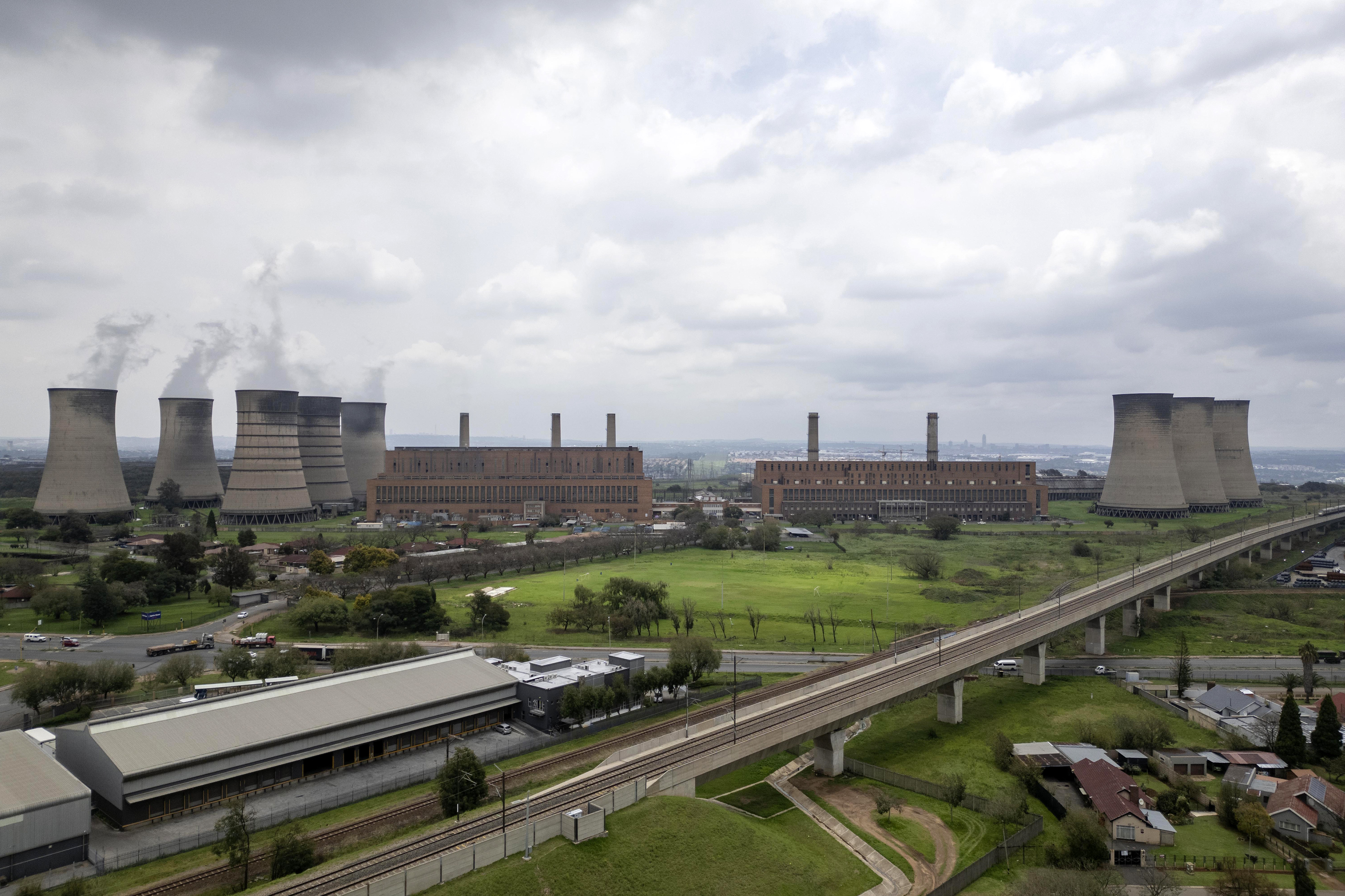
 Kelvin Power Station, which the City of Johannesburg is considering buying. (Photo: Ihsaan Haffejee / Our City News)
 The City of Johannesburg wants to buy the privately owned Kelvin Power Station and Egoli Gas to mitigate the city’s heavy reliance on Eskom, mainly because Eskom tariffs are much higher than those of Kelvin’s. The purchase is subject to a feasibility study that will guide the city on whether the investment is worthwhile.
This was contained in a report presented to the city council’s environment and infrastructure services committee this month.
At the same council meeting, City Power tabled its quarterly report, showing an entity in deep financial distress with an overdraft of R20-billion, a 42% loss of electricity bought from Eskom and a R2-billion revenue deficit.
The report noted that City Power had developed a sustainable energy strategy to diversify energy sources, stabilise supply and integrate cost-effective and sustainable solutions.
“Within this strategy, Kelvin Power Station and Egoli Gas are critical initiatives aimed at strengthening energy security, reducing dependence on Eskom, enhancing affordability, and positioning City Power to lead Johannesburg’s transition towards a resilient, diversified energy,” stated the report.
Kelvin Power Station is owned by Anergi, an Africa-based energy firm wholly owned by Harith InfraCo and the Pan-African Infrastructure Development Fund 2. Anergi manages day-to-day operations, and other stakeholders include Zungu Investments & Partners and Harith General Partners.
Sandile Zungu is the head of Zungu Investments, while Tshepo Mahloele is the CEO of Harith — a company developing billions of rands of infrastructure assets across Africa. These include the MainOne undersea cable company in Nigeria, the Henri Konan Bédié Bridge in Ivory Coast, the Lake Turkana Wind Power Station in Kenya, the Enfidha and Monastir airports in Tunisia, and the Dark Fibre Africa cable company, Lanseria International Airport and Kelvin Power Station in South Africa.
/file/attachments/orphans/ED_492967_435687.jpg "The Kelvin Power Station. (Photo: OJ Koloti / Gallo Image)")
Kelvin is one of the few privately owned coal-fired power stations in South Africa. It supplies around 10-14% of Joburg’s power needs. Commissioned in 1956, the City of Johannesburg sold it in 2001. In 2022, Kelvin generated R1.1-billion in revenue from Eskom.
The city council’s report notes that, “Eskom remains City Power’s primary electricity supplier, accounting for 7,376.1 GWh of electricity purchased during this period. This translates into a substantial expenditure of approximately R13.97-billion.
“In contrast, while Kelvin Power Station contributed a smaller absolute volume of 789.7 GWh, the financial outlay for this energy amounted to only R1.27-billion. This difference reflects not only the lower procurement volume from Kelvin but also its more favourable unit cost. Importantly, the average cost per unit from Kelvin is R1.61/kWh, compared to Eskom’s R1.89/kWh. This R0.28/kWh cost differential highlights Kelvin as a significantly more cost-effective option.”
Egoli Gas is owned by Reatile Group, a Level 1 Broad-Based Black Economic Empowerment contributor, with 100% black ownership and 30% black women ownership. Reatile Group is an investment holding company formed in 2003 to leverage the opportunities made possible by South Africa’s economic transformation. Simphiwe Mehlomakulu is the CEO.
/file/dailymaverick/wp-content/uploads/2025/03/ED_168451.jpeg "Egoli Gas is the exclusive licensed reticulator of natural gas through an underground pipeline network covering 132km within greater Johannesburg. (Photo: Fani Mahuntsi / Gallo Images)")
Egoli Gas serves more than 8,500 residential and commercial units across Johannesburg and owns and operates a 132km reticulated gas distribution network across Johannesburg.
“It [Egoli Gas] represents a strategically significant asset for the city. Its network supplies residential, commercial and industrial customers, forming the backbone of the city’s gas infrastructure. Integrating Egoli Gas into City Power’s portfolio offers multiple strategic benefits that extend beyond traditional electricity provision,” notes the report.
Acquiring Egoli Gas will allow City Power to diversify its energy mix and reduce reliance on electricity and Eskom.
The report states the Egoli Gas provides a critical platform for diversifying the city’s energy mix, reducing over-reliance on electricity and Eskom, and by offering gas as an alternative energy source, City Power can support businesses and households with cost-effective heating, cooking and industrial process energy, thereby improving energy affordability for consumers.
Moving forward, the council has given approval for City Power to undertake detailed financial, technical, legal and operational feasibility studies of the purchases, and to develop a comprehensive implementation roadmap and risk mitigation plan.
Anergi and Reatile could not be reached for comment. DM
/file/attachments/2985/WhatsAppImage2025-11-21at1946001_346702_1cea9e715c05dc0a538fc79753ac3401.jpeg)
- This story was produced by Our City News, a non-profit newsroom that serves the people of Johannesburg.