




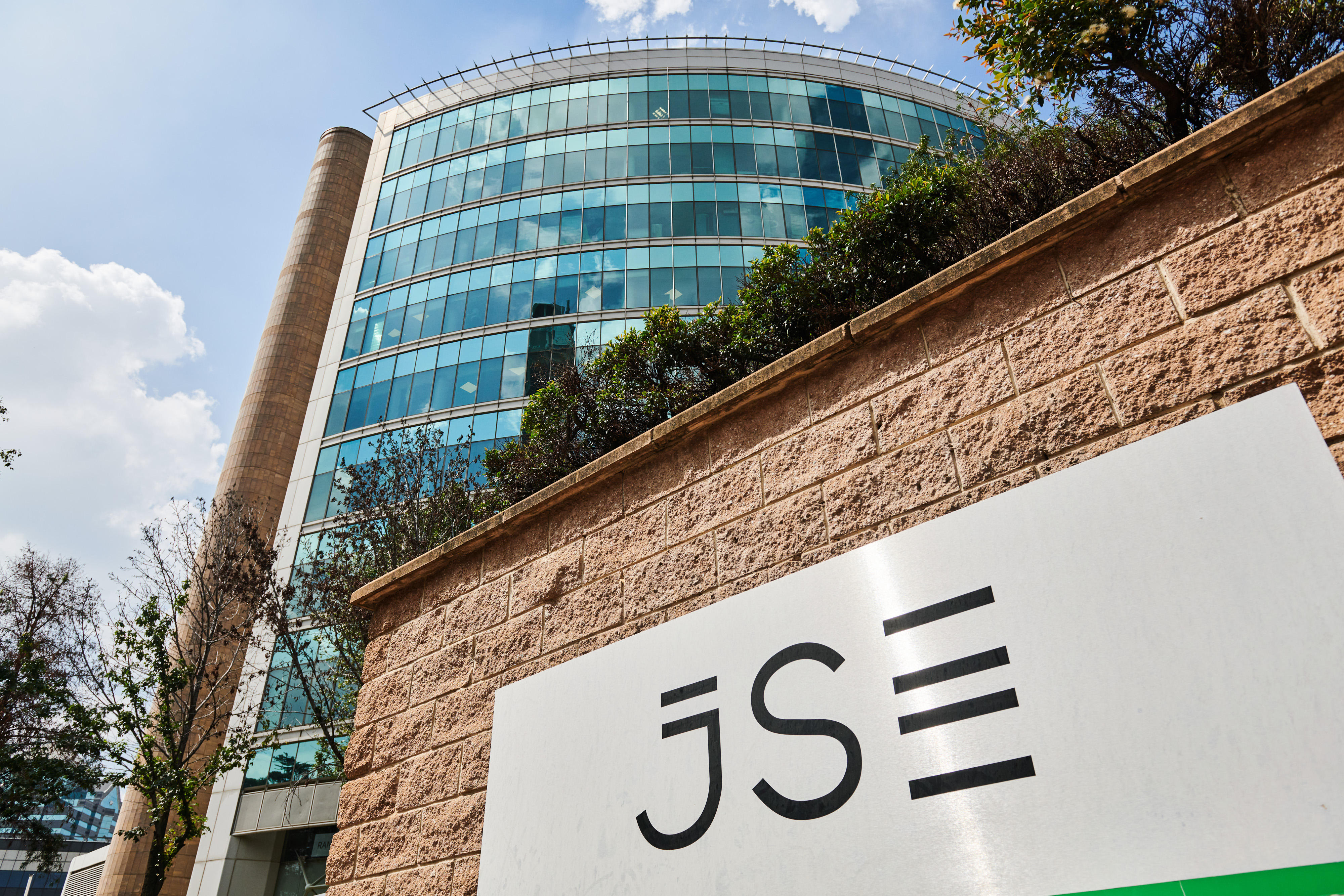
 The JSE in Johannesburg on 26 February 2025. (Photo: Waldo Swiegers / Bloomberg via Getty Images)
 Nedbank CEO Jason Quinn expressed the view that he is “cautiously optimistic about economic prospects for 2026, as well as improving banking sector profitability”.
This sentiment is backed by forecasts of improving GDP growth, which Quinn says will be “supported by structural reforms and strong collaboration, including public-private partnerships, particularly in the infrastructure space”.
Nedbank expects GDP growth of 1.4% this year, rising slightly to an average of 1.5% in 2026.
/file/attachments/2986/JasonQuinn_771536.jpg "Nedbank CEO Jason Quinn. (Photo: Supplied)")
Looking ahead, Quinn notes that banking profitability should be supported by non-interest income and strong capital levels.
“Competition remains intense against the large established banks as digital-first banks, mutual banks and retailer-backed financial services also expand aggressively,” Quinn says. This will pressure traditional banks to innovate faster, enhance digital experiences and rethink pricing models. He expects the banking sector’s focus to shift “from resilience to reinvention, with accelerated digitisation, cost optimisation and efficient customer-centric models becoming critical for competitiveness”.
Investec
Investec South Africa CEO Cumesh Moodliar noted that SA “ends 2025 on firmer ground than many expected”. He highlights that the economy has “delivered four consecutive quarters of growth for the first time in more than a decade”, buoyed by strengthened commodity prices, a steady rand and a 30% rise on the JSE.
Monetary policy is expected to become more accommodative, supporting a gradual recovery in spending and investment, according to Quinn. Nedbank expects two more rate cuts in 2026 as inflation moderates towards the new 3% target, currently standing at 3.6%. Similarly, Investec expects interest rates to be cut by roughly 50 basis points over the next year, offering welcome relief to households and businesses.
/file/attachments/2986/CumeshMoodliar1_810516.jpg "Investec South Africa CEO Cumesh Moodliar. (Photo: Supplied)")
Although lower borrowing costs and subdued inflation should ease consumer pressure, Quinn cautions that household budgets “remain tight” because of food and fuel price volatility and rising administered costs such as electricity and water.
Despite the improving sentiment, serious structural challenges remain. Moodliar warns that positive tailwinds should not distract from the fact that “gross fixed capital formation remains subdued, private-sector investment and credit extension are still muted, and domestic consumption has yet to regain sustained momentum”.
In the year ahead, Moodliar anticipates intensified competition, not only from neo-banks but also from mobile networks, large retailers and other non-traditional players entering financial services.
“In this environment, data will be the key differentiator – the ability to use it responsibly to deliver more relevant, value-adding services will define advantage.”
Telkom
Telkom Group CEO Serame Taukobong outlines a future defined not by drawing level but by actively leading.
“For the first time in modern history, Africa is standing at the starting point of technological evolution at the same moment as the rest of the world,” Taukobong says.
“In the age of intelligent systems, Africa is not behind. We are alongside.”
The company he leads is making its own vision a reality, with the infrastructure to support it already being built. The technology gap is closing not just in theory but through fibre expansion – now connecting more than 1.4 million homes – and next-generation mobile network investment.
/file/attachments/2986/SerameTaukobong_115407.jpeg "Telkom group chief executive Serame Taukobong. (Photo: Supplied)")
For Taukobong, the outlook for 2026 depends on shifting the continent’s role from passive consumption to active production. “The future is not being built in Silicon Valley. It is being built wherever people refuse to be left behind,” he says.
“We must ensure Africans are not consumers of the future but co-creators of it.”
A critical pillar of this co-creation is, of course, artificial intelligence (AI). Taukobong warns that for Africa to truly compete, its cultural identity must be baked into the code of tomorrow.
“No civilisation can thrive if its languages are silent in the systems of the future,” he said during his Satnac keynote, holding up a white paper that was submitted at the conference a decade ago about African-language large language models, and was never acted on.
Samsung
Samsung Mobile vice-president Justin Hume says 2025 has been a strong year for the brand. “If we think about the various segments of the market, we’ve seen incredible growth. The S25, that series shifted what a smartphone meant, and this idea of what an AI phone means. Arguably around about 73% of the premium market is now being sold as an AI device,” he says.
With AI being the latest buzzword in tech, Hume points out that having AI that can edit photos is not really operating at the true capability of what AI can offer. “You have to ask, is it just an app that you’re running but back in the cloud? We [Samsung] allow both the on-device AI processing as well as cloud-based processing for security and privacy reasons.
“The market has grown with some great resilience in that market, despite some of the headwinds in the SA environment here,” he says.
The entry-market cellphone segment (priced from R1,700 to about R3,000) has grown “phenomenally” during 2025, he says, whereas the mid-tier has been a little more muted because of a strained socioeconomic environment. “Nonetheless, in the past two quarters, all metrics have turned positive. The forecast going into next year is moderate growth, single-digit growth across the industry.
/file/attachments/2986/JustinHumeSamsungSAVP_317947.jpg "Samsung Mobile vice-president Justin Hume. (Photo: Supplied)")
“But what is shifting the industry rapidly at the moment is this, we call it equipment instalment programs, such as Pep’s FoneYam product, PayJoy, PayJustNow. Store finance across the base is now really becoming the go-to and it’s driving smartphone adoption at an unprecedented rate.
“So, with that being said, Samsung has grown its market share through this period and we will continue to grow our market share in the space,” Hume says.
In terms of AI and tech devices, he says there have also been “leaps and bounds” when it comes to language translations.
“Historically, languages had to be programmed in one by one by one, and the dictionary had to be updated, which took an incredibly long period of time. Now, predominantly, Google does that, and because of AI, the learning rate is so much faster. I think you are going to see some big shifts coming in that space, good shifts very soon,” he says.
He gives an example of where a woman about to sign a financial services contract can feed it into AI and have it translated into her native language.
“This is going to really democratise information and simplify complex issues for so many. I, myself, had to recently sign a contract and I was able to ask the AI to simplify it for me, pull out the key tenets and tell me what my risks are. I could then make an informed decision about whether I wanted to sign it or not,” he says.
In the business space, something like going through financial reports takes time. “But with Browser Assist, you can highlight the text and immediately get a summary. It turns what would be a 10-minute read and distils it into a 30-second read,” Hume says. Although this doesn’t necessarily replace the report, it gives the user insight into what the key points are and if reading further is necessary.
Looking ahead to 2026, Hume says AI adoption is fast becoming a critical buying decision factor. “We’ve done some benchmark studies globally and locally. A year ago, when we launched the S24, AI was the seventh most important factor for consumers when choosing devices. Today, it’s the second most important factor. Camera capabilities are still first choice.”
Standard Bank Insurance and Asset Management
Standard Bank’s CEO of insurance and asset management, Yuresh Maharaj, sat down with Daily Maverick to unpack the year that was, and to set the scene for the year ahead.
“First off, you have to stand back and recognise what’s happened in the last three months in South Africa. You have the JSE that broke the 100,000 mark and is now sustainably over 100,000 points, South Africa is off the greylist in record-breaking time, the inflation target has been dropped from the 3% to 6% band to 3% with a tolerance of 1% on either side, and then we shone in the global spotlight hosting the G20 and the B20,” he summed up.
/file/attachments/2986/Yureshheadshot67jpg_902907.jpeg "Yuresh Maharaj, CEO of Standard Bank’s insurance and asset management division. (Photo: Supplied)")
Maharaj said he is “most optimistic” on the back of all the above developments. “We just need to hold this momentum for another two quarters and I think corporate balance sheets will unlock the capital they have been holding. Once we start deploying that, we are going to see economic and infrastructure growth. I think we are at a tipping point right now, and in the right direction,” he concluded. DM
This story first appeared in our weekly DM168 newspaper, available countrywide for R35.
/file/attachments/2986/DM-19122025-001_613320_d2f06eb566b3d566ff7615022a5c63b9.jpg)