



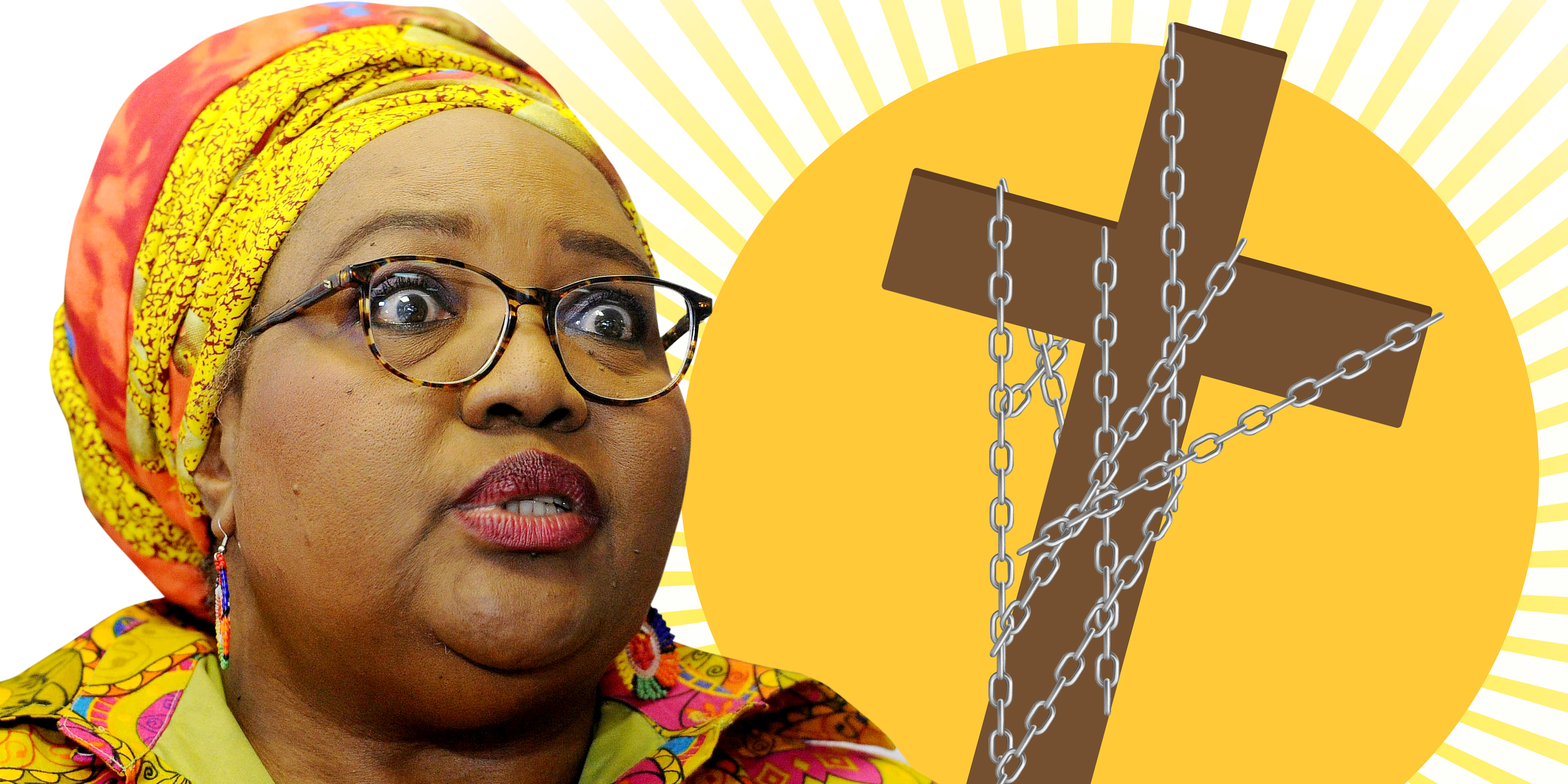
 CRL Rights Commission Chairperson, Thoko Mkhwanazi-Xaluva . (Photo by Gallo Images / Sowetan / Veli Nhlapo)
Cross: Vecteezy
CRL Rights Commission Chairperson, Thoko Mkhwanazi-Xaluva . (Photo by Gallo Images / Sowetan / Veli Nhlapo)
Cross: Vecteezy Proposed government regulation of churches “will decimate freedom of religion in South Africa”. So says the the South African Church Defenders (SACD), a Christian advocacy movement that promotes spiritual and constitutional freedoms, in an affidavit presented at the High Court in Johannesburg.
The litigation comes as the Cultural, Religious and Linguistic (CRL) Rights Commission pushed ahead with creating a committee whose work it will be to find mechanisms for improved regulation of churches in South Africa.
But the SACD has asked that the court set aside the decision to appoint this committee on a number of grounds, including that the CRL Rights Commission is not authorised to continue with this line of work because its proposals had already been found to be unconstitutional by a parliamentary portfolio committee.
/file/attachments/2985/Crowd_418663_e846ac69ac2c6f5f19c7759e28668d2a.jpg)
The SACD also says the commission has a clearly demonstrated bias against charismatic churches, its attempt to regulate churches is an act of overreaching, and it has an exclusive focus on Christian churches.
The commission has always insisted that it respects and upholds freedom of religion. However, in a 2017 report on how some churches in South Africa exploit the beliefs of their followers, it proposed measures to make sure these harmful practices are brought to an end.
Daily Maverick asked the CRL Rights Commission for comment on the SACD’s litigation, but did not receive a response by the time of publication.
Hundreds of churches have said they will resist government control over their activities. Court papers also question whether the chairperson of the commission, Thoko Mkhwanazi-Xaluva, is a fit and proper person to lead it, based on an unresolved allegation that she had overstated the support for her proposed regulations to Parliament.
Mkhwanazi-Xaluva has always denied the allegation, saying she had consulted with church office bearers at a very senior level.
There are also allegations of a conflict of interest against her because she serves as the deputy chairperson of the Cheryl Zondi Foundation, which was set up to help those who have been sexually violated in churches and religious spaces.
Zondi was one of Nigerian pastor Timothy Omotoso’s rape accusers and a star witness in his trial. He was charged with having sexually molested several of his female congregants, but found not guilty. Omotoso has since left South Africa and was declared an undesirable person.
In papers before court, SACD lawyers argue that the Omotoso case is frequently used as an example to motivate for control over churches, creating an unavoidable perception of bias. They also say the CRL Rights Commission caused the mushrooming of charismatic churches in the country to be reported as a threat in South Africa’s latest National Security Strategy.
Church arguments
/file/attachments/2985/Pastor-Mukhuba_977938_4c7fd5c8201d496079a7d4a1d6f83d82.jpg)
Mpfariseni Mukhuba, a pastor at the Unity Fellowship Church in Soweto, who deposed the founding affidavit in the matter on behalf of the SACD, states that charismatic churches are believed to be a particular target of the commission.
She says the proposed regulation of churches will include control over church doctrine, governance, the practices of religious communities and their leaders, as well as the qualification of leaders, and calls all of this unconstitutional.
Referring specifially to charismatic churches, she writes: “It is not acceptable that those who are charged with protecting religious beliefs can show such hostility to a particular expression of faith, especially one which has so many adherents.”
She describes these churches in South Africa as a “significant force for good”.
“Most, if not all, charismatic churches are involved in feeding the hungry, caring for the poor and orphans, educating and caring for children, rehabilitating criminals and gangsters, caring for the homeless, and providing shelters and protection for women from gender-based violence. Charismatic churches had to fill the hole left by the failure of the state.”
Mukhuba adds that the Constitutional Court has previously ruled that even “bizarre” beliefs are protected by the constitutional right to freedom of religion.
Meanwhile, the Muslim Lawyers’ Association also filed a separate lawsuit against the CRL Rights Commission, claiming that Islam, Hinduism and Buddhism have been completely shut out from the process.
Rebuttal of commission’s proposals
/file/attachments/2985/a18658a5abb21ee6e2fa4dcc396d4fe131a9e561w700_362967_cf06ab0c598808345e5ac321442d0e22.jpeg)
The commission suggested the establishment of a state-supported regulatory framework for religion in 2017.
This would include the establishment of “umbrella” regulatory bodies for each religion, which all religious practitioners and places of worship would be required to join, as well as a peer review council or committee within each umbrella body to handle internal disputes and ensure compliance with a set code of conduct.
The commission would act as the final arbiter or appeals body for disputes that could not be resolved internally.
In her affidavit, Mukhuba says these suggestions have been met with “overwhelming resistance” by the majority of religious bodies and faiths in South Africa. Further engagements with the CRL Rights Commission also made it clear to them that it is specifically targeting Christian churches.
She says the suggested regulation is viewed as unconstitutional, overly broad and failing to promote and protect freedom of religion.
Also unconstitutional, she points out, is that the proposal “offends” the right to freedom of association by intending to force religious practitioners to belong to a regulatory body against their will.
Mukhuba adds that South Africa does not need a new law – it needs the commission to perform its function to educate communities and law enforcement agencies to apply existing criminal legislation effectively.
Freedom of religion charter
/file/dailymaverick/wp-content/uploads/sachs-tambolect1.jpg "Retired constitutional court judge Albie Sachs (Photo: supplied)")
Retired Constitutional Court Justice Albie Sachs proposed a charter in 1990 that sets out the legal and civil consequences, rights and obligations included in the right to freedom of religion. This charter was drawn up in 2008 and formally endorsed and signed in 2010.
Mukhuba says the CRL Rights Commission never refers to this charter anywhere in its correspondence with churches in South Africa. She says it was also never submitted to Parliament for fear that it would be “watered down”.
The court papers quote the Archbishop of Johannesburg, Stephen Brislin, who said: “The recommendation that new laws be introduced to enforce registration of pastors and ministers is overkill and a response that one would expect more from a totalitarian state than a constitutional democracy.”
Portfolio committee
The CRL Rights Commission’s report on church abuses in South Africa and its recommendations for regulation were rejected by the Portfolio Committee on Cooperative Governance and Traditional Affairs (Cogta) in 2017 and 2018.
It suggested instead that a National Consultative Council should be convened to support religious leaders in dealing with troublesome issues. The committee added that religious leaders should be empowered to deal with issues themselves and regulate their own affairs.
In response to this recommendation, the commission claimed that it did not have the money to convene such a council.
/file/dailymaverick/wp-content/uploads/2024/10/0000204796.jpg "The late Pastor Ray McCauley and then Minister of Sport and Recreation, Fikile Mbalula at the funeral service of Jacob “Baby Jake” on December 13, 2013 in Johannesburg. (Photo: Gallo Images / City Press / Sifiso Nkosi)")
A Religious Leaders Summit took place in February 2019 at the late Pastor Ray McCauley’s Rhema Church in Randburg. There were concerns over inclusivity and the agenda. Those attending again expressed their strong opposition to efforts to control the church. Mkhwanazi-Xaluva rejected the outcome of this summit.
She has now created a committee to pursue the matter further – but, according to court papers, with regulations similar to those already rejected by the portfolio committee. Court papers also question whether Mkhwanazi-Xaluva, who was re-elected as CRL Rights Commission chairperson last year, can continue to serve in this position given that her relationship with the religious sector is severely damaged.
/file/attachments/2985/Screenshot2025-12-01at202645_161563.png)
The case for control
In a statement from the commission, the step to constitute a new committee is described as “a significant milestone for the Christian faith community”.
“The handover that happened on this day symbolised a collective commitment to fostering integrity, respect and accountability within religious communities, thereby paving the way for a more ethical and responsible future.
“Pursuant to its mandate, the commission established this committee in an effort to contribute to finding solutions that will significantly safeguard the spiritual and emotional wellbeing of congregants.
“Additionally, the committee’s establishment is also intended to reaffirm principles that promote and advance the respect for human dignity of all people, and to bring an end to instances of abuse that have been reported to the commission and in the media,” the statement continues.
“The road travelled to this point has not been without challenges, notably from disinformation campaigns falsely claiming that the commission advocates state regulation of religion.
“On the contrary, the issue of concern has been and continues to be about the conduct or behaviour of certain religious leaders, who place their church members in harm’s way. The commission firmly asserts that freedom of religion is sacrosanct and an inviolable constitutional right that must never be compromised by any individual.
“The findings of this investigation were subsequently presented to the Portfolio Committee on Cooperative Governance and Traditional Affairs, which held discussions with a diverse array of religious leaders, resulting in a set of significant recommendations in 2018.
“In response to these recommendations from the portfolio committee regarding self-regulation in the Christian sector, the commission invoked section 22 of the CRL Rights Commission Act to establish a Section 22 Committee, which has thus far been constituted and comprises Christian religious leaders from various umbrella organisations, including, inter alia, mainline, independent, charismatic and pentecostal churches.”
The Section 22 Committee’s mandate is to “facilitate broad consultations and conduct dialogues within 12 months that would result in mechanisms and strategies to identify and address challenges in the sector, and halt the harmful practices of some religious leaders within their congregations, thereby ensuring an effective implementation of the Cogta Portfolio Committee’s recommendations regarding self-regulation of the Christian sector”.
SACD’s response
/file/attachments/2985/NewSidebar_560935.jpg)
The SACD is asking the court to set aside the decision to create this committee. Mukhuba says in papers before court that it is being constituted in a “secretive and selective” way – not because of misdirection but “intentionally and unlawfully”.
She adds that the committee is being constituted without parliamentary authorisation and argues that its creation has had a negative impact on church unity.
The SACD also wants the CRL Rights Commission’s 2017 report, The Commercialisation of Religion and Abuse of People’s Belief Systems, to be discarded as it had been rejected by Parliament.
In the report, examples of harmful practices include pastors forcing congregants to eat grass and consume snakes and petrol. It also mentions the “prophet” who sprayed insecticide in his congregants’ faces.
Mukhuba says there is agreement from the religious community that any illegal actions are abhorrent, as well as support for those who break the law to be held accountable. But, she adds, such practices are not perpetrated by many, and she wishes to underscore that they are adequately covered by both criminal and civil laws.
Mukhuba further says that, in accordance with the 2018 recommendations by the portfolio committee, a code of conduct was drawn up.
In May, a meeting was held with the CRL Rights Commission to address the exclusion of other major
religions in South Africa from this process – but this is described in court papers as “smoke and mirrors”.
Mukhuba says a significant number of Christian churches in South Africa have been excluded from the Section 22 Committee. She adds that the very terms of reference for the committee demonstrate that the commission is acting contrary to its mandate, defying Parliament and the will of the religious sector. Some churches that are affiliated to religious bodies serving on the committee have resigned as they refuse to be part of this process.
No date has been set for the court hearing yet. The SACD has also asked that a personal cost order, on a punitive scale, be brought against Mkhwanazi-Xaluva if it wins the case.DM
This story first appeared in our weekly DM168 newspaper, available countrywide for R35.