





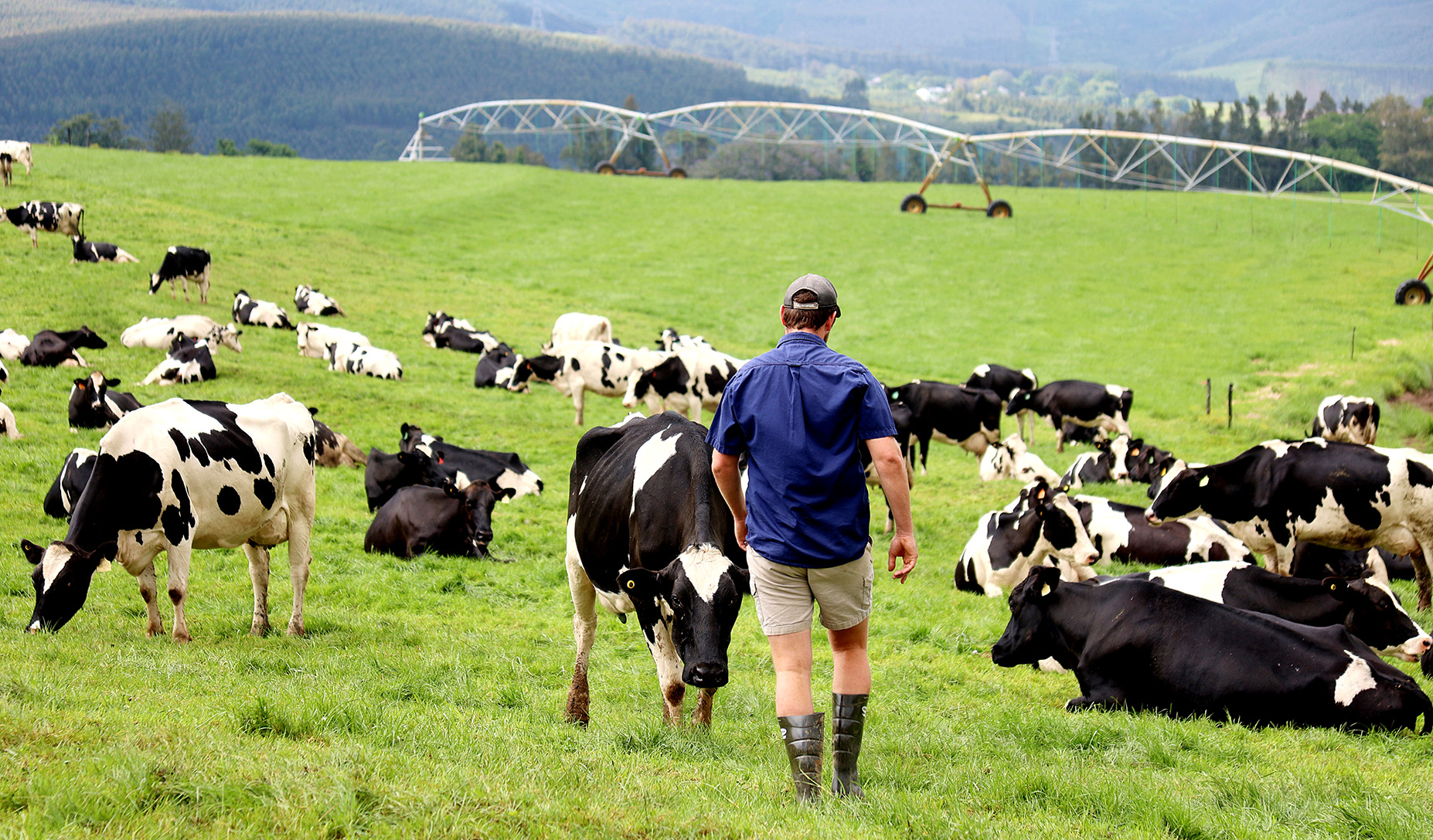
 With the ever-present threat of FMD, a farmer checks up on his cattle. (Photo: Leano Larona)
 The FMD crisis has exposed longstanding weaknesses in South Africa’s animal health system. The Milk Producers’ Organisation says that to prevent future outbreaks, the dairy sector urgently needed a reliable, diversified vaccine supply chain, rather than relying on a single manufacturer.
/file/attachments/orphans/FMD29_997131.jpg "Disinfactant stations placed along the highways around Ixopo and at the entrances of farms are one of the measures being taken to stop the spread of foot-and-mouth disease. (Photo: Leano Larona)")
/file/attachments/orphans/FMD28_521809.jpg "One of the disinfactant stations placed along the highways around Ixopo in KwaZulu-Natal. (Photo: Leano Larona)")
Call for decisive action
Daily Maverick spoke to Luke Gibbs, the chairperson of the Milk Producers’ Organisation and a dairy farmer himself. Gibbs said they were calling for decisive action, regulatory clarity, and a transparent national plan to stabilise FMD management and safeguard the dairy industry, food security and rural livelihoods.
This comes as farmers and veterinarians in the Ixopo, Creighton and Howick areas shared their frustration at not being able to access vaccines while outbreaks were getting closer and closer to their establishments.
In a written enquiry, Daily Maverick asked the Department of Agriculture and Rural Development if there was a possibility of getting vaccines for the dairy industry in KwaZulu-Natal before the planned rollout in February next year. The department said it had allocated FMD vaccines to KZN and would continue to distribute to all provinces according to need, as identified by the provinces.
/file/attachments/orphans/FMD25_692283.jpg "Farmers use cloths and bandages to treat lesions and warts that grow on infected cattles’ hooves. (Photo: Leano Larona)")
/file/attachments/orphans/FMD19_766307.jpg "A farmer dips his boots in a disinfectant solution before entering his dairy hub. (Photo: Leano Larona)")
/file/attachments/orphans/FMD23_520985.jpg "A farmer in his dairy hub. (Photo: Leano Larona)")
“The best start should be for the Umzimkhulu and PMB farmers to start at their provincial vet services. The Red Meat Industry Services, after the announcement of the Ministerial Task Team on Animal Disease Prevention, negotiated an agreement with the government in which the industry could, through Red Meat Industry Services, purchase vaccines for its own use in the case of a positive outbreak. This was done to ensure vaccine availability for high-concentration facilities such as feedlots,” the department stated.
“On 17 September this year, a meeting was held at the Red Meat Industry Services offices where the red meat and dairy industries were informed that they could order and purchase vaccines. We understand that the dairy industry later declined this offer due to an alleged lack of funds.”
The department states that when FMD began to spread via dairy farms, the Milk Producers Organisation negotiated through Red Meat Industry Services to purchase some vaccines owned by feedlots to assist dairy farmers. During October, a further 50,000 doses were made available at the Botswana Vaccine Institute, and the Milk Producers’ Organisation was then first informed to purchase the vaccine for the dairy industry, which it did.
This was confirmed by the Milk Producers’ Organisation, but it did note that 50,000 doses could not achieve immunity for a province with more than 220,000 dairy cows.
“Apart from the vaccine arrangements, the Milk Producers’ Organisation had also met with the Ministerial Task Team separately, and the government fully understood the impact on the industry. The Milk Producers’ Organisation also tabled a “Vaccinate to live” protocol for the dairy industry to allow the preventive vaccination of dairy herds, and this protocol is currently in the process of being considered and finalised.
“Minister of Agriculture John Steenhuisen in his announcement of the new countrywide vaccination plan also placed emphasis on the fact that the dairy and feedlot industries are considered high-risk industries, and will therefore be prioritised under the new strategy,” the department stated.
The new strategy includes a mass vaccination programme announced in late November by the Ministry of Agriculture. Farmers and vets raised concerns about how effective the vaccination plan will be because South Africa has a national herd of about 14 million cattle, but will only receive two million imported doses by February 2026.
The department was asked how many vaccines would be acquired for next year and how the rollout would be conducted, i.e. would it be based on the most recent outbreak areas at the time? It said it relied on two things: what was needed by the provinces, and the availability of funds.
“As soon as the Milk Producers’ Organisation and Ixopo farmers sent their needs to KZN Veterinary Services and engage Red Meat Industry Services to work out how they will avail funds, we will be able to place an order.”
The department claimed had it prioritised dairy cattle when deciding where to vaccinate first.
“It is true that dairy cattle are the worst affected by FMD. We always prioritise dairy farms when deciding on where to start with a vaccination process,” it said.
New structures
Gibbs said that beyond his position at the helm of the Milk Producers’ Organisation, the impact of dealing with FMD as a threat was burdensome.
“As a farmer, the impact has been deeply felt. The uncertainty around vaccine availability and the rapid spread of FMD in KwaZulu-Natal have placed enormous pressure on day-to-day operations. Strict biosecurity protocols were immediately implemented, yet outside factors, such as movement control challenges and human error, constantly threaten to break these measures. The inability to vaccinate proactively means that we are managing risk continuously, rather than protecting our animals in a planned and responsible manner,” he said.
“Beyond the immediate threat to livestock health, the outbreak disrupts staff morale, production stability, and long-term planning. Many farmers have had to make difficult operational decisions with incomplete or inconsistent information — a situation that is simply not sustainable.”
The Milk Producers’ Organisation’s key requests include:
- Immediate approval and fast-tracking of the Dollvet FMD vaccine import permit.
- A full national inventory of all foot-and-mouth disease vaccine stocks.
- Emergency replenishment and stabilisation of vaccine supplies for the dairy sector.
- Submission of South Africa’s FMD field strains to the Pirbright Institute.
- Clear national guidance on regulatory requirements under South Africa’s “FMD-free with vaccination” status.
- Strengthened, transparent decision-making and communication from all animal-health authorities.
- Active and timely engagement from national leadership.
Way forward
Will the state look at the possibility of a private-public partnership in terms of veterinary services to help with capacity during the outbreak and vaccine rollout?
The Department of Agriculture and Rural Development told Daily Maverick there was already a collaboration between the government and the livestock industry under the auspices of the Agriculture Agro-processing Master plan called the Value Chain Round Table.
The Value Chain Round Table is co-chaired by Dewald Olivier from Red Meat Industry Services and Dr Madime Mokoena from the Department of Agriculture.
/file/attachments/orphans/FMD24_607250.jpg "Farmer Dave Moberly describes how he struggled to keep his cattle alive and stop the spread of FMD. (Photo: Leano Larona)")
/file/attachments/orphans/FMD2_222852.jpg "Dairy farmer Dale Hutton and vet Dr Savannah Stutchbury express frustration over the implications of FMD, and plead with the government to help them combat the spread of the disease. (Photo: Leano Larona)")
“This is where collaboration decisions are made. Animal disease control is a concurrent function of the national and provincial departments of agriculture. Farmers are reminded that they should engage their provincial Department of Agriculture, which will submit their needs to the Department of Agriculture at the national level. Rushing to engage the national department and bypassing the provincial department only delays processes,” the Department of Agriculture and Rural Development said.
Gibbs acknowledged efforts to collaborate and said the sector was resilient and still committed to producing safe milk, but noted how hard it was for many farmers to stay safe.
“What gives me hope is the remarkable resilience of our farmers and the dedication of veterinary teams working on the ground. Despite limited resources, they continue to do everything possible to protect the national herd,” Gibbs said.
“Financially, the burden is significant. The cost of vaccination, when available, and managing FMD outbreaks falls almost entirely on farmers. Under current market conditions, these expenses are often unmanageable. Disease management at this scale cannot rest on individual producers alone; it requires a functioning national system, reliable vaccine supply, and shared responsibility,” said Gibbs.
Alternative solutions?
On Wednesday, 10 December 2025, the Deputy Secretary of Agricultural Defense at Brazil’s Ministry of Agriculture and Livestock, Allan Alvarenga, delivered a technical briefing on how Brazil successfully eradicated foot-and-mouth disease (FMD) at a seminar held in Pretoria.
He was joined by senior South African veterinary experts, industry representatives and importers for a discussion on science-based systems that prevent unnecessary market disruptions and strengthen national food security.
Daily Maverick interviewed the president of the Brazilian Association of Animal Protein, Ricardo Santin, on 11 December 2025 on the outcomes of the seminar.
“The seminar was about two main issues – regionalisation on avian influenza, and African fever and foot-and-mouth disease... Brazil is already free of foot and mouth disease without vaccination,” said Santin.
He said some of the key strategies were to look at the character of each zone or block the country had been divided into and coordinate control efforts such as movement control, surveillance and vaccination. The efforts were based on virus circulation and shared risks instead of treating the country as a single unit. This also minimised trade disruptions as the unaffected blocks could still trade.
“We start the strategy with the state level, and after that we go forward for the block, and then we put some states together that have the same conditions, the same situation, and we start to become free without vaccination,” Santin said.
He said this helped with markets such as Japan, to which Brazil exported pork, which required the export country to be free of FMD without vaccination.
“The health strategy is a global strategy that we already have in Brazil, not only for foot-and-mouth disease but also anti-microbial resistance... when you take care more and you have more welfare for your flocks, you can reach these results,” Santin said. DM