




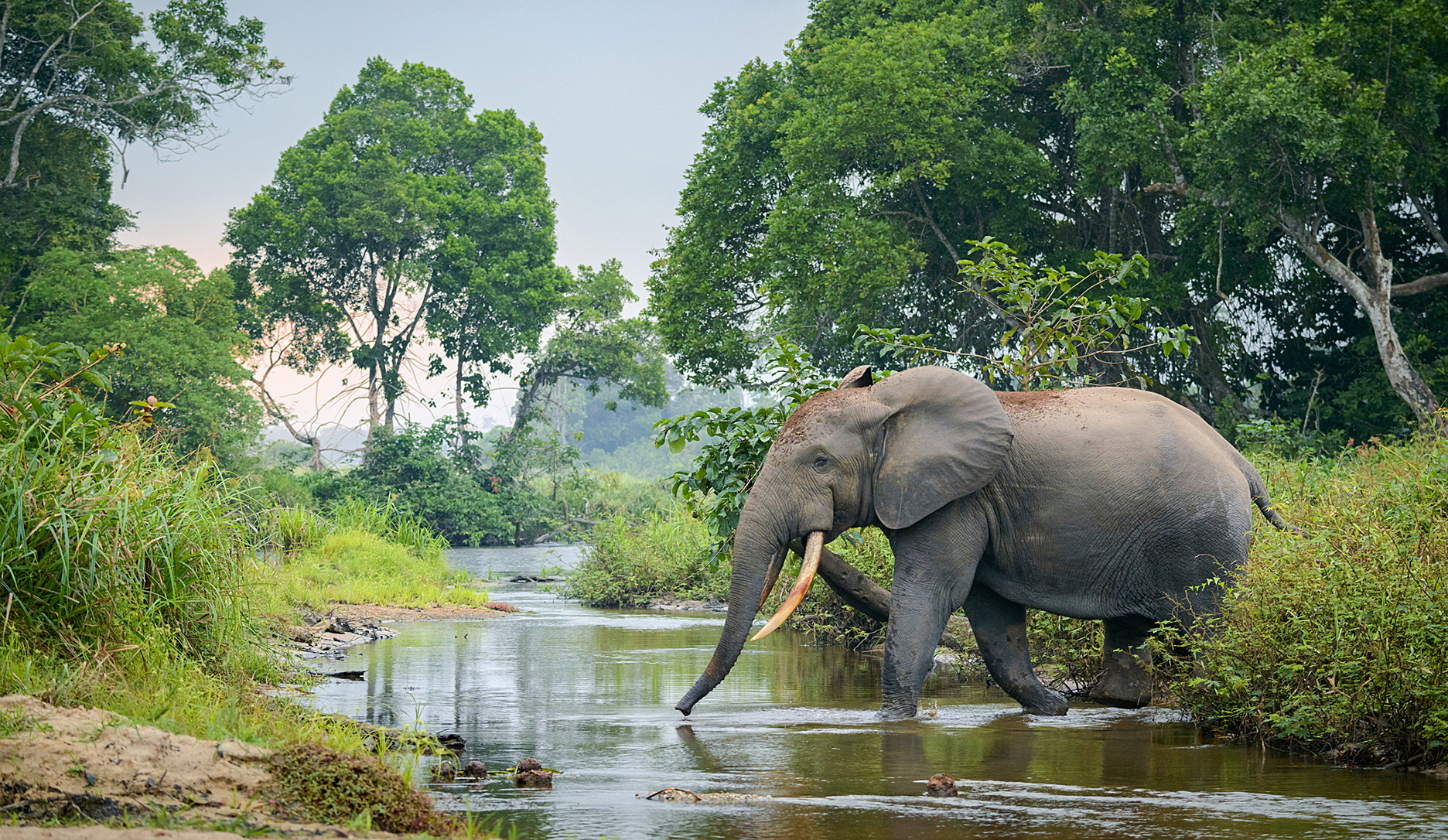
 A forest elephant (Loxodonta cyclotis) drinks from the Lekoli River in the Odzala-Kokoua National Park, Republic of Congo. (Photo: iStock)
 /file/dailymaverick/wp-content/uploads/2025/10/label-analysis-2.jpg)
A new 2024 status report dedicated to the African forest elephant collates the most comprehensive dataset yet for the species across its range. Its topline estimate – about 145,050 elephants when combining systematic estimates with additional “guesses” for poorly surveyed areas – is higher than the total presented in 2016. But the report’s core warning is stark: this apparent increase is largely the result of improved surveying and better coverage, not evidence of a sustained population rebound.
Forest elephants remain listed as critically endangered, and the drivers of their long-term collapse – poaching, habitat loss and conflict with people – continue to shape their future.
Why the headline number looks better
Counting forest elephants is exceptionally difficult. They live in dense rainforest, often in remote or insecure landscapes, at naturally low densities spread across vast areas. Unlike savanna elephants, they are rarely visible from the air. Many surveys rely on indirect methods such as dung counts, which must be translated into elephant density using assumptions about dung decay and defecation rates. Newer techniques – including DNA capture-recapture – can improve accuracy, but they are expensive and logistically demanding.
The 2024 report reflects a major expansion of data inputs since the previous continental assessment. It includes 153 “input zone” assessments, compared with 76 in 2016, and a far greater share of the population is now covered by systematic, high-reliability surveys. In plain terms: there are more surveys, in more places, using stronger methods.
That improved coverage is one reason the total has shifted upward. The report also points to a major factor: new or updated work in Gabon, where a nationwide survey using genetic methods sharpened earlier understandings of population size and distribution. The takeaway, though, is not “the species is bouncing back”, but “we are closer to knowing what is left”.
The species is still concentrated in a few places
The report makes it clear that forest elephants are overwhelmingly a central African species in 2024. About 96% of estimated forest elephants occur in this region, which also contains the majority of known and possible forest-elephant range.
Two countries dominate the picture: Gabon and the Republic of Congo. The report indicates roughly two-thirds of estimated forest elephants are in Gabon, and about one-fifth are in Congo. This concentration matters: it means the global future of the species is tied to a comparatively small number of political and enforcement environments. If protections weaken in these places – or if industrial expansion accelerates – the global consequences would be immediate. Forest elephants are not just “another elephant”. They differ from savanna elephants in anatomy, biology, ecology and life history, and they recover slowly even when pressures ease. They reproduce at a slower rate than many large mammals, have long generation times, and depend on large connected forests to maintain viable populations. When they are removed from a landscape, restoration is not quick.
/file/attachments/orphans/Forestelephants_3_430253.jpg "Regional estimates of forest elephants. (Source: @IUCN Status Report)")
That is why an improved estimate cannot be treated as reassurance. The species’ critically endangered status is the product of decades of decline, and the report does not argue that those conditions have been reversed. It argues that the database is improving – an essential step, but not a substitute for protection.
Poaching pressure has shifted — not disappeared
The report flags poaching for ivory as a principal threat across forest-elephant range. Central Africa’s forests were hit especially hard in the modern ivory trade, with organised networks exploiting weak governance, limited enforcement capacity and porous borders.
The report notes that indicators suggest illegal killing decreased after roughly 2018-2019, but it is careful about interpretation. Monitoring is uneven, and reduced poaching in some areas does not mean the threat has ended. Illicit markets can revive quickly when enforcement falters, when conflict expands or when trafficking routes shift.
A species that is highly valuable on illegal markets does not become safe just because pressure dips for a few years.
Human-elephant conflict is rising in many landscapes
The report also emphasises human-elephant conflict as a growing challenge. This is not merely a “community issue” at the edges of conservation areas; it is an existential problem for forest-elephant survival in landscapes where farms, roads and settlements are expanding into formerly continuous forest.
When elephants enter cropland, communities absorb the loss directly – through food insecurity and reduced income. Retaliatory killing becomes more likely, and political tolerance for conservation erodes. Conflict, in other words, is not a side-effect. It is one of the routes by which habitat loss converts into elephant mortality.
/file/attachments/orphans/Forestelephants_1_375007.jpg "Continental map of forest elephants. (Source: @IUCN Status Report)")
Reducing conflict requires resources: early warning systems, barriers and deterrents, compensation mechanisms that work in practice, and land-use planning that avoids pushing people and elephants into repeated confrontation.
Habitat destruction and fragmentation remain a structural threat
Habitat change is the pressure that quietly locks in long-term decline. Roads open forests to settlement and facilitate trafficking. Logging and mining fragment intact habitat into smaller blocks. Plantations and agriculture remove forest outright. Even when elephants persist in modified landscapes, their movements are constrained, genetic exchange declines and conflict with humans rises.
The report highlights west Africa as a region where forest-elephant populations are small and fragmented and where overall estimates appear lower than those reported in 2016. It links this pattern to intense habitat loss and fragmentation, and to the difficulty of obtaining robust counts in certain areas. The broader point is unavoidable: where forests are carved into isolated remnants, elephants become easier to kill and harder to conserve.
Significant parts of the range are still not properly assessed
One of the report’s more sobering statistics is about what remains unknown. Forest elephants occupy a known plus possible range of roughly 907,830km², yet the report can only provide estimates or informed “guesses” for about 74% of that area. Roughly 26% remains unassessed, meaning there are places within the potential range where we cannot currently say, with confidence, how many elephants remain.
/file/attachments/orphans/Forestelephant_4_684342.jpg "A forest elephant in Gabon. (Photo: @IUCN Status Report)")
This matters because uncertainty can be misused. When numbers are hard to pin down, it becomes easier for decision-makers to delay action – or, conversely, to seize on a higher estimate as permission to relax. The report’s framing argues for the opposite in that data improvements should sharpen urgency, rather than blunt it.
What the report implies for policy and enforcement
If the 2024 assessment has a policy lesson, it is that the forest elephant’s future will be decided by a handful of practical choices: Defend core strongholds with sustained financing for ranger capacity, intelligence-led enforcement and judicial follow-through; protect connectivity, so that populations are not trapped in ecological islands that slowly fail; plan land use around elephant movement, rather than treating conflict as an afterthought once farms and roads are already in place; and invest in monitoring, because good decisions require credible baselines – and credible baselines are still absent for large parts of the species’ range.
/file/dailymaverick/wp-content/uploads/2023/04/Onke-unsungHero6.jpg "An elephant in Nigeria’s Omo Forest Reserve. (Photo: Supplied)")
The serious misinterpretation of ‘more elephants than we thought’
It is tempting to look for good news wherever it appears, but the responsible reading of this report is not optimistic; it is urgent.
The headline figure is higher because we have improved our view of the forest. In places like Gabon, better methods have refined earlier suppositions. That is valuable. It means conservation is not working blind.
But an improved estimate does not reverse the realities of poaching risk, habitat conversion and accelerating conflict. Forest elephants remain critically endangered because the pressures that brought them to this point are still active – and because the species cannot rapidly recover even when conditions improve. DM