




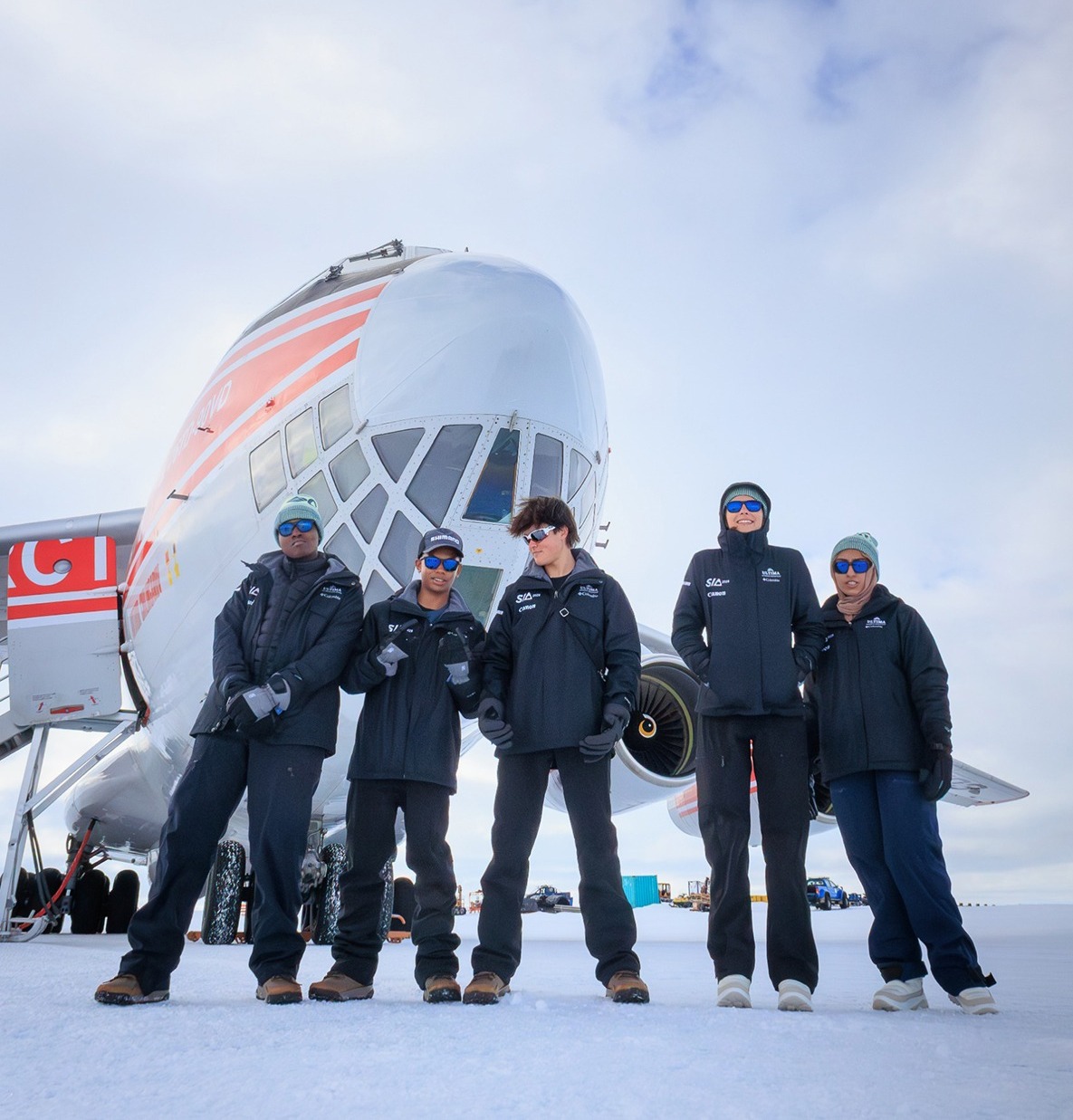
 The five students who travelled to Antarctica in December as part of the Students in Antarctica programme. From left: Ntokozo Nkuna, Luke Boswell, Naethan Mol, Allegra du Randt and Aaminah Choonara at the Ultima Novo Base. (Photo: Supplied / Manser Media)
 When seventeen-year-old Luke Boswell landed in Antarctica’s Deep Field, he expected cold. What he didn’t expect was the scale of the wilderness – endless ice stretching in every direction – and the way it would change how he thinks about the environment and his future.
Boswell said that he had always cared about the environment, but maybe “not enough”. Seeing Antarctica’s pristine wilderness and learning how quickly it could change made it impossible not to care, he said.
The Pearson High School pupil from Gqeberha was one of just five South Africans selected for the prestigious Students in Antarctica programme in December last year, an experience designed to turn curiosity into practical action.
The cohort included Aaminah Choonara of Lenasia Muslim School, Allegra du Randt of Thomas More College, Naethan Mol of Bishops Diocesan College, and Ntokozo Nkuna of the Khanyisa Education Centre.
A programme designed to inspire change
The programme is the brainchild of adventurer and environmentalist Riaan Manser, who has spent the past six years taking five South African students at a time to the frozen continent.
Convinced that inspiring and equipping young people can spark real change, Manser has shaped a programme unlike any other. While most visitors reach Antarctica by ship or by travelling to nearby islands such as Gough, his students are flown directly into Deep Field Antarctica, giving them a rare chance to set foot on the ice itself.
/file/attachments/orphans/Photo2_WhatsAppImage2026-01-06at114754_697596_979552.jpeg "Luke Boswell, a student at Pearson High School in Gqeberha, photographed before departing for Antarctica. (Photo: Supplied / Luke Boswell)")
“This is the only programme of its kind in the world, where African students are taken into Deep Field Antarctica,” Manser says. “We do not want to be just another environmental programme. There are already plenty of people shouting from the rooftops or protesting outside government buildings.
“What we want are young people who can find solutions to environmental problems. In 10 years, we hope these students will be the ones in boardrooms actually making change. They are impressive, their intelligence levels are off the charts, and we want to influence them to make a real, practical difference.”
Aaminah’s story begins with a humanitarian upbringing, where she learned that meaningful change often starts close to home.
“I come from a humanitarian background, and I think that’s one of the most important reasons I became part of Students in Antarctica,” she said. Born into a family committed to community development, she grew up watching her grandfather build the African Muslims Agency South Africa, and from the age of nine she understood that assisting others was not abstract work done in far-off places, but something urgently needed here at home.
“We tend to think humanitarian work only exists internationally in places like Syria or elsewhere in Africa, but the truth is that a huge amount needs to be done right on our own doorstep,” she said. “Often it is the smallest actions that make the biggest difference in someone’s life.”
While the programme centred on climate change, she believes its power also lay in personal transformation.
“The ice plunges, the camping, the environmental challenges, every part of it forced us out of our comfort zones,” she said. “Personal growth was a crucial element. We were pushed in different ways, and that made the lessons about the environment even more meaningful.”
/file/attachments/orphans/Photo3_WhatsAppImage2026-01-08at143250_359422.jpeg "Aaminah Choonara from Gauteng. (Photo: Supplied / Aaminah Choonara)")
The programme blends classroom-style learning with physical challenge. Students visit Antarctica’s striking landmarks, from the towering Ice Wall to ancient ice tunnels carved over thousands of years. Night hikes end in camp-outs where they sleep in temperatures of -25°C without tents, mirroring the experience of early explorers. They also take part in the “Upside Down Run”, a half-marathon named for the continent’s position at the bottom of the world, and every student completes it.
“It is not a joy ride,” Manser says. “We want the students to enjoy the trip, but it is designed to challenge them, push them, and inspire them to think differently about the environment.”
Antarctica’s impact on young minds
For Boswell, the impact was immediate.
“They kept telling us it wouldn’t really hit until we saw it ourselves, and I didn’t believe them,” he said. “When I arrived at the Ultima base, I thought it was awesome, but it still hadn’t set in. Only when we got all our polar gear and flew down did it finally sink in — and you can imagine, it really did.”
The scale of Antarctica overwhelmed him. He remembers stepping onto the ice and seeing nothing but white stretching endlessly in every direction.
“No documentary or photo can describe it. It is another world entirely, just white, as far as the eye can see.”
Early environmental interests
Meanwhile, Naethan traces his interest in environmental and conservation work back to a school initiative called Big Ideas, where pupils were challenged to develop practical projects and see them through.
He started a project called “Farming a Bag”, using geotextile grow bags and recycled bottles as a simple irrigation system, allowing plants and vegetables to grow even in poor soil. Partnering with Beautiful Gate, a nonprofit in Philippi, he helped establish a small grow-bag farm there.
“It was originally just an idea, but this is really how my passion for environmental science surfaced,” he said. “I got super involved and took it outside of the school initiative. I really enjoyed it, and I would like to take it further.”
/file/attachments/orphans/Photo4_WhatsAppImage2026-01-08at144341_755586.jpeg "Naethan Mol from the Western Cape in front of the cargo plane he travelled on to reach Antarctica in December. (Photo: Supplied / Naethan Mol)")
Speaking on the broader meaning of conservation, he said: “The environment is not separate from us. Everyone thinks conservation is about saving animals or protecting pretty forests and things, but that is not true. Conservation is about protecting the systems that support human life. This became very clear when we went to Antarctica.”
One lesson from the expedition, he added, had left a lasting impression.
“The biggest thing by far, and this is a quote Riaan always uses is: ‘There is an ocean between saying and doing.’ That was such a big lesson for me. He wants us to be ready to do something, to put effort and motivation into action. My biggest takeaway is the importance of just doing it. Don’t wait for perfect moments. Just do it. I’ll definitely incorporate that into the future and in other things I do.”
Engineering ambitions meet environmental purpose
Boswell said he had always leaned toward engineering and was planning to pursue an engineering degree. While he had long cared about the environment, his time on the ice gave him a deeper perspective.
“This experience gave me a huge new insight into nature and conservation. I cared about the environment before, but maybe not enough. Seeing Antarctica’s pristine wilderness and learning how quickly it could change made it impossible not to care. Whatever I do in my career, I want it to have a positive impact on the natural world.”
His fascination with wind and turbine design began in Grade 8, when a five-day power outage pushed him to try to build his own turbine. The spark grew after he discovered the story of William Kamkwamba, the Malawian teenager who famously built a windmill from scrap to bring electricity to his village.
“At some point I said I was tired of this and wanted to make a wind turbine. Obviously it was terrible and could not generate power, but it sparked my interest,” he said.
He applied for Students In Antarctica because it felt like the next natural step. Years of informal experimentation had shown him what he loved, and competing in a structured expo format offered a chance to push his skills further.
Even when things did not go according to plan, he says the experience taught him that unexpected challenges often spark new ideas and lead to better understanding.
Looking ahead, Boswell is eager to tackle a new research project on wind turbines, drawing from what he saw on the continent.
“I expected extreme winds and brought an anemometer to record them. I did not get a single reading above thirty kilometres an hour. It was disappointing for someone obsessed with wind, but it reminded me that life rarely goes as expected.”
He now hopes to design a turbine capable of withstanding violent, turbulent winds similar to those he had hoped to measure.
“I am very interested in a new research project that applies physics I have never used before. The goal is to create a turbine that can survive turbulent conditions. Antarctica has some of the fastest and most unpredictable winds in the world, regularly reaching 100km/hr. Being there shows the kind of infrastructure needed, and it motivates me to create something that could withstand it.” DM