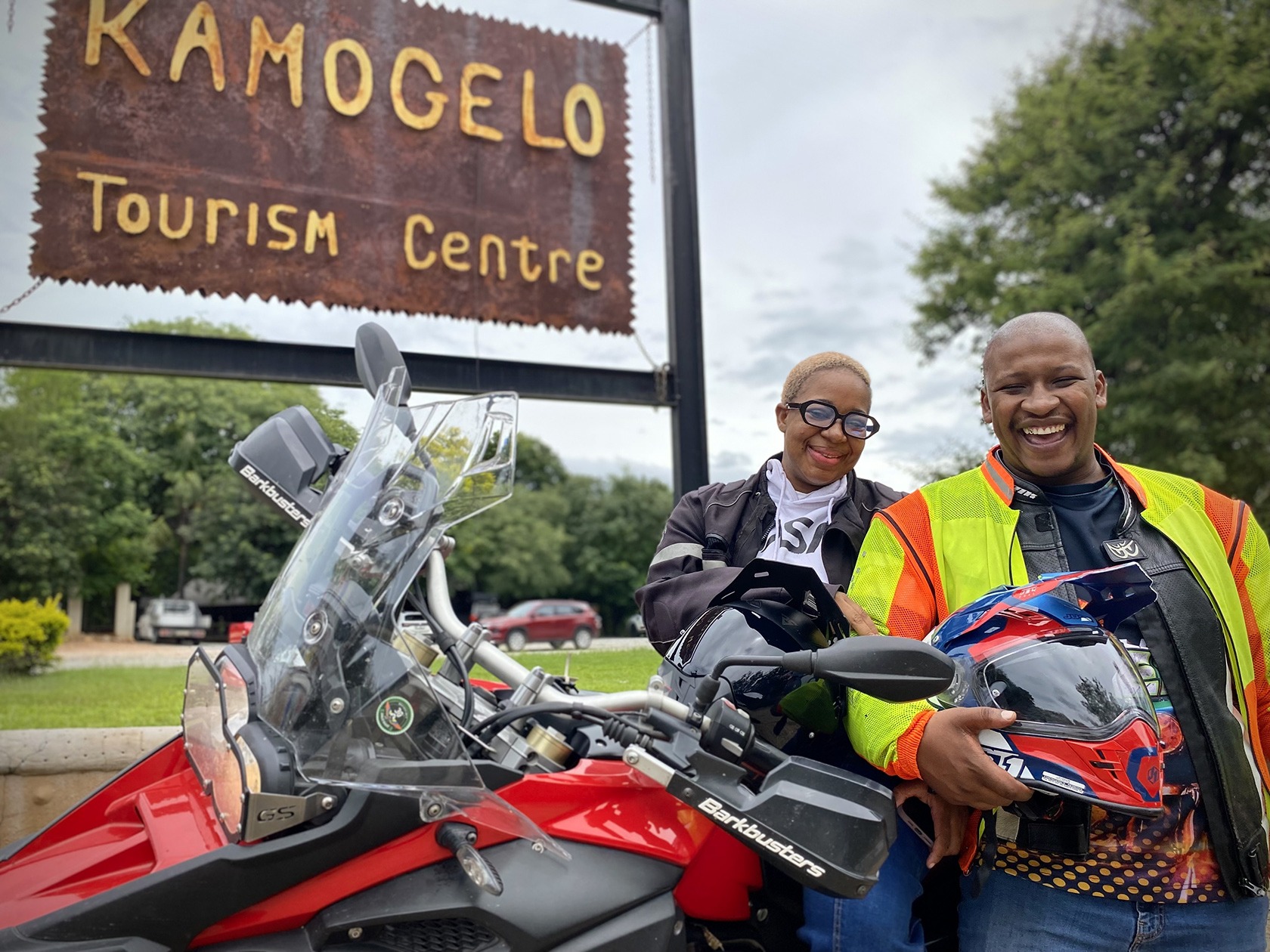
 Stopping over at Hoedspruit's Kamogelo Tourism Centre, Nathan and Lumka Smith mark his 31st birthday with a motorcycle ride from Nelspruit. 'I was praying for the rains to clear,' said Nathan. 20 January 2026. (Photo: Tiara Walters)
 For those of us who have lived through the floods in greater Kruger Park, it wasn’t the water that hurt us.
It wasn’t the white noise pelting down on our roofs and lives, unceasingly. But when it did cease, and there was momentary silence, the pitter-patter of droplets on red earth would reappear. It was the sound of more sheets of water that would now spill and spread on deeply saturated soil all over again.
But it wasn’t the sound of the returning storm that broke our hearts.
The reckoning emerged in the realisation of what the waters took from us.
It is a form of grief.
“How I linger to admire, admire, admire the things of this world that are kind, and maybe also troubled — roses in the wind, the sea geese on the steep waves, a love to which there is no reply?” the poet Mary Oliver writes in Heavy, her poem on grief.
/file/attachments/orphans/Workingbridge_664419.jpg "Cars move across the Zandspruit Bridge on the R527 leading to the Hoedspruit CBD, 20 January 2026. (Photo: Tiara Walters)")
Grief is love without an answer.
Some Lowvelders are still cut off by the ferocious flood waters that blew in from Mozambique last week. Settlements have been destroyed, lodges submerged and about 40 people lost their lives. At least 400mm of rain claimed R4-billion in infrastructure damage. These are the things that are devastating beyond comparison.
But also in the wake of natural disaster, emerges the absence of lives we took for granted — and even the missing daily irritants we then understand as loss.
/file/attachments/orphans/Hoedspruit15Jan_641560.jpg "The centre of Hoedspruit during a reprieve in the rain, 15 January 2026. (Photo: Tiara Walters)")
/file/attachments/orphans/Sunsetlaundry_317877.jpg "A safari vehicle passes the Sunset Dry Cleaning & Laundry sign during afternoon traffic, 20 January 2026. (Photo: Tiara Walters)")
Two guinea fowl frequent the long grass in front of my Lowveld veranda. Joined at the hip, they are never apart, always foraging together, by habit tapping at their reflection in the veranda doors. Not infrequently, they do so at presumptuous hours before the sun itself has even knocked on the door.
I call them Brolloks and Bittergal, not because they are the grotesque characters of CJ Langenhoven’s Afrikaans children’s classics, but because they are two loveable misfits in awkward feathers who seemingly must always be with each other to remain Brolloks and Bittergal.
Two days ago, a bedraggled, big-eyed Brolloks tottered out of the soaked grass. Bittergal was gone. I said a little prayer for Brolloks, hoping he would not feel too lost without his shadow.
At the blue hour before sunup the next day, I heard an unmistakeable sound — two little guinea fowl beaks tapping at the stoep doors. Bittergal. Bittergal was back.
/file/attachments/orphans/GuineaFowlStreet_393344.jpg "Guinea Fowl Street at Hoedspruit Wildlife Estate, 20 January 2026. (Photo: Tiara Walters)")
/file/attachments/orphans/Peopleatwaterbottles_375212.jpg "After the storms affected local water infrastructure, Cristiena Kruger of Hoedspruit Farm Watch hands out Cell C bottled water to town residents, 20 January 2026. (Photo: Tiara Walters)")
/file/attachments/orphans/Bottlelaughs_690121.jpg "Swazi Moeng receives Cell C bottled water from Monika Boulanger of Hoedspruit Farm Watch, 20 January 2026. (Photo: Tiara Walters)")
So, now, is the rumble of the bush train that swells in the distance and toots its own horn when it passes somewhere nearby.
I never did love the sound of traffic, especially not in the bush. But when the Zandspruit Bridge outside Hoedspruit was claimed by the flood, the sound of silence that followed became the sound of a vibrant dorp that had ground to a halt.
It became the sound of friends and acquaintances marooned in wet wilderness on the other side of the bridge. It was the sound of uncertainty that bore the hallmarks of a Covid-19 lockdown — of not knowing when we would laugh together over coffee in town again.
/file/attachments/orphans/IniGatPubandCarWash_893915.jpg "With sandbags stacked at the entrance, Sarel Cilliers, owner of Ini Gat Pub and Car Wash, says his business is open to punters, 20 January 2026. (Photo: Tiara Walters)")
/file/attachments/orphans/Bewaredrunkclients_304416.jpg "Situated opposite the Hoedspruit Dutch Reformed Church, a sign at Ini Gat Pub and Car Wash warns about \"drunk clients\". Owner Sarel Cilliers says he has seen some crawl across the street, 20 January 2026. (Photo: Tiara Walters)")
/file/attachments/orphans/VanessaLomasArtGallery_875287.jpg "Customers stop by the Vanessa Lomas Art Gallery in the centre of Hoedspruit, 20 January 2026. (Photo: Tiara Walters)")
This week, Daily Maverick documented a different outcome — how the people of a small town with no traffic light pulled together to rebuild that bridge with their own money and big machines.
/file/attachments/orphans/Mayor-with-Farm-Watch_278051.jpg "Maruleng Mayor Tsheko Musolwa (left) and Hoedspruit Farm Watch Reaction Head Lafras Tremper during reconstruction of the Zandspruit Bridge, 15 January 2026. (Photo: Tiara Walters)<br>")
The bridge has been open for some days now, and I have started listening out above the coucals and the kingfishers for the distant sound of traffic on the R527 to return to its former swish and bustle.
When it does, and surely it will, we will toast the spirit of a hardy town that refused to accept a love to which there was no reply.
This article first appeared in the Maverick Earth newsletter on 20 January 2026. For more behind-the-scenes perspectives on our how our environmental writers see the planet that sustains us, subscribe to our weekly newsletter.