





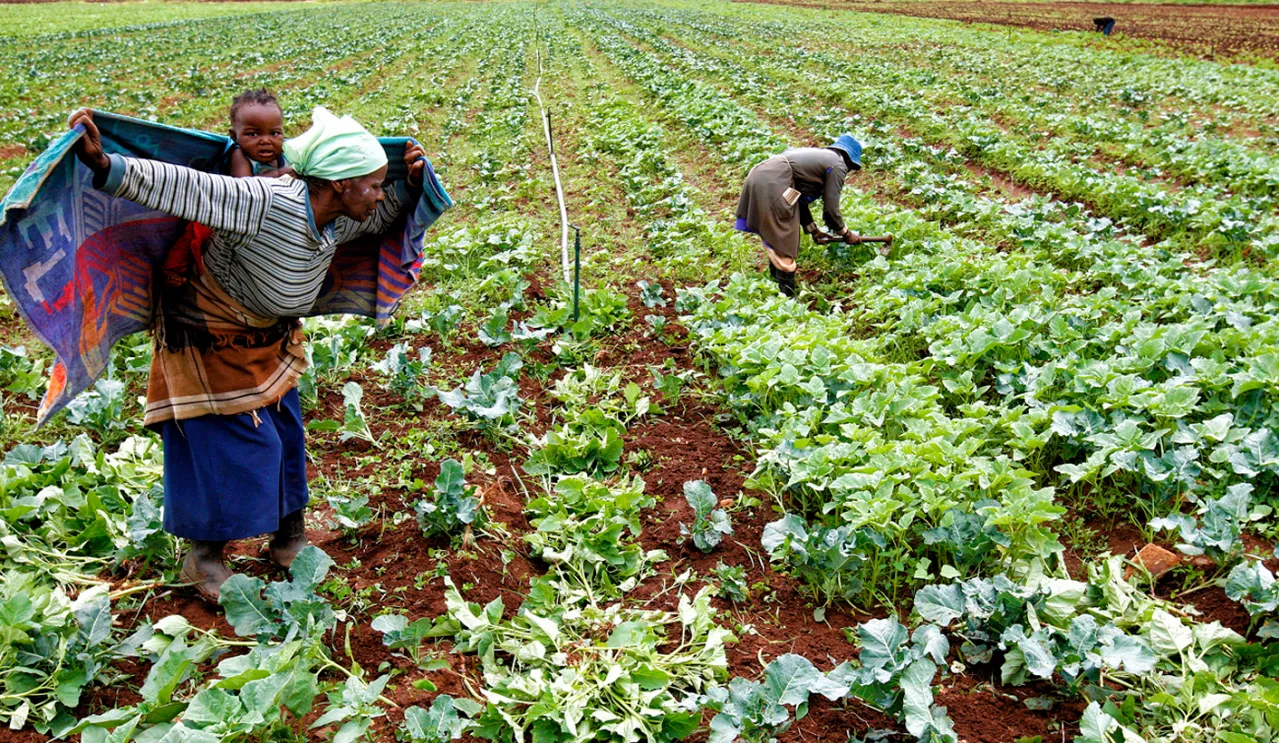
 The findings of the Africa Agriculture Trade Monitor 2025 emphasise the need for trade reforms to enhance food security in Africa. (Photo: Siphiwe Sibeko / Reuters)
 Food security has deteriorated significantly in Africa over the past five years, with undernourishment now affecting 20.2% of Africa’s population, according to the 8th edition of the Africa Agriculture Trade Monitor (AATM) launched on Tuesday, 16 December 2025 in Dakar, Senegal, and virtually.
“This large increase indicates that 73 million additional people are suffering from moderate or severe food insecurity, with much of the increase occurring between 2019 and 2020. This disappointing food security outcome stems from several factors, including the limited development of domestic agri-food systems, which has been exacerbated by climate change, conflicts and political instability, and major global shocks, most notably geopolitical tensions, trade wars, the Russia-Ukraine conflict and the economic slowdown following the Covid-19 pandemic,” the report’s foreword says.
The report indicates that although intra-African agricultural trade tripled from approximately US$6-billion in 2003 to nearly US$20-billion in 2023, Africa’s agricultural import bill is still high.
This makes the continent vulnerable to tariff tensions, climate shocks and global conflict, which have exacerbated hunger and malnutrition.
The AATM report examines recent trends and drivers of Africa’s global and regional trade, with a focus on the trade-food security nexus. Published by Akademiya2063 and the International Food Policy Research Institute, AATM 2025 analyses rice trade patterns and competitiveness, as well as the role of fertiliser trade in achieving food security.
/file/attachments/2986/1000156495_938601_ea383fd04fbe2354677fac3307e7152c.jpg)
The report also discusses how the African Continental Free Trade Area (AfCFTA) is reshaping trade among regional economic communities and advancing continental integration.
Dr Andreas Schaumayer, division head for food and nutrition security and fisheries in German Federal Ministry for Economic Cooperation and Development, was a member of the multi-sector panel that unpacked and reacted to the findings of the report at the launch.
“We need pathways to build resilient food systems and strengthen global cooperation,” Schaumayer stated.
“This is a great motivation to also shift the policy choices towards a more positive and pro-trade agenda. But there are warning signs remaining. Africa’s agricultural imports, as we heard from outside the continent, are […] five times the burden of its intra-African trade. And this dependency is increasing and it also creates a lot of political shocks due to the structural and historical factors,” Schaumayer said.
“The report is clear. Without a stronger regional production and trade system, Africa will stay exposed to global disruptions. Future trade is more resilient than global trade and it deserves political prioritisation. The African Continental Free Trade Area (AfCFTA) provides a framework which will make markets more attractive and competitive by reducing non-tariff barriers, simplifying and digitalising customs procedures, harmonising standards across regions and increasing transparency, for example, through the trade monitoring dashboard,” Schaumayer said.
/file/attachments/2986/1000156500_591813_e9f1b02b67f79eb709d071d5a01639b0.jpg)
Lowering trade barriers to reduce food insecurity
The report offers policy change recommendations, such as creating infrastructure and an environment that makes intracontinental trade easier, and policies to help decrease the food insecurity and malnutrition crisis.
Key 2025 AATM policy recommendations include strengthening regional markets and lowering trade barriers to reduce food insecurity.
“Countries should deepen implementation of the AfCFTA by reducing tariff and non-tariff barriers, harmonising standards and investing in cross-border infrastructure. Stronger and better-integrated regional markets would allow countries to make better-informed trade decisions and rely more on African supply and less on volatile global imports,” the report reads.
Expanding regional food production, upgrading transport and storage systems, and lowering intra-African trade costs are vital to building resilient, efficient supply chains capable of meeting rising demand
The report also calls for improved regional food systems resilience through investments in productivity, logistics, and supply chains.
“Africa’s dependence on imports remains high. Expanding regional food production, upgrading transport and storage systems, and lowering intra-African trade costs are vital to building resilient, efficient supply chains capable of meeting rising demand,” the report reads
The report editors, Sunday Odjo, Fousseini Traore, and Chahir Zaki, also suggest the boosting productivity in key staples, including rice, through “better water-use efficiency, irrigation, and adoption of drought-resistant varieties”.
“Strengthening aggregation, processing, and milling capacity will also improve competitiveness and reduce import reliance,” the report reads.
Other recommendations include expanding and coordinating the fertiliser trade within Africa and addressing restrictive non-tariff measures to unlock Africa’s export potential.
“African exporters face some of the world’s most restrictive non-tariff measures. Reducing compliance burdens and strengthening regulatory capacity, while building trade-related capacities, would expand market access and help countries diversify away from highly concentrated import sources, better positioning Africa in the global economy,” the report states.
/file/attachments/2986/1000156501_829489_a52ea22d1bf53f041d43ef4b2f6d63f0.jpg)
Africa’s top agriculture exporters
The report shows that South Africa is Africa’s top agricultural exporter for 2009–2013 and 2019–2023, with exports estimated at US$14.4-billion in the second period, equivalent to over 25% of the total exports of the top 10 countries. The top 10 list also includes Côte d’Ivoire, Morocco, Egypt, Kenya, Ghana and Ethiopia. Of these, South Africa, Egypt, and Morocco participate in fruit and vegetable value chains. South Africa’s two leading agricultural exports are citrus and wine. Yet around 15 to 16 million people in South Africa have inadequate or severely inadequate access to food including agricultural households and farmworkers who often face high food insecurity.
As the report points out, there is a contrast between great trade and food insecurity in these countries.
“The predominance of agricultural products in African countries’ international trade could be an asset in addressing food insecurity. Indeed, beyond any potential forced specialisation aimed at capitalising on the continent’s revealed comparative advantages, this importance should increase food availability in deficit regions, stabilise consumer prices, and ensure decent incomes for agricultural households that depend on this activity, thereby promoting and/or preserving food security. However, the data analysed on food security by region show that this is not the case.” DM