




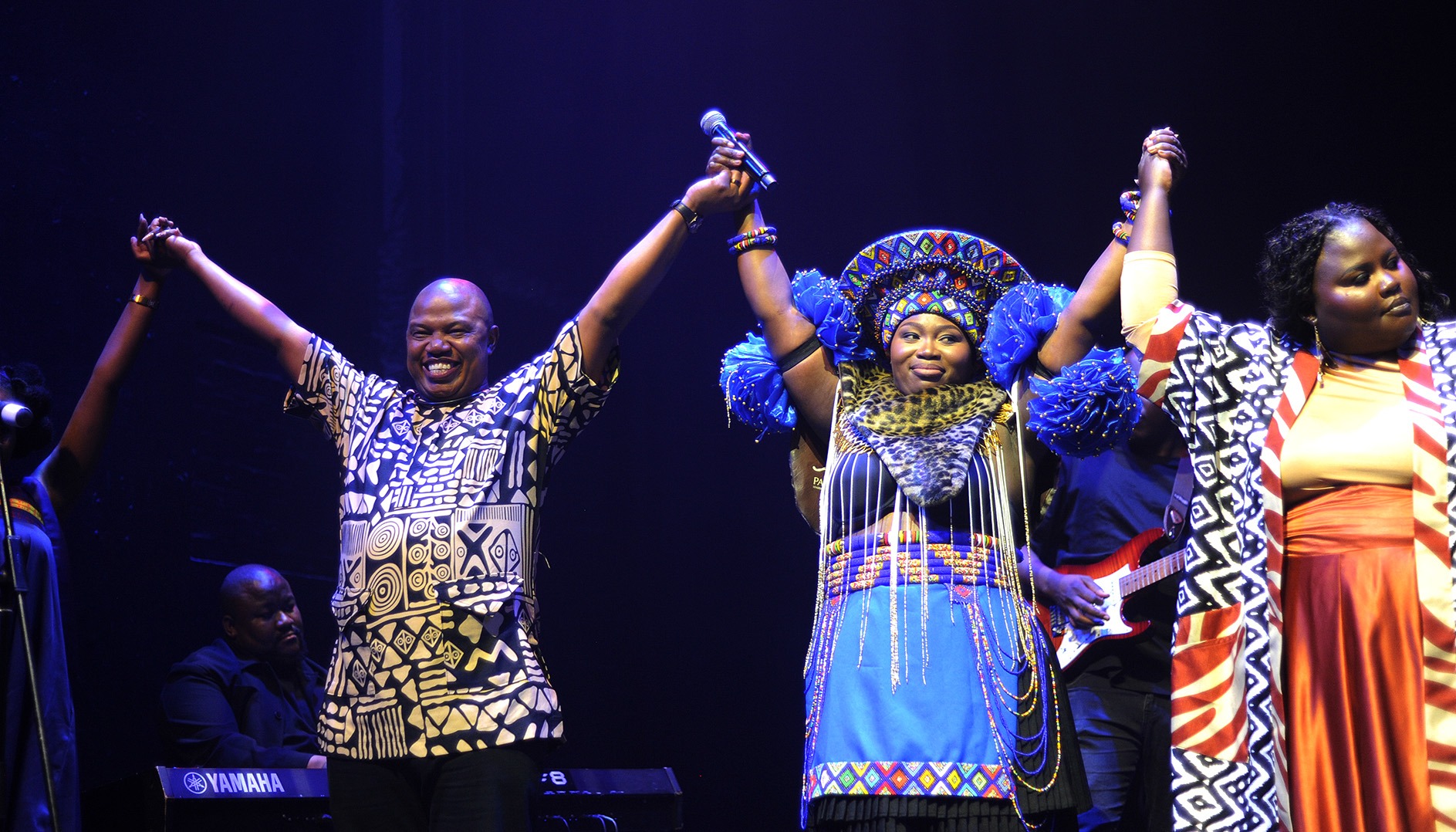
 Zawadi YaMungu and The Soil bid the audience adieu after the night’s performances. (Photo: Cebelihle Mbuyisa)
 The show stage, under blue and red lights, brimmed with life even before comedian Lerato Sokhulu – a brilliant host for the night – introduced the first act.
It fell to K2 The Rapson, a hip-hop artist from Pretoria, to emerge from behind the curtain and start the night. Accompanied by Sibusiso “Terry D” Dube (keyboard) and Sean Sebola (electric guitar), he owned the stage, crooning “I want it all!”, along with the audience.
Regal in a flowing orange dress that borrows from Xhosa tradition and on her head what Zulu people call isicholo, a traditional hat worn by married women, Zawadi YaMungu took the stage with a six-piece band and two backing vocalists.
The audience fell in love with her immediately, with some people telling her she was beautiful, in IsiZulu, IsiXhosa and English.
The opening track on Ngimuhle, the album she was launching, is Isibikezelo, an introduction of sorts. It is not a song in the conventional sense, but a poem.
YaMungu invited her collaborator, the poet Lulwandle Sindiswa Zulu, to join her for this opening piece. As Zulu recited the story of a girl gifted with song from emnyakeni engaphezudlwana kweyinkulungwane eyedlule (just more than 1,000 years ago) YaMungu accompanied her with playing and chant.
By then the audience was fully under the artists’ spell, transported into the world of Zulu’s poem rather than seated in maroon theatre chairs. On stage, though faithful to the recorded studio version, the piece took on a life of its own, its emotional force immediate and palpable.
/file/attachments/orphans/LulwandleSindiswaZuluinthelobbyoftheHomecomingCentreinCapeTownafterthenightsperformances_CebelihleMbuyisa_343973.jpg "Lulwandle Sindiswa Zulu in the lobby of the Homecoming Centre in Cape Town after the night’s performances. (Photo: Cebelihle Mbuyisa)")
Zulu stayed on stage and recited another poem as YaMungu, alongside her backing vocalists, crooned refrains of Mayibuye. By the time the piece ended, emotion had overtaken the room; a woman wailed, others released sounds in broken intervals, and a sense of oneness settled between the artists and the audience.
The dominant sentiment of this part of the performance was the need for acknowledgement of what has happened in South Africa for centuries, and continues to happen: the violent and systematic dispossession of black people. Men driven from their fertile lands and sent to man-made caverns in the belly of the earth to dig for gold, which though they have always known, have never had any use for.
And at the barrel of a gun their lands and its bounty stolen from beneath their feet; turned servants on their own land, by those who stole it; and always striving to build a life with the sorry peanuts thrown their way. And, in different ways, often failing.
Musani ukwenza shengathi kanazi
Kwadliwa izinkomo zamadoda la
Thina eyethu imfuyo wayungasoze wayibal’ ebhukwini lediphu
Kwakuyoba ngumshonisalanga
Njengekubala izinwele ekhand’ elinganampandla
Umnumzane thizeni waseNgilandi unethezeke emzini kaMnguni
Zulu seemed to be inviting the audience to look at the nakedness of the violence of this country anew – the history and the current reality it birthed; to be affected by it, even if it meant allowing it to arouse anger.
But the mood would not be sombre for long. As soon as the song ended and the artists caught their breath, a woman in the audience shouted, “Usenzani, sisi wethu (what are you doing to us, our sister)?”
Staying with the theme of history, YaMungu then sang a lullaby called Woza We Mvula which, on the album, is song number seven. But a lullaby, in the hands of all the seasoned musicians on the Homecoming Centre’s stage, became something more. As YaMungu sang, reaching distant lands with her voice, trumpeter Thabo Sikhakhane punctuated some key moments.
The next song was a reworking of Busi Mhlongo’s Khula Tshitshi and Uganga Nge Ngane, followed by Andonja, a song whose direct KiSwahili translation is “I am feeling weak”. In IsiXhosa, however, when spoken a certain way, it takes on an entirely different meaning. YaMungu pointed this out herself, drawing warm laughter from the audience.
As YaMungu and her band exited the stage, Zulu folk musician Jabulile Majola – the artist behind the acclaimed album Isitifiketi – took over. He was joined by Ross Dorkin on the keyboard, a close collaborator who subtly echoed and lifted Majola’s acoustic guitar lines. There is a beguiling quietude in Majola’s music. He is a storyteller who knows exactly where to pause, where to whisper and where to hum. He opened his set with Bamba Isandla Sam’, the penultimate song on Isitifiketi. The emotional quality in these songs is so strong that it hardly matters even if you barely understand the lyrics. The core of the music, the emotion of it, comes to you first.
But the ambiguity of poetry is not in uJakalasi, which he performed last. From the first line, the images are strong: Lomfana ufana ntse nobab’mncane (the boy is the spitting image of uncle). You think about the boy, the uncle, the political violence of the recent past, about the victims of it.
Do you ever think about those necklaced, shot, butchered with knobkerries and wounded in every way in KwaZulu-Natal during the political violence instigated by the state in the late 1980s to early 1990s? They died horrible deaths. They had names, like Jakalasi, and had families that frantically searched for remains and sought details of how their loved ones died.
/file/attachments/orphans/ZawadiYaMungudeliveringanimpromptuperformancewithshowhostLeratoSokhulu_CebelihleMbuyisa_497252.jpg "Zawadi YaMungu delivering an impromptu performance with show host Lerato Sokhulu. (Photo: Cebelihle Mbuyisa)")
By the time he sings asinalutho, baba/ ayikapheli inyanga (we have nothing, sir/ it is not month end yet) in uJakalasi, the audience fully understands the story. A majority of black people in this country know what it is like to subsist only on meagre monthly earnings that disappear as soon as they come.
After a brief interval, Sokhulu invited YaMungu back onto the stage, now in traditional Zulu attire. She opened with Ngithethelele, quickly erasing any sense that she had ever left. Following a reimagining of Oliver Mtukudzi’s Neria, YaMungu and her band closed with Xoxo, bringing the audience to its feet.
YaMungu then said some beautiful words about The Soil and the friendship they have had for many years in the music industry. The Soil is an established group and have been in business for many, many years – and are on the whole beloved.
Led by Ntsika Ngxanga, the group launched straight into crowd favourite Joy. Buhlanti followed, and Theo Matshoba showcased her remarkable presence and talent. Drawing from hidden depths, Luphindo Ngxanga provided the guiding rhythm using only his voice and the projection of the microphone. Later, YaMungu joined the ensemble for a rendition of Malaika, the KiSwahili classic popularised by Miriam Makeba in the 1960s.
YaMungu, born Nkosingiphile Mpanza, hails from eMandeni in KwaZulu-Natal. Her stage name, Zawadi YaMungu, means “gift from God” in KiSwahili – a direct translation of her given name – and is reserved for her music and performances. She has collaborated closely with artists Dr Nduduzo Makhathini and Mbuso Khoza, joining the Afrikan Heritage Ensemble in 2016.
She also places Princess Magogo and Bavikile Ngema in her direct musical lineage. Both women are renowned for their masterful playing of umakhweyane, an instrument that features in many of YaMungu’s songs that night.
Her practice, and that of every artist who stood on the theatre stage, carries with it a very deep appreciation of history. But at the centre of it is a lot of love – a love of themselves and, by extension, of people who look like them. And an open and brave sorrow for all those who for centuries and decades have casually perished at colonialism’s cruel hand, which never really rested. DM