




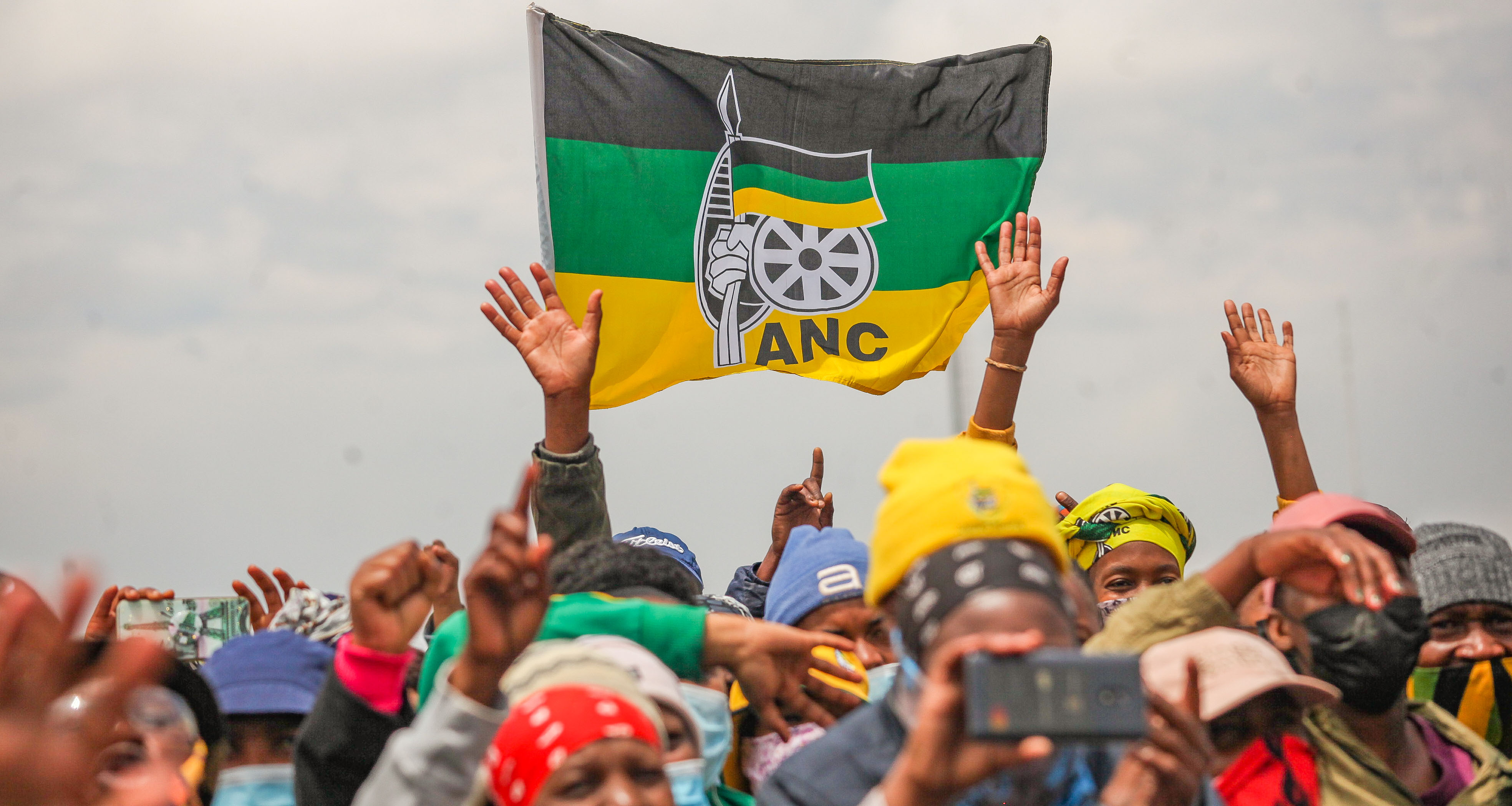
 Supporters during ANC election campaigning in Soweto, South Africa. As the ANC confronts its legacy, corruption threatens to overshadow its founding values and future prospects. (Photo: Gallo Images / Sharon Seretlo)
 /file/dailymaverick/wp-content/uploads/2025/10/label-analysis-2.jpg)
In his majestic history of the ANC, The Founders, the historian André Odendaal writes of the party founders: “The early intellectuals and activists were political innovators, responding in courageous, often contradictory ways to the challenges of their times. As one scholar has noted, ‘they journeyed back and forth across vast political, cultural and personal chasms’ to engineer new discourses and paths in politics… The actions and aspirations of the first generations, shaped by their time and place, were realistic, often insightful and forward-looking.”
Odendaal chronicles the religious leaders, the newspaper editors, intellectuals and landowners who came together to form the South African Native National Congress in a church in Bloemfontein in 1912 – the forbear of the ANC.
The culture of that generation persisted through the various phases of the Struggle against apartheid and into the first years of democracy, exemplified by its presidents: Nelson Mandela was an apparent heir of the founders, Thabo Mbeki more (and sometimes less so); Kgalema Motlanthe was cut from the same suit and so is Cyril Ramaphosa – you can see it in his bookish style of speech and his statesmanlike bearing.
There are younger people in this mould, but on the whole the founders’ culture is no longer dominant in the ANC.
The story of 2026 will be about the local government elections, but also about whether the ANC will continue its decline, as liberation movements tend to do. Or whether it can reverse its trajectory as it said it would when the National General Council closed at the end of 2025.
Laced through the party’s “base document” to inform its agenda at the National General Council is a lament on the quality of its leadership and membership, and the distance between the rich cadre-ship the ANC was able to nurture for most of its history, until things soon turned after 1994.
Read more: Ramaphosa will lead the 2026 ANC local government election campaign as plot rumours fizzle
/file/attachments/orphans/6I1A5786_959705.jpg "President Cyril Ramaphosa with Gwede Mantshe on the last day of the 5th National General Council of the African National Congress held at Birchwood hotel in Boksburg on 11 December 2025. (Photo: Felix Dlangamandla)")
In his book on the topic, Liberation and Corruption: Why Freedom Movements Fail, Peter Hain remembers Mandela’s words in 1997: “One of the negative features is the emergence of careerism in our ranks. Many among our members see… the ANC as a means to advance their personal ambitions to attain positions of power and access to resources for their own individual gratification.”
Since 1994, it has been beset by at least 40 major corruption scandals that have sapped its history and now threaten its future.
The ANC is ensnared by patronage. This is where political leaders at all levels use their positions to extract rent from the state and then earn favours or funds to sustain their lifestyles or support their political ambitions. It’s so rife that trying to root it out is existential for the ANC.
This has meant that while Ramaphosa’s promise of renewal has brought some reform to the state, in the ANC it has enjoyed limited success. In fact, the revelations by KwaZulu-Natal Police Commissioner Nhlanhla Mkhwanazi in July catalysed the Madlanga Commission of Inquiry and the parliamentary ad hoc inquiry, both of which have revealed that patronage politics, or patrimonialism, has entrenched itself in the ANC in deeper and more dangerous ways.
Comrades Brown, Cat and Julius
What the two inquiries have started to reveal is that South Africa has moved from the capture to the criminalisation of the state, defined by Stephen Ellis, Jean-François Bayart and Béatrice Hibou in their book The Criminalisation of the State in Africa.
One definition is that “state structures may operate like organised crime networks, blurring the line between political authority and criminal economic interests”.
Crime mastermind and tenderpreneur Vusimuzi “Cat” Matlala is at the centre of what appears to be this new trend, and his long tail of influence snakes into the party.
/file/attachments/orphans/ED_588250_571722.jpg "Vusimuzi 'Cat' Matlala Testifies at the Parliamentary Ad Hoc Committee inquiry into alleged corruption and political interference in the criminal justice system at Kgosi Mampuru Correctional Facility on November 27, 2025 in Pretoria, South Africa. (Photo: Gallo Images / Frennie Shivambu)")
Matlala runs influence ops into the state using his access to party cadres in and outside the state, the two inquiries have shown. The ANC has tried to distance itself from crime intelligence informer and political influencer Brown Mogotsi from North West, who operates nationally.
Access mongers like him are a dime a dozen in the ANC, but what made the country sit up to take notice is that Mogotsi parlayed his influence all the way into the highest security structures of the state – inveigling his way into the network of currently suspended Police Minister Senzo Mchunu. Mchunu has testified in both inquiries that he is innocent. Still, under tough questioning from Judge Mbuyiseli Madlanga, the minister did not convincingly explain why he appeared to be doing Matlala’s bidding by disbanding the Political Killings Task Team at the height of last year’s festive season.
Read more: How Mkhwanazi’s allegations against Mchunu stack up almost six months later
You don’t have to look far to find numerous images to prove that Mogotsi built influence as an ANC cadre and member.
/file/attachments/2986/ANC-Brown-Mogotsi-11_918068_038552b87d0220a0fbb287f3591ff113.jpg)
/file/attachments/2986/Sodis-50th-Birthday_312713_32b235ecda364d91079005ef6d19c425.jpg)
Matlala is not an active party cadre, but he courted and was courted at senior levels in the ANC. He claimed in testimony that he had paid to support former police minister Bheki Cele’s lifestyle and had given him cash. In the image above, he attends Edwin Sodi’s fiftieth birthday party. Sodi is another tenderpreneur with tentacled influence in the ANC. Also at the table are ANC Deputy President Paul Mashatile’s close adviser, Keith Khoza (himself an ANC leader), and Morgan Maumela, the Tembisa Hospital don and owner of the forfeited blue Lamborghinis.
This is network politics, or what we have started to call the “mafia state”. What it reveals is the matrix of political and business interests or money politics that has eaten into the ANC’s standing.
There’s a third figure we will use to show the trend.
A sub-theme of the Madlanga Commission is that of sub-national policing corruption, with a focus on the Ekurhuleni Metropolitan Police Department and its suspended chief, Julius Mkhwanazi.
/file/attachments/2986/ANC-Julius-Mkhwanazi-21_541789_8a58928e7d9fa611b818054595dd6d2f.jpg "Suspended Ekurhuleni Metro Police Department Chief Julius Mkhwanazi at an ANC event. (Photo: Facebook)")
Mkhwanazi, according to testimony, was the first official to grant Matlala access to the state security network, which enabled him to build a web right to Wachthuis, the South African Police Service’s HQ. In his testimony, Mkhwanazi said Matlala funded his personal expenses and that the tenderpreneur had received blue light access in return for supplying cars to the metro fleet.
This raises so many red flags that it could get us back on the Financial Action Task Force (FATF) grey list of countries that transgress global anti-corruption norms. But Mkhwanazi saw no problem. He behaved as if with impunity, and why is clear if you peruse his social media. Mkhwanazi is a party cadre, and he made that clear to colleagues who tried to rein in his patronage circles at the Ekurhuleni Metropolitan Police Department.
While the ANC is trying to put a Comrades Marathon of distance between itself and cadres like Mogotsi, Mkhwanazi and Matlala, they represent a cadreship that has grown like a cancer in the ANC.
The party’s Integrity Committee recommended to its National Executive Committee that lifestyle audits be made standard practice and that the party’s step-aside rules (under which leaders and members named in adverse or corrupt practices should step aside) be adopted, but, on the whole, the body is regarded as pretty toothless.
The latest Reconciliation Barometer of the Institute of Justice and Reconciliation has found that trust in political leaders and institutions has continued to plummet to all-time lows.
While the party believes it can become a majority party again and that the 2024 electoral loss was only a temporary setback, all polls and projections suggest this is unlikely. There are signs the ANC has started to arrest its decline. Still, the trajectory of other liberation movements that become governments is that they tend to lose power after 30 years, often eaten up from within.
Comrades Cyril, Firoz, Snuki and the renewal of the ANC
At the recent National General Council, the Acting Police Minister Firoz Cachalia carried around a copy of The Founders. He is among the cadres of old values in the party who are all constitutionalists and who have not been snared by what the party has called “the sins of incumbency” – corruption and materialism.
Cachalia, on the cusp of retirement, was roped in to deal with the policing crisis that Nhlanhla Mkhwanazi uncorked. A law professor and one of the architects of South Africa’s Constitution, he was the chairperson of the National Anti-Corruption Advisory Council. Hence, he knows what needs to be done. Ramaphosa himself has campaigned for reform of the ANC, and he has used judicial commissions of inquiry to try to clean up his party in government.
Of course, the Phala Phala scandal (in which US dollars were stuffed into a couch at his stud farm) has not been fully explained, although three official investigations have exonerated him. The third exemplar of those who can stem the ANC decline and stop a death spiral is ANC Veterans League chairperson, Snuki Zikalala.
He is the battering ram for reform, and at the National General Council he pushed for more muscular anti-corruption measures in the party.
Between a glorious past and an uncertain future
From the revolutionary parties of Latin America, like the Nicaraguan Sandinistas, to those in our neighbourhood like Zimbabwe’s Zanu-PF, liberation movements tend to lose their way and burn out. The ANC’s trajectory has been the same, but also different.
The party conceded defeat in 2024 and negotiated for the Government of National Unity, whereas other liberation movements have compromised institutions and remained in power at the barrel of a gun. The leaders of others have turned into autocrats. Whether the ANC can sustain its reform trajectory in the spirit of its founders or whether Comrades Brown, Cat and Julius become its dominant form is still unclear – in 2026, the party’s choice and future should become clearer. DM
This story first appeared in our weekly Daily Maverick 168 newspaper, which is available countrywide for R35.
/file/attachments/2986/DM-19122025-001_407439_c8ee56123400b25d4c3a51565fceafd7.jpg)