




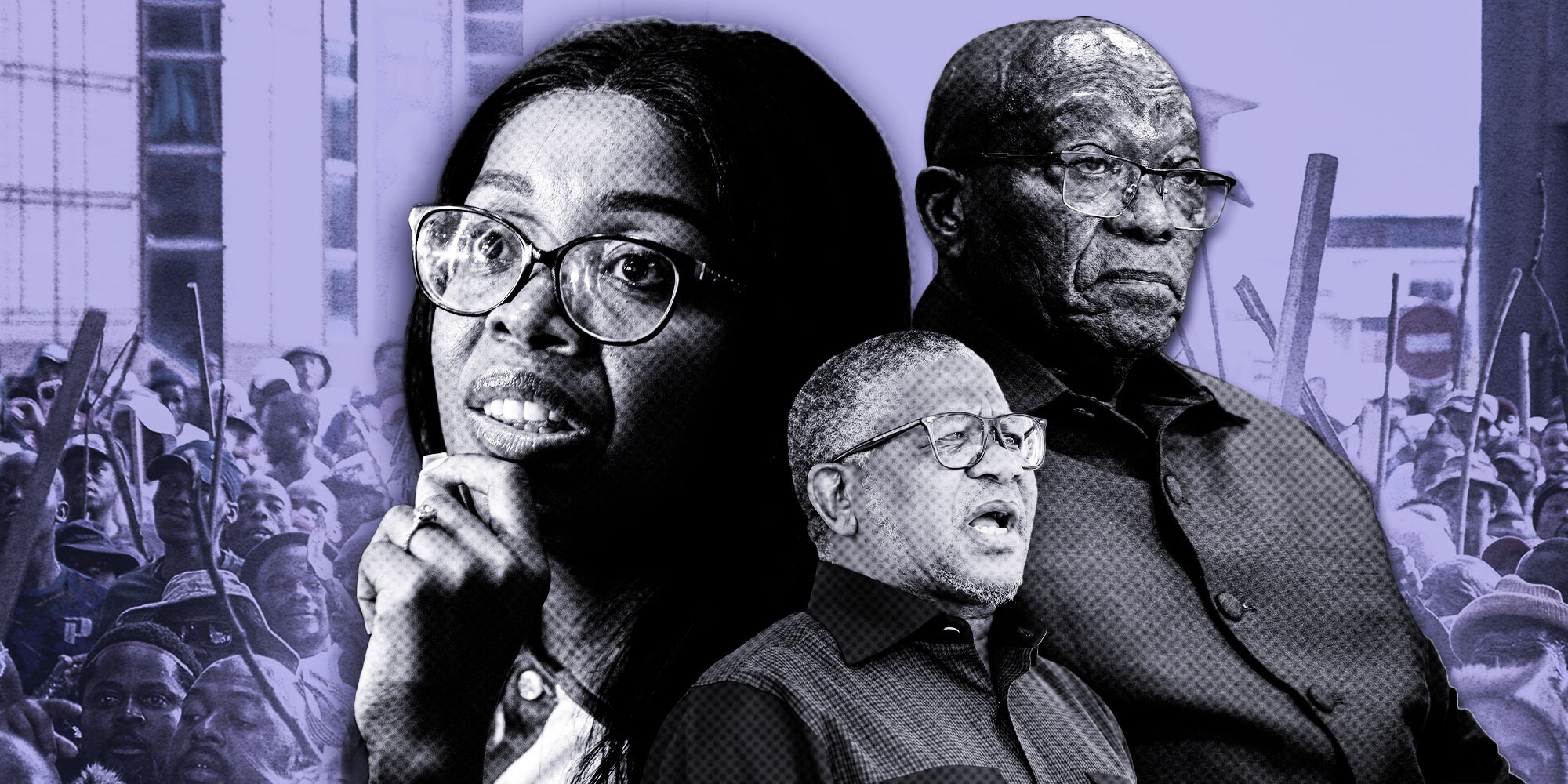
 Illustrative image: March and March leader Jacinta Ngobese-Zuma. (Photo: Per-Anders Pettersson / Getty Images) | Former South African president Jacob Zuma. (Photo: Per-Anders Pettersson / Getty Images) | Fikile Mbalula. (Photo: Gallo Images / OJ Koloti) | People protest against illegal immigration in Durban on 20 May 2026. (Photo: Gallo Images / Darren Stewart) | (By Daniella Lee Ming Yesca)
Jacinta Ngobese-Zuma, the former radio show host at the centre of South Africa’s current xenophobic unrest, says her movement, March and March, is apolitical. But, while multiple parties have legitimised her anti-immigrant agenda, at least two parties have actively furthered it, stoking fears ahead of March and March’s ominous 30 June deadline, with multiple immigrants killed and thousands already displaced across the country.
Despite Ngobese-Zuma’s claims of March and March being “non-aligned to any political party,” there are clear links to Jacob Zuma’s uMkhonto Wesizwe (MK) party. For starters, Sanele Khambule, a director of March and March listed on company records and the movement’s National Treasurer, was a candidate on the MK Party’s national election list ahead of the May 2024 general election.
Khambule consequently didn’t make it to Parliament, but it’s unclear whether he remains a member of the party.
MK and Khambule did not respond to Daily Maverick’s questions on Khambule’s membership status. Ngobese-Zuma, in her response, referred to Sections 18 and 19 of the Constitution, which deal with the right to freedom of association and to make political choices.
“Having regard to the above-mentioned provisions, our members have a right to join political parties of their choice, provided that the political beliefs of that political party are not in conflict with the dictates of our constitution and that of the Republic,” she said.
She did not respond to a question from Daily Maverick regarding whether March and March was pursuing a formal endorsement, partnership or political coalition with MK ahead of the 4 November local government elections.
/file/attachments/orphans/ED_613465_810356.jpg "Jacinta Ngobese-Zuma briefs the media ahead of March and March’s 30 June protest. (Photo: Gallo Images / Sharon Seretlo)")
The scale and sophistication of March and March’s actions across South Africa have prompted questions about who finances its mobilisation. Speaking to 702 Radio last week, South African Federation of Trade Unions (Saftu) general secretary Zwelinzima Vavi alleged that MK and its leader, Jacob Zuma, were in an “alliance” with the movement.
“We are worried that there seems to be a coordination. There’s money involved … But more importantly and worryingly to us, there is a political hand of the very same forces that generated the July 2021 unrest, who are now marching together with March and March, who are pointing the finger at migrants when they are responsible for most of the crises that South Africa [finds itself in] today,” he said.
A BackaBuddy crowdsourced funding campaign has collected R13,167 towards a goal of R20,000 in six months, with donors giving an average of R200. Asked whether March and March has received any direct financial contributions, logistical support or indirect funding from MK and/or any of its representatives, Ngobese-Zuma said: “The movement does not receive funding from any political party, that includes the MKP.”
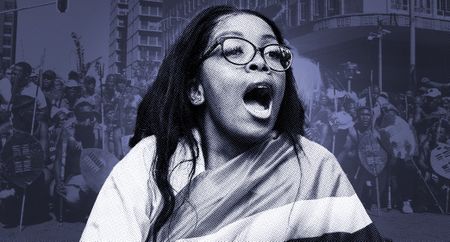
In response to questions from Daily Maverick, the MK party said: “Vavi has failed in every job he has ever had. It is unfortunate that he has resorted to using Zuma’s name to gain some much-needed attention.”
“We are not March and March, we simply support the call for all illegal immigrants to return to their respective countries,” the party added.
Although MK says it is not formally aligned with March and March, the party has thrown its weight behind its anti-migrant agenda. MK party secretary-general, Sibonelo Nomvalo, recently told Mail and Guardian that March and March stood for “the correct cause”, and MK supported it “in its stance against illegal immigration”.
MK’s support for the movement is also evident through the participation of its members in numerous March and March protests. Earlier this month, Nomvalo and Ngobese-Zuma led a protest together in Durban, KwaZulu-Natal, against “service delivery failures, nepotism and corruption”, reported TimesLive.
/file/dailymaverick/wp-content/uploads/2025/06/ED_561196.jpg "MK party president Jacob Zuma and MK Youth League president Qiniso Cibane at the league’s launch at Christianenburg Stadium in Durban on 16 June 12025. (Photo: Gallo Images / Darren Stewart)")
But March and March is building other strong political linkages ahead of the polls. The anti-migrant group has held engagements with political parties, including ActionSA, MK, the Patriotic Alliance (PA), and the Inkatha Freedom Party (IFP), but denied that such engagements meant it was aligned with any political organisation.
ActionSA leader Herman Mashaba, in particular, has said he would “celebrate” if Ngobese-Zuma made herself available to be the party’s mayoral candidate in eThekwini. In KuGompo, Eastern Cape, March and March was a leading participant in violent protests against the performative coronation of a so-called Igbo King in April. ActionSA joined the protests.
Ngobese-Zuma has also met the DA’s mayoral candidate for Johannesburg, Helen Zille, which had DA leaders “fuming”, saying she lacked permission to do so. The DA did not respond to a question from Daily Maverick about the meeting.
/file/attachments/orphans/ED_556143copy_484311.jpg "Helen Zille, DA mayoral candidate for Johannesburg. (Photo: Gallo Images / Fani Mahuntsi)")
/file/attachments/orphans/ED_597084_804157.jpg "ActionSA leader and Joburg mayoral candidate Herman Mashaba. (Photo: Gallo Images / Fani Mahuntsi)")
March and March’s impending 30 June “deadline” for undocumented migrants to leave the country is a crisis co-written by South Africa’s political class.
While MK and ActionSA have courted March and March and appear to be working towards a similar agenda, some political parties have also jumped on the xenophobic bandwagon, continuing to utter “illegal immigrant” rhetoric ahead of the polls to gain votes, while others have stayed silent. The Government of National Unity (GNU), meanwhile, has failed to present a unified front, largely ceding the narrative to anti-migrant vigilante groups.
This collective political failure has allowed March and March and allied formations to set the national agenda, and enabled the threat of 30 June to hold the country hostage.
ActionSA and the PA did not respond to questions from Daily Maverick. Questions were also sent to the Presidency, but a response had not been received by the time of publication.
Who is to blame…
“Politics likes to have a singular villain, and to some extent, the effort to put all of South Africa’s woes on immigrants is indicative of that. We want to have that person [who we can blame],” said Professor Loren Landau of the African Centre for Migration and Society (ACMS) at Wits University. “But, I think when you start looking at home, you start to realise that there’s plenty of blame to go around.”
Landau noted that there were “any number of [political] actors” in South Africa who have capitalised on anti-immigrant sentiment for their own benefit over the years. The ANC, he explained, went from condemning xenophobia to putting anti-immigrant rhetoric and a discussion about migration as a security threat into the White Paper on Citizenship, Immigration and Refugee Protection.
Populist figures such as Mashaba and PA leader Gayton McKenzie, who both espouse xenophobia as a way of finding the “other” against whom to campaign, then contributed to “moving what was fringe and uncomfortable, [to] something that is comfortable and central to South African politics”.
In the case of 30 June, Landau said he is “content to blame the government at large”.
“But I wouldn’t say it’s what they [the government] has or has not done over the past year. It’s really what they’ve done – or not done – since 2008,” he said.
In 2008, a series of xenophobic attacks, accompanied by widespread looting and vandalism, left at least 62 people dead and 100,000 people displaced. According to Human Rights Watch, police arrested more than 500 people on charges of public violence, malicious damage to property and grievous bodily harm.
“There were a few arrests, but almost nobody, and certainly none of the movement leaders, were held accountable. The same goes for every [xenophobic] movement since then. If they do [make] arrests, they arrest people on the ground … That’s not going to get at the structure and incentives behind these movements,” said Landau.
“But if they [the government] had spent this kind of money – R600-million – years ago, investigating and holding people accountable, we would never be here,” he said, referring to the cost of the South African Police Service (SAPS) operation to counter xenophobic unrest on 30 June.
He suggested that an effective measure would be to use “intelligence operations to cut the funding supply” to xenophobic movements such as March and March.
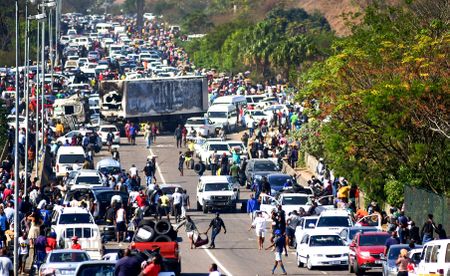
In an interview with Daily Maverick, Human Rights Watch researcher Nomathamsanqa Masiko-Mpaka said that over the past 12 months, vigilante groups like March and March and Operation Dudula have prevented migrants from accessing healthcare in places like Addington, KZN and Hillbrow, Johannesburg.
“This has been happening for about a year. It’s an ongoing crisis, but this is really … the build-up … A lot of [people] feel like the government is really only starting to act now at the eleventh hour, whereas they should’ve acted a year ago,” she said. Like Landau, Masiko-Mpaka also noted the glaring lack of arrests.
“If nobody was prosecuted for the crime of preventing somebody from accessing healthcare and all these other violations that we have seen taking place in the past three months, what makes us feel secure that when 30 June comes, the same police officers who have been turning the other way are actually going to finally do their jobs?”
Instead of arresting those responsible for instigating the unrest, the government has moved to placate South Africans by “trying to do the work of March and March”, said Landau. It has beefed up its immigration systems and border security, and Home Affairs and law enforcement officials are conducting more raids on businesses in an effort to tackle illegal immigration following President Cyril Ramaphosa’s address to the nation on 7 June.
/file/attachments/orphans/ANCCONFday1111_169460.jpg "President Cyril Ramaphosa. (Photo: Leila Dougan/Daily Maverick)")
“That’s what they’ve been doing, but what they’re showing is that they’ve allowed March and March to tell them what to do… And the fact that the government has to bow to this movement is a sign of weakness,” he said.
Last month, ministers of the Justice, Crime Prevention and Security Cluster (JCPS) met top security officials, political parties and various groups behind the wave of anti-immigrant protests, including March and March, at the Union Buildings, to address the escalating protests against undocumented migrants. The Sunday Times reported that March and March’s Khambule walked out of the meeting, branding it a “talk-shop”.
Landau was concerned that a meeting of this nature further legitimised the movement.
“Those meetings should – if they had to happen, and there’s always a need to keep dialogue open – have happened… [somewhere] quietly. Where no one was watching … When you invite someone through the front door, you’re basically saying I see you as our equal.”
... And what is to gain?
Over the course of several interviews with Daily Maverick in recent weeks, Landau has repeated a phrase, “xenophobic violence pays”.
And so there are other political dimensions here, since some political parties stand to benefit in certain ways from the fomenting of xenophobic tensions, while others stand to lose.
“It will benefit all of the opposition parties who have been saying immigration is the problem. It legitimises them. It shows that they have their finger on the pulse of the South African electorate. And, of course, March and March will benefit the most,” said Landau.
The MK Party is projected to surge dramatically in eThekwini, potentially becoming the largest bloc in a 222-seat chamber where no party is expected to clear a majority. For MK, March and March helps expose Government of National Unity (GNU) governance failures, and mobilise the township and logistics worker votes – particularly in KZN, where MK and March and March both have a strong geographical presence – ahead of the 2026 local elections.
Susan Booysen, political analyst and director of research at the Mapungubwe Institute, who has been analysing the party’s recent by-election results in KZN, said MK seems to have become well-established as a “solid middle party” in the province.
“In terms of local politics, where there is so much diffusion of the vote, so many participants, and so many options, I really think they could come out as a mid-range party with solid support around the province – if not in many other places around the country as well,” she said.
Both Landau and Booysen believe that the ANC, and the GNU as a whole, stand to lose tremendously.
“I think, in the short term, Ramaphosa certainly will be the overall loser. He’s already embattled. But, I think, in some ways, many politicians within the government will continue to benefit as they have on all of this,” said Landau, adding that the public’s attention had been redirected from the likes of the Phala Phala saga and Madlanga Commission.
“The ANC probably loses the most,” said Booysen. “It was in their power to do more – to do more to manage border policy, to do more to manage conditions on the ground – poverty, unemployment, [and] inequality [during the 32 years that it has been in power].”
At a press conference on Thursday, 25 June, ANC secretary-general Fikile Mbabula issued a stunning rebuke of anti-immigrant groups and former president Zuma.
“Let us first place the facts before the public because they are too often drowned out by noise and by those who profit from fear. Government is acting, and it is acting at scale,” said Mbalula.
/file/attachments/orphans/ED_593543_420977.jpg "ANC secretary-general Fikile Mbalula has issued a rebuke of anti-immigrant groups ahead of planned nationwide protests. (Photo: Gallo Images / Sharon Seretlo)")
He echoed Vavi’s comments about a political hand being behind the xenophobic protests.
“Having placed the facts before you, let us now speak plainly and politically, because what is now unfolding on our streets is not, at its heart, about immigration at all. We have seen this architecture before. In July 2021, our country was dragged to the very edge of the abyss by a coordinated assault dressed up as a grievance; an organised attempt to render the country ungovernable and to challenge the authority of the democratic state itself.
“What we are witnessing now carries the same fingerprints. Unlawful immigration is being manipulated by new political formations – a convenient cover by political formations whose real purpose is to manufacture chaos to collapse the institutions of the state, and to engineer fear and unfair conditions on the very eve of our local government elections,” he continued.
Mbalula, then, took aim at Zuma himself.
“Jacob Zuma was the state president of this country. He was here when people were crying about illegal immigrants … Today, he stands on platforms… supporting March and March, standing in the streets, and marshalling our people to chaos and anarchy.
“There are formations in our politics that have embraced an open ethno-nationalism, politically convenient to mobilise our people politically for… election manipulation… Populism will win some votes, but it will not be forever,” he concluded.
‘Mabahambe’
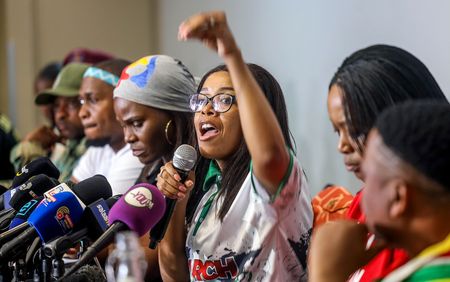
At a press conference on Wednesday, 24 June, the organisers of the 30 June demonstrations, which include more than 20 anti-immigrant groups, including March and March, said they were pressing ahead with plans for nationwide protests next Tuesday. However, they insisted that no violence, killing or looting would occur.
Ngobese-Zuma said it was the responsibility of the state to maintain law and order.
“Whose responsibility is it to protect the country? Is it us? It’s definitely not our responsibility. You can’t place that on us. If the government is going to be spending R600-million, then they must work for it. They must show us that they can be able to protect the country,” she said.
On Wednesday, acting Police Minister Firoz Cachalia announced that SAPS would collaborate with private security companies to increase manpower and prevent a repetition of the July 2021 unrest that left thousands of businesses looted and more than 300 people dead.
The MK party has confirmed that it will participate in the 30 June action, but has called up its members to “conduct themselves in a peaceful, disciplined and lawful manner”.
In Gauteng, some residents have joined the calls for undocumented migrants to leave South Africa ahead of the planned mass action.
Sphiwe Miles Hlatshwayo (47) from Old Dobsonville, Soweto, said he was advocating for the expulsion of undocumented migrants.
“The system has prioritised illegal migrants instead of South Africans,” he said.
Asked if he should then not direct his anger at the system and those in charge of its implementation, Hlatshwayo said he did not see any problem with directing his anger at foreign nationals because it would evoke the same reaction from the government as it would have had the anger been directed at it.
“I cannot say what will happen on 30 June, but I will also be part of the marches in Soweto. I don’t believe that we should take the law into our hands. Crowds can be very deceiving, but you want to be careful not to face the music alone in the end,” he said.
/file/attachments/orphans/Z63_4846copy_879547.jpg "‘Foreigners Must Go’: A small group of March and March protesters move along the Wynberg Main Road, Johannesburg, on Saturday 20 June 2026. (Photo: David Harrison)")
“I believe that all illegal foreigners have received the message. The government has received the message and we must let the government handle the law enforcement part to avoid direct confrontations and bloodshed… We have been quiet for far too long and I don’t think the sudden call to action is exaggerated at all. It’s a result of years of crying out to an incompetent government for help,” said Hlatshwayo.
Siyabonga Zwane (59) from Jabulani, Soweto, called on residents to not “lose [their] humanity” by laying their hands on others on 30 June.
“Mabahambe, kodwa bengahlaselwa,” said Zwane, stating his position in Zulu, that undocumented migrants must leave SA but not be harmed.
“I fully support the call for illegal immigrants to leave the country,” he said. “They are a burden to an already struggling nation.”
“I personally wish nothing happens on 30 June other than the peaceful marches. No one knows what will happen, but there is too much anger from many people,” he said.
“We need to be disciplined if we are to be taken seriously. We cannot complain about illegal foreigners, but then loot their businesses. The crowds must remain disciplined throughout the marches.”
Nhlanhla Skosana (22) from Pimville, Soweto, disagreed, saying he believed undocumented migrants would be “expelled” on Tuesday. “I think on 30 June we will be all over, expelling illegal foreigners and reclaiming our businesses and spaces,” he said.
“I don’t believe in violence, but I believe that illegal foreigners must be pushed out,” said Skosana.
/file/attachments/orphans/MARCH20_574920.jpg "Protesters march to companies alleged to be employing foreign nationals in the Boksburg and Benoni areas, east of Johannesburg, on Monday, 8 June 2026. (Photo: Leon Sadiki)")
/file/attachments/orphans/MARCH1_412158.jpg "Anti-foreigner protesters march in the Boksburg and Benoni areas on Monday, 8 June 2026. (Photo: Leon Sadiki)")
Langelihle Ndlovu (38), who lives in Berea, near Hillbrow, said she does not support the anti-immigrant movements. “I do not support this March and March… They just want to create looting on the 30th, and I think whatever they are up to is not legal.”
“I also think this thing is very selective, there are groups that are being targeted, like Somalians, Nigerians, Zimbabweans and people from Mozambique. No one is asking if there [are] any illegal white people in the country.”
Leaving in fear
Musa Mariko (57) from Mali, who has lived in SA since 2006, owns a store in Johannesburg. When Daily Maverick spoke to Mariko, he was on his lunch break, seated on a bench just outside his workplace.
He said he had witnessed a lot of people leave in fear of what was going to happen on 30 June, but he was not going anywhere. “I know this thing… This is not the first time we are experiencing this, [the] same thing was happening back in 2008,” he said.
“For now, I cannot say anything, we just have to wait and see what will happen… People are really scared. I have been living in Johannesburg since I arrived in South Africa, and to tell you the truth, it is emptying day by day. Whatever the anti-immigration movements are doing is wrong; it’s like they are undermining the work of the government. It’s not fair to drag people from their homes and ask for papers… that is the job of police and immigration officers,” he said.
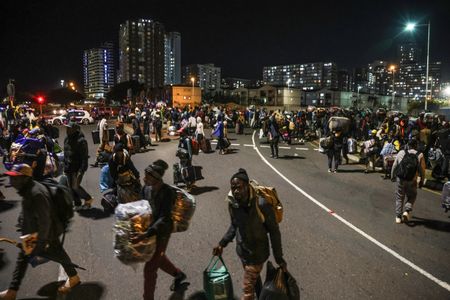
Amid the wave of anti-immigrant protests, the Siyafana Sonke Action Campaign, representing 160 civil society organisations across South Africa, has requested an urgent meeting with President Ramaphosa, and has called for the immediate cancellation of the 30 June action and of the “self-declared deadline”.
The campaign was due to meet with officials from the Presidency on Thursday evening.
“We demand this intervention to prevent any further loss of innocent life. The ongoing pogroms being carried out against migrant communities, including the forced removals from their homes and forced repatriation, must end today. Each day of delay evidently results in further escalation of this crisis, and we can no longer afford inaction or silence,” they said.
/file/attachments/orphans/WFD_7665_559937.jpg "Refugees wait at a repatriation centre in Durban on 24 June 2026 as preparations for processing continue. (Photo: Felix Dlangamandla)")
Mahtab Abedin (35), from Bangladesh, owns a spaza shop in downtown Johannesburg and came to South Africa in 2015. When the protests began escalating, Abedin said it was best that his family remain in Bangladesh.
“It is easier to deal with these issues without having to worry about my family,” he said. “I cannot count how many times I have been forced to close my shop by the protest guys – they always come back to ask for papers … I have a permit to operate the shop here.”
Daily Maverick sent questions to the SAPS, but had received no response by the time of publication. DM
Additional reporting by Bheki Simelane.
/file/attachments/2994/FastFactsMigrantsinSA_22June2026_revised_page-0001_445602.jpg)
/file/attachments/2994/FastFactsMigrantsinSA_22June2026_revised_page-0002_911274.jpg)
Comments
Scroll down to load comments...