



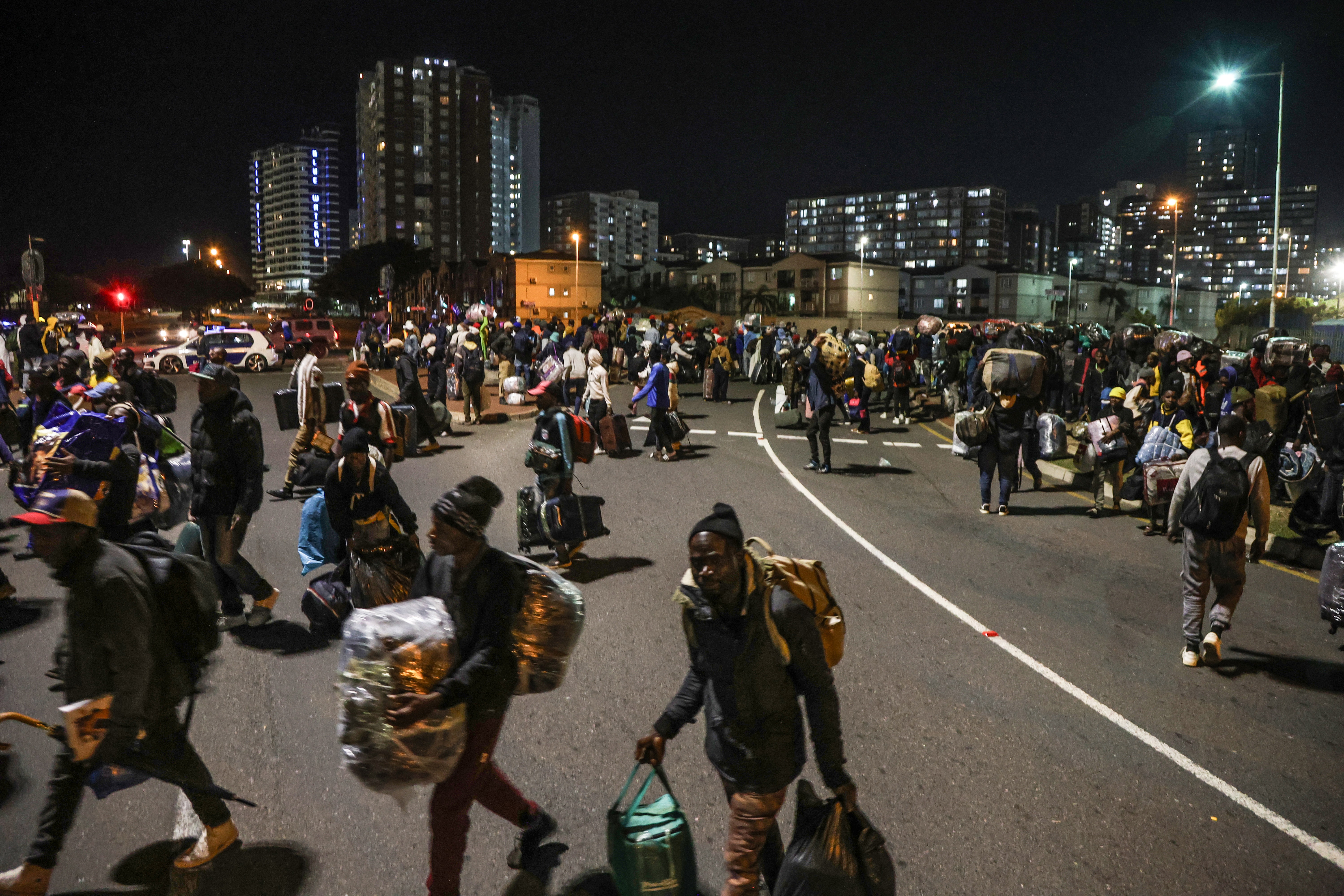
 Malawian nationals arrive in large numbers at a repatriation centre in Durban’s city centre on 23 June, ahead of their voluntary return to Malawi. (Photo: Felix Dlangamandla)
As South Africans brace themselves for violence on 30 June, thousands of terrified Malawians are flocking to the old Durban Drive-In site to escape xenophobic attacks.
Relief workers are caring for about 11,000 people seeking repatriation after being chased from their homes. The site is about one square kilometre, a few hundred metres from the beachfront.
The government has vowed not to be cowed by the organisers of the planned anti-illegal immigration protests on 30 June, but security forces and civilians, especially in KwaZulu-Natal, are on high alert.
Many residents are stockpiling essentials, fearing a repeat of the July 2021 violence that claimed more than 350 lives.
The drive-in site has become the face of South African xenophobia. Malawians initially congregated on a suburban sportsfield in Sherwood, 10km away, but as their numbers swelled, a humanitarian crisis unfolded, prompting authorities to open up the old drive-in site.
This is one of several camps where people have sought refuge.
In Pietermaritzburg, more than 1,000 Malawians have gathered in an abandoned government building. In Chatsworth, south of Durban, Zimbabweans have congregated. In Glenwood, many Congolese are camped outside a government office.
At the Durban Drive-In site, a host of charities are catering for multitudes whose lives seem like something out of a horror movie. Queues snake around the site, boxed in by a palisade fence with one entrance, which is manned by city police and private security.
/file/attachments/orphans/WFD_7665_559937.jpg "Malawians on 24 June at the old Durban Drive-In, which has turned into a repatriation centre. (Photo: Felix Dlangamandla)")
/file/attachments/orphans/6I1A5491_673335.jpg "Volunteers prepare food for refugees at a repatriation centre in Durban on 24 June. (Photo: Felix Dlangamandla)")
“We came here because they came in the middle of the night with sticks,” said Wisdom Kaiee, a tailor who has lived in South Africa for a year. “They shouted at us to leave.”
Pulling a suitcase, he was among a group who arrived at the site on Wednesday morning.
“We are fearful,” he said. “We must go home.”
‘People have died’
Kaiee has no idea how long the journey will take.
“We could stay here for a week. We could stay here for two weeks. But people have died, so we came here to protect our lives.”
He and his friends were among the first to line up outside the fence, anxious to secure a place inside the enclosure. They waited with their possessions packed into hastily assembled bundles, and children huddled at the feet of their visibly exhausted parents.
Hawkers lined the fence selling energy drinks. Others were doing brisk business selling solar-powered phone chargers.
Inside the camp, circus-sized tents have been erected to shelter people from the elements, but 31-year-old Mayo Manelema said he, his wife and their five-year-old son have been outside the tents for three days.
The family, like thousands of others, finds cold comfort on thin grass mats or blankets, clinging to what few possessions they could salvage before they fled.
“I hope it doesn’t rain. There is no space in the tent for us,” said Manelema, tending to his son.
The family expects to wait at least two more days before they get seats on a bus home.
/file/attachments/orphans/6I1A5363_387746.jpg "Malawians in a tent at the old Durban Drive-In on 23 June, as they await processing for repatriation. (Photo: Felix Dlangamandla)")
/file/attachments/orphans/6I1A5406_732535.jpg "Metro police officers monitor the arrival of Malawian nationals at the old Durban Drive-In on 23 June. (Photo: Felix Dlangamandla)")
/file/attachments/orphans/6I1A5340_627427.jpg "Malawians queue outside the old Durban Drive-In on 23 June. (Photo: Felix Dlangamandla)")
Processing the Malawians for repatriation is excruciatingly slow. Most of them are undocumented.
Bureaucratic process
Cyril Mncwabe, the provincial manager of Home Affairs, said more than 9,000 Malawians had been repatriated since mid-June, but he acknowledged the bureaucratic process was “long”.
Returnees queue to be fingerprinted at a police desk to check for criminal records. Then they move on to the Home Affairs queue and finally to a desk staffed by Malawian officials.
Only then can they get their names on a list to board a bus.
“There is no way you can short-circuit this. Initially, we took them to appear before a magistrate, but that deportation process was tedious. We abandoned that and started this repatriation, but we have to follow the steps,” said Mncwabe.
“It is difficult for me to say how long this will take. This is not something that will be finished soon.”
Volunteer relief workers are frustrated with the process.
They said it would take weeks to clear the crowds if buses left regularly, but on some days, only three buses (each with 70 passengers) left.
/file/attachments/orphans/6I1A5385_260885.jpg "Malawians inside a bus in Durban on 23 June as they begin their journey back home. (Photo: Felix Dlangamandla)")
/file/attachments/orphans/6I1A5347_517954.jpg "Malawian nationals board Malawi-bound buses outside the repatriation centre in Durban's city centre on 23 June. (Photo: Felix Dlangamandla)")
On other days, as many as 20 buses are filled.
“We have buses waiting to take them home, and thousands more are arriving every day, but they can’t go because of the paperwork,” said a relief worker.
Tented hospital
At the old drive-in site, municipal workers empty rows of portable toilets and fix pipes to makeshift showers. There is a tented hospital with an emergency room, a Red Cross station and tents supplying food and medicine. People receive one cooked meal a day, plus baby food and blankets.
Brothers Yassir and Naweed Osman are members of Islamic Relief South Africa, possibly the biggest volunteer group at the site.
“We don’t know how many people there actually are,” said Naweed. “We think there are 11,000 people inside and about 2,700 outside. We have 60 pots on the boil. Each pot feeds about 150 people with a hot meal. Plus, we go through about 2,000 loaves of bread in the morning and the same in the evening.”
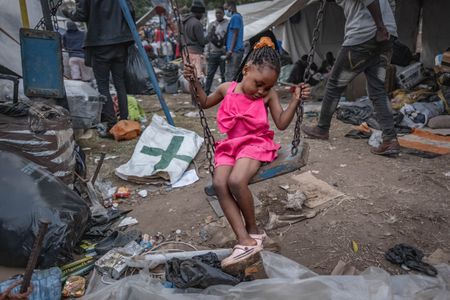
The Osman brothers work with Catherine Smith, a member of the City Hope group, a Christian-based charity.
Smith said hygiene packs, baby food and blankets were in high demand. Relief workers said seven babies were born at the Sherwood site and one at the old drive-in site.
“It is heartbreaking to see these children,” said Yassir. “Everybody wants to go home. None of these people want to stay here, but at this rate it will take weeks to get them home.”
/file/attachments/orphans/6I1A5478_726278.jpg "A young boy stands beside his mother outside a repatriation centre in Durban on 24 June as they wait to be processed for their return journey to Malawi. (Photo: Felix Dlangamandla)")
/file/attachments/orphans/WFD_7708_669000.jpg "Malawians play soccer at a repatriation centre in Durban on 24 June, while awaiting transportation back home. (Photo: Felix Dlangamandla)")
Bilall Jeewa from the Gift of the Givers Foundation said his organisation had dispatched its first bus transporting Malawians from Durban to Blantyre, a three-day trip.
“Many of those waiting are vulnerable, like mothers with infants, who have been waiting outdoors in difficult conditions for their turn to travel. It’s a crisis, but people are working together to deal with it.”
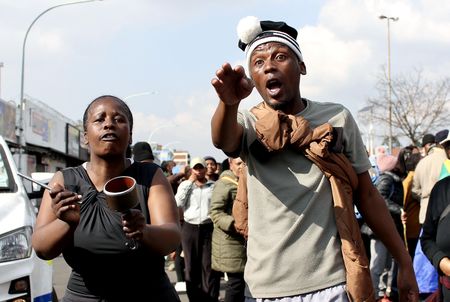
While charity groups scramble to help the displaced, sjambok-wielding, spear-waving protesters who chased them to the site prepare for 30 June.
Anti-immigrant demonstration organisers said they have applied for demonstration permits and have distanced themselves from violence. But they say it is the government’s responsibility to protect people.
The South African Police Service says it will spend R600-million to beef up security ahead of 30 June. The acting national police commissioner, Lieutenant General Puleng Dimpane, said operational plans had been finalised and resources mobilised.
In KZN, messages urging preparedness are being shared on company and community social media groups.
A message on a community policing forum group urged residents to be wary of fake news and fearmongering, but to stock up on essentials.
Another message on a security group promised that police would adopt “zero-tolerance” towards public displays of dangerous weapons.
Security analysts have warned that transport corridors and strategic logistics nodes could face disruption on 30 June.
/file/attachments/orphans/6I1A5522_401456.jpg "Malawians awaiting repatriation at the old Durban Drive-In on 24 June. (Photo: Felix Dlangamandla)")
The South African National Taxi Council has distanced itself from planned marches and issued a strong warning against attempts to disrupt public transport services.
Fouché Burgers from Business Against Crime South Africa said, “We are without a doubt a lot better prepared than in July 2021. We have more than 500 private security companies providing situational information; drones, helicopters, armoured vehicles, you name it.
“There are lots of boots on the ground. Big and small private security companies will be able to help police the public space if need be. Our cooperation with the police, under the banner of the Eyes and Ears initiative, formalises our structures in joint SAPS provincial command centres and the National Operational Command Centre. All the information we get from radios ... and social media goes directly to the police. I have a lot of hope in our capacity to stop any violence.” DM
Comments
Scroll down to load comments...