




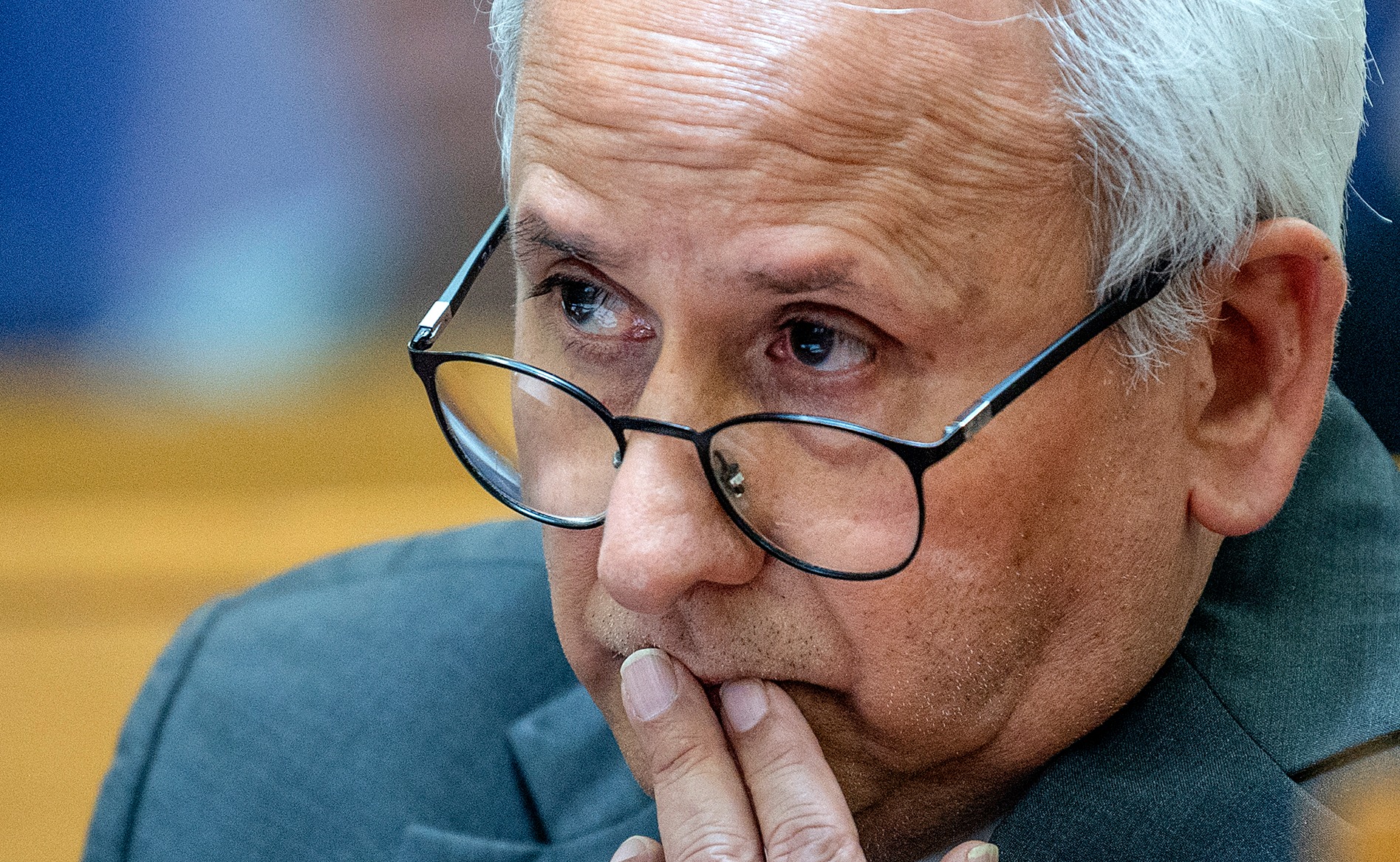
 Acting Police Minister Firoz Cachalia has warned that violence and armed participation in protests will not be tolerated (Photo: Brenton Geach / Gallo Images)
Acting Police Minister Firoz Cachalia has issued a firm warning to those contemplating acts of lawlessness during anti-immigrant protests on 30 June, saying violence will not be tolerated and no one is allowed to participate in protest action armed.
“Our message is clear: Everyone has the constitutional right to protest peacefully and within the confines of the law. However, criminality, intimidation, violence, the destruction of property and any attempt to undermine public safety will not be tolerated,” Cachalia said at a press conference on Monday, 22 June.
“We have been hesitant for too long to speak clearly on this matter. There is no reason why anybody should come to protest with any kind of instrument which could be used as a weapon.
“We are giving a clear message today that people should participate in protest action unarmed.”
Cachalia, together with Defence Minister Angie Motshekga and the acting national commissioner of the South African Police Service (SAPS), Lieutenant General Puleng Dimpane, addressed the media on preparations ahead of the 30 June deadline that has been set by anti-immigrant groups.
This comes after a 29-year-old Malawian man was killed and two other foreign nationals were attacked by a vigilante group in Pietermaritzburg on Friday. The incidents followed a protest by the anti-foreigner group March and March, led by Jacinta Ngobese-Zuma, reported News24.
Earlier this month, two Mozambican nationals were killed in Mossel Bay, Western Cape, when xenophobic violence erupted against foreign nationals in the area.
The recurring reports of violence, racism and xenophobia against migrants come as anti-immigrant protests led or inspired by March and March continue to gather pace. The organisers of the ongoing campaign against immigrants have set a 30 June “deadline” for undocumented foreign nationals to leave South Africa.
/file/attachments/orphans/MARCH16_371392.jpg "Protesters, made up of community members and civic organisations, march to companies alleged to be employing foreign nationals in Boksburg and Benoni, east of Johannesburg, on 8 June. (Photo: Leon Sadiki)")
On Monday, Cachalia said the SAPS had ramped up its operational readiness across all nine provinces, with plans in place to protect communities, critical infrastructure and public spaces. KwaZulu-Natal, Gauteng, Eastern Cape and Western Cape have been flagged as potential hotspots.
The special operation, Cachalia said, was costing taxpayers more than R600-million.
“That’s what it costs when there are efforts to destabilise the country,” he said.
He added that those who want to protest next week “are expected to indicate in advance what their plans are, how many marshals they have employed, and to give a clear message to their supporters not to arrive and participate in protest action armed.
“We call on every South African to reject violence, to uphold the rule of law — uphold the dignity of all the people who are in our country — and to work with law enforcement in maintaining peace and stability.
“To those who may be contemplating acts of lawlessness, our message is equally clear: the full might of the law will be brought to deal decisively with anyone who seeks to undermine the safety, security and constitutional order of our republic.”
Leaders must step up
Cachalia called on local and national leaders to speak clearly in support of the SAPS efforts.
“I think in this moment, apart from the responsibilities of law enforcement, it is very important for the leaders of our people on the ground, those who play important roles, to step up and to make a clear statement in support of the efforts of the South African Police Service to maintain the safety and security of our people.
“We should leave no area of uncertainty on this matter,” he said.
His statements come after Justice and Constitutional Development Minister Mmamoloko Kubayi and Deputy Minister of International Relations and Cooperation Thandi Moraka met with the prime minister of the Zulu Kingdom, Inkosi Thulasizwe Buthelezi, on Sunday, to seek the support of traditional leadership in addressing concerns relating to illegal immigration ahead of 30 June.
President Cyril Ramaphosa met with faith-based organisations last Wednesday to discuss, among other things, immigration issues.
As part of the preparations, Cachalia said that SAPS would engage with premiers across all provinces “to ensure there is a coordinated, whole-of-government approach to maintaining peace, stability and the uninterrupted functioning of essential services.”
/file/attachments/orphans/Z63_5140copy_412870.jpg "A March and March protest in Wynberg, Cape Town, on 20 June 2026. (Photo: David Harrison)")
Cachalia said that SAPS may request the support of the South African National Defence Force (SANDF), should the operational environment require additional support to augment existing police efforts.
Motshekga said that while the SANDF has a “limited and restricted role” in public order policing, based on the government’s experience of the 2021 riots, there is a need for the SANDF to act as a contingency measure “in case things just go out of hand.
“We don’t expect that from the information that we are getting, and we want to assume that [there are] going to be orderly marches. In case things get out of hand, police will invite us to assist,” she said, adding that the President needs to grant permission for SANDF deployment. DM
Comments
Scroll down to load comments...