



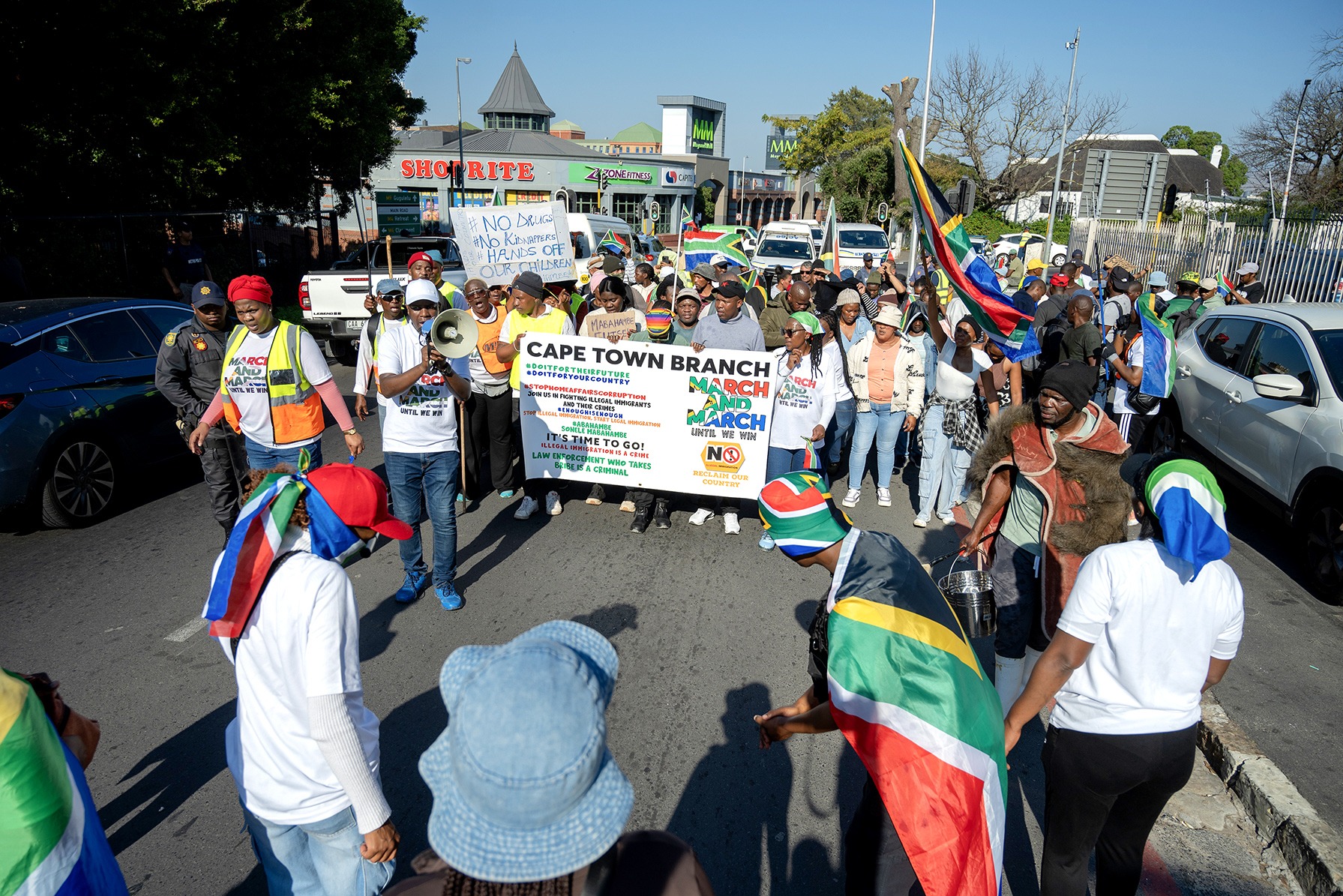
 March and March supporters protest in the Cape Town suburb of Wynberg on Saturday, 20. (Photo: David Harrison)
The acting minister of police, Firoz Cachalia, says the South African Police Service (SAPS) is operationally prepared to deal with planned demonstrations scheduled for 30 June, as anti-immigration campaigns and calls for undocumented foreign nationals to leave the country by that date gain momentum across South Africa.
Cachalia met with SAPS management, led by Acting National Commissioner Lieutenant General Puleng Dimpane, at the Tshwane Academy College in Pretoria on Saturday, 20 June, where he received briefings on national and provincial operational plans to ensure demonstrations take place safely and peacefully.
/file/attachments/orphans/WhatsApp-Image-2026-04-23-at-17552_457624_669172.jpg "From left: President Cyril Ramaphosa, the acting police commissioner, Lieutenant-General Puleng Dimpane, and the acting minister of police, Professor Firoz Cachalia. (Photo: Siyabulela Duda / GCIS)")
“While the constitutional right to peaceful protest will be respected, no acts of lawlessness, violence, intimidation or criminality will be tolerated. Weekly enforcement operations remain ongoing to verify the legal status of foreign nationals in the country,” said Cachalia.
“These operations are aimed at ensuring that all foreign nationals residing in South Africa are in the country legally and are in possession of valid documentation. Where violations of the law are identified, appropriate action will be taken in accordance with the law.”
Cape Town protest
The police preparations come as the anti-immigration movement March and March marched along Main Road from Wynberg towards Newlands in Cape Town on Saturday, protesting against undocumented migrants, who they say are taking jobs and school placements and contributing to drug-related crime. The march did not draw substantial numbers, estimated to be around 60.
/file/attachments/orphans/Z63_4661copy_840831.jpg "March and March protesters in Wynberg, Cape Town, on 20 June. (Photo: David Harrison)")
Authorities deployed a multi-agency force — including members of the SAPS, metro police, traffic police and law enforcement agencies — to monitor an anticipated crowd of 500 protesters, prompting most shops along the route to close.
According to organiser Charlie Roux, the demonstration served to support March and March leader Jacinta Ngobese-Zuma and protest against illegal foreign nationals, whom he said were taking jobs from South Africans.
/file/attachments/orphans/Z63_4800copy_755701.jpg "March and March organiser Charlie Roux gets into a heated argument with an SAPS officer after being informed that protesters would not be allowed to carry sticks. (Photo: David Harrison)")

“My household pays taxes… I followed Jacinta because at the time I had a kid who was doing Grade 7, who needed space for Grade 8 the next year in Durbanville. I’ve applied in the previous year already, when she was in Grade 7 and then came Grade 8: there were no spaces in public schools, and nobody could help me, but foreigners — they go today; tomorrow they have an answer,” claimed Roux.
“We are here today to urge the government to hear our grievances… All these different layers of businesses — whether they’re your domestics, your gardeners, or your maids — these are not scarce skills.
“There have been businesses and companies where we’ve got the right people to go into these places and conduct legit raids. Like, we heard that you have employed 20-plus foreigners, while you have two South Africans, and they are said to be illegal.”
A participant in the march, Bongani Mdletshe, claimed, “We understand that the law allows people to come to South Africa, but it is when we see that our fellow Africans have huge privileges in South Africa despite them doing huge things in different places, and many fellow Africans are here without proper documentation. Me being here is to ensure that I love my country. I am also here to ensure that South Africans take control of their own country.”
/file/attachments/orphans/Z63_4846copy_879547.jpg "March and March protesters march along Main Road, Wynberg, on Saturday, 20 June. (Photo: David Harrison)")
There was a smaller March and March protest in Sea Point on 16 June, in which about 40 people took part.
The marches come on the heels of President Cyril Ramaphosa’s June 7 speech detailing new immigration controls and condemning vigilante violence.
Data published by Daily Maverick indicates that migrants represent less than four million of the nation’s 63 million people; however, xenophobic violence remains a frequent electoral flashpoint, with major flare-ups occurring in 2008, 2015, 2019 and 2022.
/file/attachments/orphans/Z63_5140copy_412870.jpg "A small group of people pushed back against the March and March protest on Saturday, 20 June. (Photo: David Harrison)")
While protesters marched through Wynberg, a number of residents voiced solidarity with foreign nationals, telling Daily Maverick that expelling them would cause severe financial hardship for families with shared children.
/file/attachments/orphans/Z63_4922copy_549971.jpg "Onlookers watch the march from their apartment balconies in Wynberg. (Photo: David Harrison)")
A Burundian migrant, Shabaani Hannis, said, “We understand that [they are marching over illegal foreign nationals], but some people have work here legally, but there are [also] illegal people. It’s a difficult topic.”
“I don’t even know what to say about legal and illegal because I understand there are illegal immigrants here in the area; there are a lot of them. South Africa is the United States of Africa. People would come from all over for opportunities. Some of them, they get opportunities. They go back home, and they do their own businesses. We’re all looking for that pot of gold, to get something and go back home, but unfortunately, it happens that people stay longer than they should.”
/file/attachments/orphans/Z63_4752copy_393561.jpg "Some onlookers filmed the protesters as they marched on Saturday. (Photo: David Harrison)")
Another Burundi national, Schekem Gakila, said the reason behind the mass drive to South Africa was hunger. “The thing that I can say as a foreigner here in South Africa is we cannot say that we are innocent. There are foreigners who are doing crime. But most of the foreigners are not involved in criminal things, or drugs or whatever.
“Most foreigners are stuck in here, not because of jobs. Most foreigners are stuck here because of the food. The country [South Africa] is well established, so you cannot live somewhere where there is no food.”
Justice Minister Mmamoloko Kubayi said in Ethekwini on Sunday that approximately 5,000 Malawian immigrants have been repatriated, with another 2,000, mostly men, processed and due to leave on Sunday night. Malawian nationals have fled their homes and are being sheltered in tents where they are processed and sent home on buses. Women and children made up the bulk of the 5,000 group. Residents and the Red Cross have been providing support through medical care and food.
DM
Comments
Scroll down to load comments...