




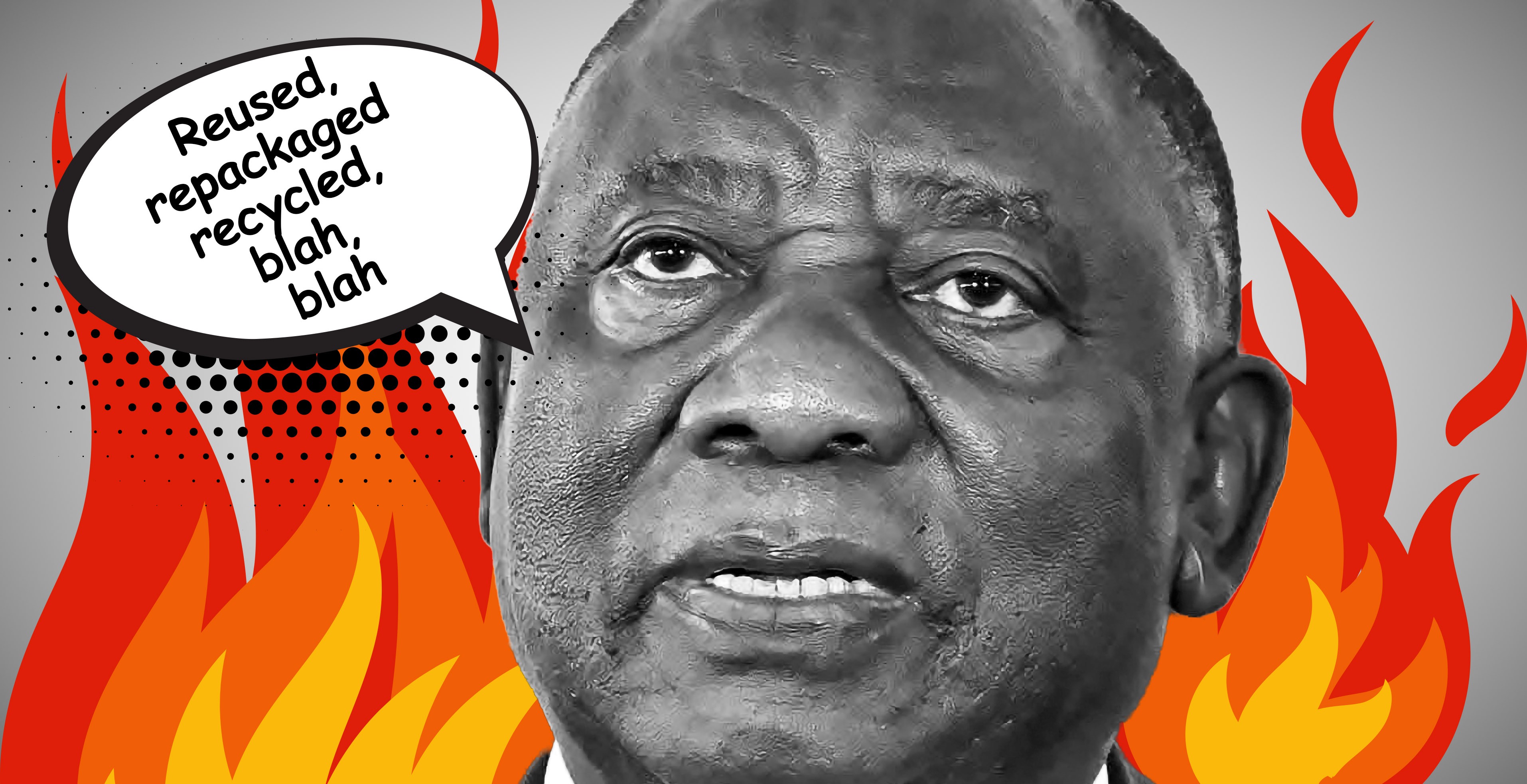
 Illustrative image: President Cyril Ramaphosa (Photo and images: Mlungisi Louw/Volksblad/Gallo Images; Vecteezy)
Under pressure from anti-foreigner groups, President Cyril Ramaphosa has rehashed old policies in an attempt to take control of the immigration debate.
In a televised address on Sunday, 7 June, Ramaphosa announced a series of measures to tackle illegal immigration, while also condemning the groups inciting lawlessness and violence.
“We will act against forces who are exploiting the concerns of our people about illegal immigration to further their own political, personal or criminal agendas. We will not be fooled or influenced by social media campaigns that spread misinformation, fake news and lies about foreign nationals,” he said.
His address comes as anti-foreigner protests around South Africa continue to gather pace, and politicians increasingly utter xenophobic and Afrophobic rhetoric as a way to garner votes ahead of the 2026 municipal elections. Two people have been killed in the xenophobic unrest in Mossel Bay.
The protests, led or inspired by the anti-foreigner movement March and March and other groups, have continued unabated after Ramaphosa’s speech, including in Boksburg, Springs and Benoni.
There are fewer than four million migrants in South Africa, which has a total population of 63 million. But xenophobic violence has become frequent, particularly during election periods. The worst incidents and the most resulting deaths occurred in 2008, 2015, 2019 and 2022.
According to Xenowatch, a project at the African Centre for Migration and Society (ACMS) at Wits University, the violence has claimed at least 612 lives since 2008.
After each surge in attacks, Pretoria has drafted plans to address the issue. In 2015, it established an inter-ministerial committee to tackle it. In 2019, the Cabinet approved the National Action Plan to Combat Racism, Racial Discrimination, Xenophobia and Related Intolerance.
/file/attachments/2993/JACINTA-NGOBESE-866x5771_321287.jpg "The leader of March and March, Jacinta Ngobese-Zuma, giving a speech. (Photo: Facebook)")
A Human Rights Watch report released in September 2020 found that the action plan had failed to curb xenophobic violence and the problems faced by foreign nationals in South Africa.
On Sunday, Ramaphosa focused instead on a five-part plan to tackle illegal immigration. The plan is mostly based on existing government policies.
Activists and researchers are concerned about this recycled approach and what it is trying to achieve. Professor Loren Landau of the ACMS said it relied on perceptions rather than facts.
“The right way to address this issue is to figure out what problem it is that we’re trying to solve. Are we trying to solve unemployment, insecurity, poor services, lack of education, etc? If that’s the problem we’re trying to solve, everything he’s proposed is useless,” Landau said.
“If the problem that we’re trying to solve is the perception that we are being inundated by immigrants, which is not true … [then] what he’s doing is in the playbook of other countries: trying to perform sovereignty. But even then, it seems it’s not enough, because if it were, the likes of [Operation] Dudula and March and March wouldn’t have been marching,” he added.
Sharon Ekambaram of Lawyers for Human Rights said that focusing time and resources on fewer than four million people does little to address poverty and inequality – problems for which migrants are often scapegoated but are, in reality, the result of the state’s failure to solve them.
In a joint statement on Tuesday, 9 June, civil society organisations noted their concerns about elements of the plan, such as the relocation of refugee centres to border posts and the new Employment Services Amendment Bill.
/file/attachments/2993/HKR_oayWMAAUh3-_920748.jpg)
Crackdown on violations of existing laws
The first part of the government’s response, Ramaphosa said, is “a concerted crackdown on violations of existing immigration, labour and other laws”.
He announced that the government would set up specialised courts to deal with immigration to “speedily” support the deportation of undocumented migrants. The proposal is contained in the revised White Paper on Citizenship, Immigration and Refugee Protection, which the Cabinet approved in March.
According to the white paper, these courts would address the “systematic delays in immigration adjudication” by expediting the review of decisions made by the Home Affairs director-general and minister; providing a structured legal avenue for immigration appeals to be heard and resolved within a reasonable time; and preventing unnecessary case backlogs in the high court.
Home Affairs Deputy Minister Njabulo Nzuza told Talk Radio 702 earlier this week that these courts would help reduce delays in the deportation process.
“With the specialised courts it’s going to be much easier for us to be able to pick up a person, then take them to those specialised courts, and then deport those people. Obviously, it comes at a very high cost,” said Nzuza, referring to deportations.
However, he suggested that South Africa would start “sending the bill” to the embassies of the countries the deportees belong to.
Department of Justice and Constitutional Development spokesperson Palesa Rammitlwa suggested that the specialised courts would not be physically new structures. Instead, the department would use “existing courtrooms and other suitable state buildings and structures to be identified”. She mentioned OR Tambo International Airport as an example.
Rammitlwa added that the courts would be established using existing funds.
“Engagements are still ongoing with stakeholders… As soon as those are completed, then a timeframe will be established,” she told Daily Maverick.
In his speech, Ramaphosa said the Department of Employment and Labour (DEL) had launched the phased recruitment of 10,000 labour inspectors for this financial year – an announcement he had made in his State of the Nation Address in February.
A DEL presentation to Parliament on 3 June indicated that there are about 2,300 labour inspectors, who are able to inspect just over 300,000 workplaces a year.
/file/attachments/2993/Nomakhosazana-Meth-1170x750-1-1024x656_888214.jpg "Minister of Employment and Labour Nomakhosazana Meth. (Photo: Getty Images)")
“The additional 10,000 inspectors would be able to cover over 1,600,000 workplaces per annum. Which would be a staggering achievement,” the presentation read.
Addressing the question of 10,000 labour inspectors, Sam Morotoba, acting director-general at the DEL, told the committee that the department had already begun a programme involving 20,000 young people, with about 4,000 already placed in labour centres. Efforts are under way to recruit the remaining participants for the first phase of 10,000 inspectors, while a second intake is planned for the 2027/28 financial year.
However, Morotoba also explained that the President’s announcement of the 10,000 inspectors had not initially been included in the department’s annual plan or budget allocations, as budget planning had already been under way. However, discussions with the National Treasury would begin this month to secure funding for implementation in the 2027/28 financial year.
Nzuza told Talk Radio 702 that Ramaphosa’s announcement meant that Home Affairs’ capacity for inspections would be supported by the DEL and the South African Police Service. He said Home Affairs had begun preparations ahead of Ramaphosa’s speech.
Securing our borders
Ramaphosa said the government would take additional measures to secure South Africa’s borders. This includes continued investment in “modern technology, infrastructure and personnel”, he said.
The Border Management Authority, which is tasked with protecting the country’s borders, has been hamstrung by chronic underfunding, outdated technology and staffing constraints, despite promises to improve its capabilities since its establishment in 2023.
Last year, officials from the authority told Parliament that it had vacancies of more than 8,500 personnel and was operating with only 2,600, News24 reported.
/file/attachments/2993/ED_597179_875057.jpg "PRETORIA, SOUTH AFRICA - FEBRUARY 23: Minister of Home Affairs Dr Leon Schreiber briefs the media to provide an update on its ongoing investigation into allegations of serious maladministration within the Department of Home Affairs (DHA) at Tshedimosetso House on February 23, 2026 in Pretoria, South Africa. The investigation focused on recurring schemes involving document fraud, visa and work-permit manipulation, and facilitation networks enabling unauthorised entry into South Africa. (Photo by Gallo Images/Frennie Shivambu)")
In February, Finance Minister Enoch Godongwana allocated an additional R990-million to the authority over the medium term to fill 738 positions.
In his speech, Ramaphosa also said the government would begin a “phased relocation” of refugee reception centres to South Africa’s border posts, starting with the Tshwane Refugee Centre later this year.
“Many other countries have refugee reception centres close to the place where refugees enter the country seeking asylum or refuge. The relocation of refugee reception centres closer to our borders is intended to ensure that asylum applications are processed more efficiently, more securely and more fairly,” he said.
He added that this would allow the government to determine people’s protection needs at the border to ensure that those requiring genuine protection receive assistance as fast as possible.
The government has proposed and tried the relocation of refugee reception centres multiple times over the past decade. The revised White Paper on Citizenship, Immigration and Refugee Protection says that South Africa’s refugee reception offices “must be located at ports of entry to facilitate immediate assessment of asylum claims”.
However, it also recognises that the relocation of these centres to ports of entry is a “long-term goal that requires additional funding to be realised”.
The proposal has received criticism from civil society groups and activists who are concerned about refugees’ protection.
“South Africa’s asylum system is already under severe strain. The Refugee Reception Offices in Pretoria, Cape Town and Durban operate with enormous backlogs. Persons with valid asylum-seeker permits are frequently unable to renew their documentation for months, through no fault of their own. The Constitutional Court and other courts have repeatedly found administrative failures in the asylum system to be constitutionally untenable.
“We call on the government to engage meaningfully with civil society and affected communities before implementing any relocation of refugee reception infrastructure, and to commission a human rights impact assessment,” civil society organisations said in a joint statement.
In an opinion piece in News24 this week, Landau and Ekambaram wrote that relocating refugee centres was not administratively efficient and, if the centres were to effectively detain people at the border, they would probably violate the Constitution and be in conflict with South Africa’s obligations under the 1951 Refugee Convention, the 1969 OAU Convention on Refugee Protection in Africa, and the country’s own refugee laws.
Landau told Daily Maverick that relocating the offices to the border would not address the problems in South Africa’s asylum system. “You can move the offices wherever you like. That system is still not going to work,” he said.
Daily Maverick sent detailed questions to Home Affairs, but did not receive a response by the time of going to press.
Rooting out corruption
The third part of the government’s response, Ramaphosa said, “will be to continue strengthening our immigration system by stamping out corruption and deploying cutting-edge technology”. He admitted that there have been “weaknesses” in the way migration has been managed by the state, and recognised corruption as an enabler of irregular migration.
In February, an interim report by the Special Investigating Unit (SIU) revealed widespread corruption in Home Affairs. The report found, among other things, that a syndicate of four officials earned more than R16.3-million by exploiting their roles in visa processing.
/file/attachments/2993/jpeg_715269.jpeg "Supporters of the anti-foreigner movement March and March protesting in the streets of Durban earlier this year. Photo:")
The acting SIU head, Leonard Lekgetho, said the unit had uncovered evidence of collusion between foreign nationals and corrupt Home Affairs officials. He added that the SIU had made 275 criminal referrals to the National Prosecuting Authority and carried out 100 deportations following its investigation.
Nzuza told Talk Radio 702: “When it comes to the issue of corruption, we’ve made it very clear that we’re not going to tolerate it.”
Home Affairs had introduced the SIU to “clean up” the department.
Among the other measures Ramaphosa announced are the establishment of an Intelligent Population Register, which would contain biometric information for every person in SA, and the expedited phasing out of the green ID book, which has been identified as an enabler of identity theft by those wanting fake papers to stay in SA.
Aiming to close a loophole that allows widespread abuse, the Department of Transport plans to reform a system under which it allocates “traffic register numbers” (TRNs) to people without ID numbers so they can register vehicles and obtain driver’s licences.
Department spokesperson Collen Msibi told Daily Maverick: “There has been abuse of TRNs, including the use of TRNs beyond their intended transport-related purpose.
“The department is currently engaged in urgent consultation with its legal team on how to discontinue TRNs that have been identified as fraudulent…
“The department is also having urgent discussions with Home Affairs on how a unique ID number can be introduced which will be used as the basis for issuing of TRNs in the future.”
Closing gaps in legislation
Ramaphosa said: “The fourth part of our response is to close the gaps in our laws and policies. The laws that regulate immigration in South Africa are fragmented and often contradictory. They allow legal loopholes that are exploited by undocumented migrants.”
The National Labour Migration Policy White Paper, which the Cabinet approved in May 2025, and the Employment Services Amendment Bill, gazetted on 26 May this year and approved by the Cabinet, are two pieces of legislation Ramaphosa suggested would close these loopholes.
Both policies would restrict the employment of foreign nationals.
The bill, if enacted, would allow the minister of employment and labour to set quotas for foreign workers in certain sectors and mandate employers to prioritise South African workers. Employers would need to prove that no suitably qualified South African was available.
The civil society groups said the bill requires “careful human rights scrutiny”.
They added: “We note that employment quotas based on nationality raise complex questions of equality law, constitutional rights and international labour standards that require careful and evidence-based consideration.”
/file/attachments/2993/496303280_1104548551699464_3019745984189593515_n_927594.jpg "Minister of Transport Barbara Creecy. Photo: Gallo Images")
Envoys to African nations
The fifth and final part of Ramaphosa’s plan is to dispatch envoys to African nations to address the “broader challenge of migration” on the continent.
He first made this announcement during a meeting with Kenyan President William Ruto at the Union Buildings in Pretoria earlier this month.
The surge in xenophobic violence has resulted in a number of African nations issuing security advisories to their nationals and helping them to leave the country.
Zimbabwe, Ghana, Malawi, Mozambique and Nigeria have all deployed emergency transport to repatriate citizens in recent weeks. The Nigerian foreign minister said this week that her country was considering retaliating against South Africa for alleged attacks on its citizens.
This is not the first time South Africa has sent envoys to other countries over xenophobic violence. In 2019, Ramaphosa dispatched three officials to seven African nations to manage the diplomatic fallout after intense continental criticism of SA. Although Ramaphosa’s latest dispatch of envoys seems aimed at engaging African states to address migration together, his previous delegation focused on the steps the government was taking to stop the violence and hold the perpetrators to account. DM
Additional reporting by Peter Fabricius and Neesa Moodley.
This story first appeared in our weekly DM168 newspaper, available countrywide for R35.
/file/attachments/2993/DM-120626_491550.jpg)
Comments
Scroll down to load comments...