




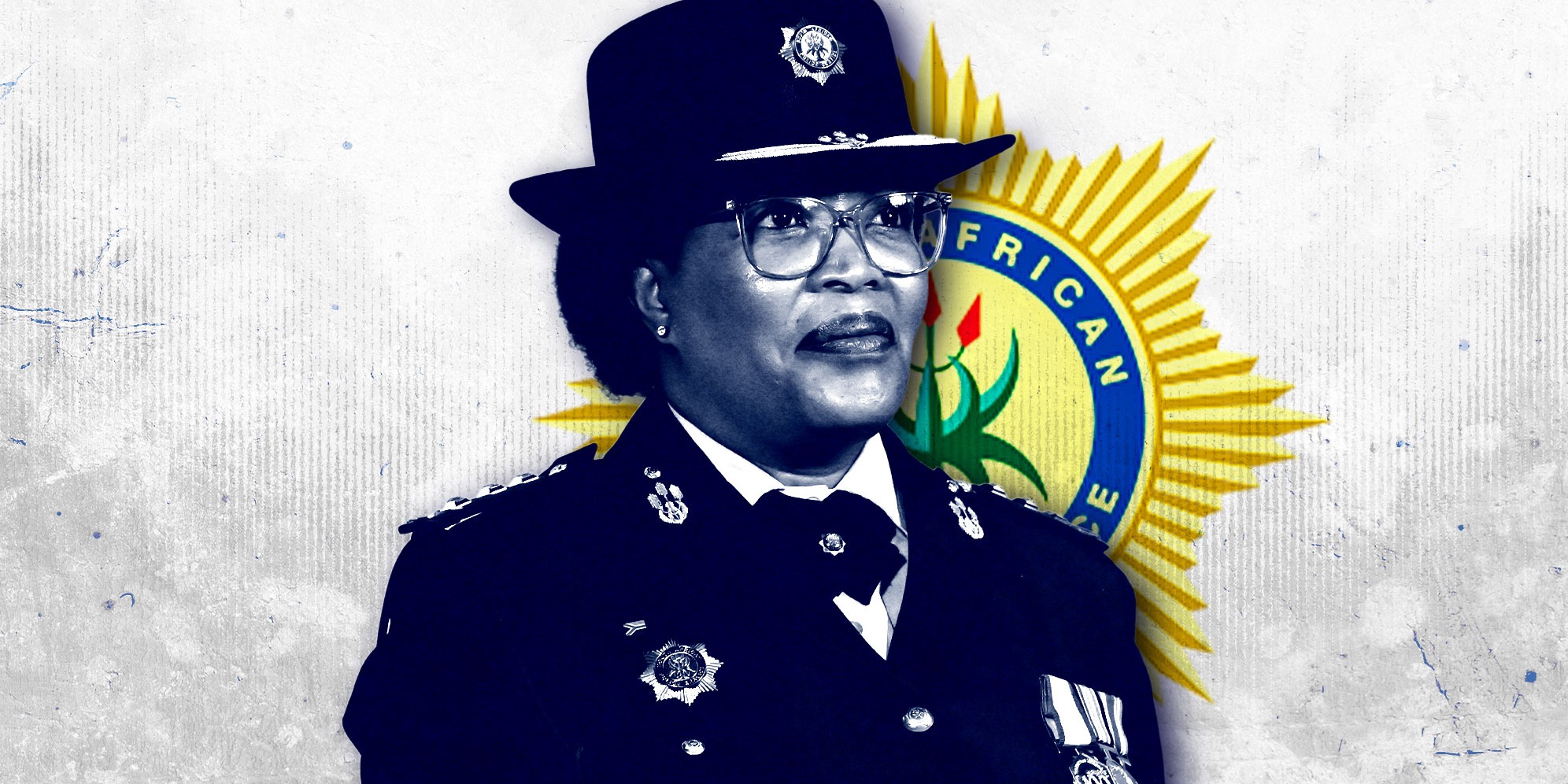
 Illustrative image: Lieutenant General Puleng Dimpane. (Photo: Frennie Shivambu / Gallo Images) | SAPS logo. (Image: Wikicommons) | (By Daniella Lee Ming Yesca)
Lieutenant General Puleng Dimpane has previously flagged what she terms a “problem” in the South African Police Service (SAPS) – no seriousness when it comes to consequences for irregular expenditure.
She is the police’s chief financial officer and detailed this stance when testifying in November last year before Parliament’s ad hoc committee investigating accusations that a drug cartel has infiltrated the criminal justice system, politics and private security.
Dimpane had come across as confident when testifying that officers involved in irregular spending faced written warnings or corrective counselling, but that this indicated “a culture in SAPS where [when it comes to] irregular expenditure, you’ll find, [that] there’s no seriousness [with] the accountability on it.”
She clearly did not mind outlining these policing problems on a national and public platform.
Dimpane now faces much more of that, along with intense public scrutiny.
Ramaphosa makes his move
On Thursday, 23 April 2026, President Cyril Ramaphosa appointed her to act in National Police Commissioner Fannie Masemola’s position after he placed Masemola on precautionary suspension.
Masemola’s sidelining comes two days after he made his first court appearance in Pretoria on criminal charges for allegedly contravening the Public Finance Management Act in a case connected to a dubiously awarded SAPS tender.
His court appearance put extra pressure on Ramaphosa to announce what would happen to him.
/file/attachments/orphans/WhatsApp-Image-2026-04-23-at-1755_165889.jpg "President Cyril Ramaphosa and new Acting Police Commissioner Lieutenant General Puleng Dimpane. (Photo: Siyabulela Duda / GCIS)")
This led to Ramaphosa publicly outlining his decision on Thursday.
He said given the “seriousness” of the charges Maseomla faced, he had agreed with Masemola to place him on precautionary suspension “pending the conclusion of the case”.
Ramaphosa described Dimpane, who steps in for Masemola, as having a reputation for “professionalism as well as for integrity”.
If she does not already have it, she will also need serious stamina as she is now in charge of the country’s police service at a time when it is experiencing unprecedented turbulence.
It has also become undeniably clear that there are rival factions in the SAPS.
If officers do not accept Dimpane’s leadership style or any changes she implements, she may be targeted, which might include smear campaigns.
Any past indiscretions on her part may now also be dredged up.
Plan to tackle procurement manipulation
Ramaphosa outlined Dimpane’s priority area of focus.
“A key area of attention for the acting national commissioner and the police leadership as a whole is to urgently address weaknesses in the procurement system for goods and services in the police service,” he said.
Ramaphosa said procurement had been identified as a source of corruption during a previous commission of inquiry into State Capture and at the Madlanga Commission of Inquiry, which is investigating criminal infiltration of law enforcement.
He said the “Minister of Police” would support the SAPS leadership “to undertake to insulate procurement processes from any form of manipulation”.
The police minister is, of course, Firoz Cachalia, who has been acting in the position since Senzo Mchunu was sidelined last year because of accusations that surfaced against him in the same law enforcement scandal now impacting on Masemola. Mchunu has denied any wrongdoing.
Dimpane’s appointment means that South Africa has both an acting national police commissioner and an acting police minister.
Masemola and Matlala
The criminal charges that have essentially resulted in Masemola’s suspension are connected to a R360-million SAPS tender that was awarded under dubious circumstances two years ago to a company, Medicare 24 Tshwane District.
This company was run by Vusimuzi “Cat” Matlala, who faces several criminal charges and has been accused of colluding with senior police officers.
/file/attachments/orphans/ED_604867_972755.jpg "Now-suspended National Police Commissioner Fannie Masemola appears in the Pretoria Magistrates’ Court on 21 April 2026. Masemola faces criminal charges linked to alleged breaches of the Public Finance Management Act. (Photo: Gallo Images / Frennie Shivambu)")
Matlala, one of his business associates and 12 other senior police officers already face criminal charges in the Medicare 24 Tshwane District contract case.
Masemola is expected back in the dock with them on 13 May.
Dimpane, given her chief financial officer position in policing, is no stranger to the Medicare 24 Tshwane District contract scandal.
Dimpane’s finance roles
But first, some background on the new acting commissioner.
According to the affidavit she submitted to Parliament’s ad hoc committee in November, Dimpane joined the SAPS in 2007 as an internal auditor.
She was the Free State police’s internal audit unit head, and later became the province’s finance boss.
At the start of 2019, Dimpane started as the SAPS’s chief financial officer, and this role included budget and expenditure management for the entire police service.
But Dimpane was not involved in operational issues, such as awarding contracts.
“I reiterate that I do not deal directly with service providers, nor do I have direct knowledge of individual contracts or their operational performance until issues are raised through established channels,” she said in her November affidavit to Parliament.
Dimpane added that she was not a member of the bid evaluation committee or the bid adjudication committee that awarded the tender to Matlala’s Medicare 24 Tshwane District.
The controversial cop contract
In her November affidavit, she said she first heard about issues linked to the tender when she returned from leave in January 2025.
“The matter fell within my area of responsibility because the National Commissioner had tasked the internal audit and risk management components with reviewing the award,” Dimpane said.
She received the first formal report on it in March 2025, and it flagged “there might be possible irregular expenditure that would have to be declared concerning the contract.”
/file/attachments/orphans/ED_601860_804170.jpg "Vusimuzi ‘Cat’ Matlala appears in the Pretoria Magistrates’ Court on 25 March 2026. His company, Medicare 24 Tshwane District, was controversially awarded a police tender in 2024 that now forms part of a major court case. (Photo: Gallo Images / Frennie Shivambu)")
Dimpane said she approached the “National Commissioner”, presumably Masemola, and proposed that an experienced and independent individual be tasked with ascertaining if there had indeed been irregular expenditure.
Gauteng police head of finance management services performed this “determination test” and concluded that there had been irregular expenditure.
Dimpane said she disclosed this in annual financial statements to the Auditor-General and National Treasury.
She had also instructed her team to stop payments relating to the tender.
Reality of the role
Dimpane smiled as she stood alongside Ramaphosa on Thursday when he announced her as South Africa’s acting police commissioner.
She also seemed a little overwhelmed or awkward, but that may have just been because she had to stand still and look ahead throughout Ramaphosa’s address and a question-and-answer session that together lasted about half an hour.
Dimpane fills the highest-ranking police role that several others have left amid extreme controversy and even criminal accusations.
It has become something of a pattern.
President @CyrilRamaphosa announced the appointment of Lieutenant-General Puleng Dimpane as Acting National Police Commissioner in a media briefing held earlier today at the Union Buildings.
— The Presidency 🇿🇦 (@PresidencyZA) April 23, 2026
She brings extensive experience from SAPS and public service. pic.twitter.com/hlSXFUaivm
Ramaphosa on Thursday described what was now happening with the SAPS amid its “substantial challenges”.
Dimpane will have to shoulder the harsh reality underpinning those two words while also steering the SAPS to try to get a grip on widespread criminality.
South Africa’s police boss controversies:
Jackie Selebi was national police commissioner between 2000 and 2008 – he ended up a convicted criminal for dealings with drug dealer Glenn Agliotti.
Bheki Cele took over as national police commissioner between 2009, the year Jacob Zuma became president, and 2012. There was some controversy while Cele was the country’s police boss. He later became the police minister. He has testified at the parallel hearings into the police infiltration accusations and confirmed he knew Matlala, even staying free of charge at his penthouse.
Nhlanhla Mkhwanazi, now KwaZulu-Natal’s police commissioner (who in 2025 sparked South Africa’s law enforcement implosion), acted in the position from around 2011 to 2012.
Riah Phiyega became national commissioner in 2012 and was at the helm when the Marikana massacre happened that year. Forty-four people, 34 of them miners, were killed.
Khomotso Phahlane was appointed acting national police chief in 2015. He faced various criminal accusations and countered that he was the target of smear campaigns. Phahlane is among those who testified at the parallel hearings into the cartel infiltration scandal.
Khehla Sitole was appointed national police commissioner in late 2017. About half a decade later, in 2022, by which time Cyril Ramaphosa was President, Sitole was made to step down in the best interests of South Africa. This was after Jennifer Ntlatseng, the head of the Independent Police Investigative Directorate, lodged a criminal case against him for alleged non-cooperation with an investigation related to the 2020 murder of police officer Charl Kinnear, who had been working on cases involving illegal gun licences, corrupt SAPS colleagues and prominent organised crime figures. Sitole denied the accusation.
Fannie Masemola was appointed national commissioner in 2022. On 23 April 2026, he was placed on precautionary suspension amid a scandal involving a dubiously awarded police tender. The police’s chief financial officer, Lieutenant General Puleng Dimpane, was appointed to act in his capacity.
DM
Comments
Scroll down to load comments...