



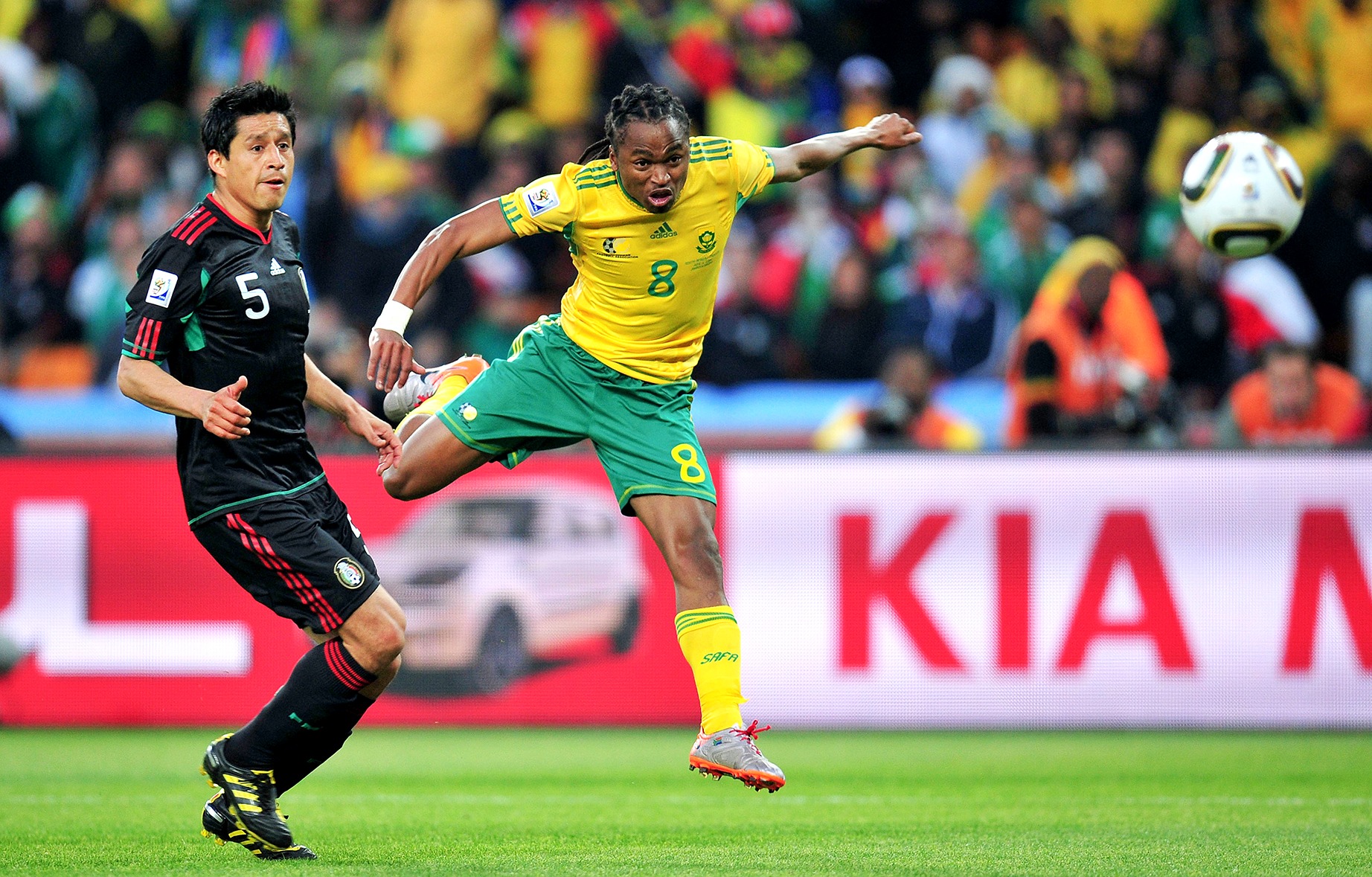
 Siphiwe Tshabalala of South Africa scored the first goal of the 2010 Fifa World Cup in a match between Bafana Bafan and Mexico. (Photo: Clive Mason / Getty Images)
It’s been 16 long years since South Africans could directly cheer for their own country at the Fifa World Cup. The wait is finally over as South Africa (SA) is set to not only return to the global stage for the first time since 2010, but they will be participating in the curtain-raiser of the latest edition of the global soccer showpiece.
Bafana Bafana face cohost nation Mexico on Thursday, 11 June, at 9pm South African time. They played the same country at the 2010 edition, which was the first World Cup to be staged on African soil. That particular encounter ended in a 1-1 draw, with El Tri equalising via captain Rafael Márquez after Siphiwe Tshabalala had netted the first-ever World Cup goal on African soil.
It was a volcanic atmosphere back then at Johannesburg’s FNB Stadium, and the South Africans can expect something similar when they tackle their Mexican counterparts in a replay at the famous Azteca Stadium in Mexico City.
History meets the present
The oldest player in the current South African setup, Mamelodi Sundowns midfielder Themba Zwane, was just 20 when the 2010 World Cup began; he turned 21 two months later. Zwane was still playing for amateur Tembisa club Vardos. He was signed by Sundowns in 2011.
Another Bafana Bafana veteran, captain Ronwen Williams, was still an academy player at the now-defunct SuperSport United.
The youngest player for SA at the 2026 tournament will be Chicago Fire defender Mbekezeli Mbokazi. He was just four years old when that historic match between SA and Mexico kicked-off 16 years ago.
/file/attachments/orphans/GettyImages-101982404_186434.jpg "While players such as Itumeleng Khune were representing SA at the 2010 World Cup, the bulk of the Bafana Bafana crop was still young. (Photo: Clive Rose / Getty Images)")
Now he and his teammates have an opportunity to taste the World Cup for the first time at the Azteca Stadium, which opened in 1966. The venue has a lengthy history with the World Cup. It is where the legendary Pelé cemented his status in 1970 by winning his third World Cup with Brazil. The forward remains the only player, man or woman, to win the tournament three times.
The Azteca was also the scene of one of soccer’s most controversial moments when Argentina beat England 2-1 in a 1986 World Cup quarterfinal. Another soccer great, Diego Maradona, “scored” Argentina’s first goal using his hand, which the match officials missed. Four minutes later, Maradona scored what is considered to be the greatest goal in World Cup history, clinching the game for his team.
“It will be a fantastic experience because my players have never been in this situation. It will be very important that we keep to our game plan and we don’t listen to what is happening in the stands,” said Bafana Bafana boss Hugo Broos.
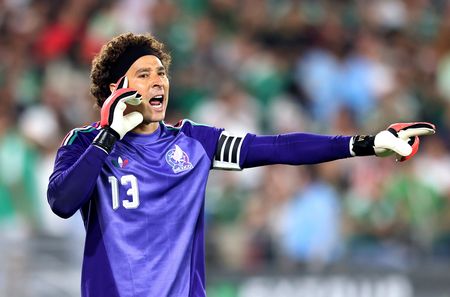
“We know how many Mexicans will be in the stadium, compared to just a few South Africans. But we know that we have the support of the whole nation. We are playing for all those people who believe in us,” Broos said. “It’s for those people that we will fight like lions.”
/file/attachments/orphans/2280618099_627955.jpg "Bafana Bafana head coach Hugo Broos says his players will 'fight like lions' in their quest to begin the 2026 World Cup on a positive note. (Photo: Oscar Fuentes / Jam Media / Getty Images)")
The Mexican challenge
On what Broos and his troops are expecting from Mexico, their first opponents in a mini-league that also features Czechia and South Korea, he said: “They are all dangerous. It’s a very complete team, with a lot of movement and solidarity. They are a very good team and we have to be at our best level if we want to get a good result.”
/file/attachments/orphans/GettyImages-2027769915_122020.jpg "The contribution of Ronwen Williams, as both a goalkeeper and leader, will be key for Bafana Bafana's ambitions. (Photo: Visionhaus / Getty Images)")
Prior to Broos leading this current crop of players to the global stage, it was Portuguese tactician Carlos Queiroz who guided SA to World Cup qualification, as far back as 2002. However, after a poor showing at the 2002 Africa Cup of Nations, Queiroz was replaced by Jomo Sono before the World Cup.
Broos, 74, has always insisted that after this fairytale World Cup experience for both him and Bafana Bafana (he has coached them since May 2021), he will retire altogether from coaching and move back to Belgium.
The Broos dream
Broos retired as a player a couple of years after his last World Cup appearance in 1986, in Mexico. So, he made it a personal mission to help Bafana Bafana end their World Cup drought. He succeeded where a number of his predecessors had failed. This includes the likes of Pitso Mosimane, Steve Komphela, Stuart Baxter and Gordon Igesund.
/file/attachments/orphans/2279690146_765773.jpg "Hugo Broos has altered South African perceptions of Bafana Bafana since taking over the coaching reins in 2021. (Photo: Oscar Fuentes / Jam Media / Getty Images)")
“When we (Belgium) played our opening game against Mexico 40 years ago, while I was a player, it was a fantastic event. Something I will never forget. That was the period where I felt what a World Cup was; something special,” Broos said.
“Now I’m back again in Mexico and we will play the opening match of the World Cup, again it will be against Mexico. It will also be at the Azteca Stadium [like 40 years ago]. It’s an amazing coincidence that I’m in the same situation, but as a coach now.
“I’m excited. It is the biggest highlight for me as a coach to be at this World Cup,” he added.
On SA being the labelled the weakest country in Group A, Broos simply said: “I’m very happy with the fact that some people think we are the weakest team.” DM
Comments
Scroll down to load comments...