




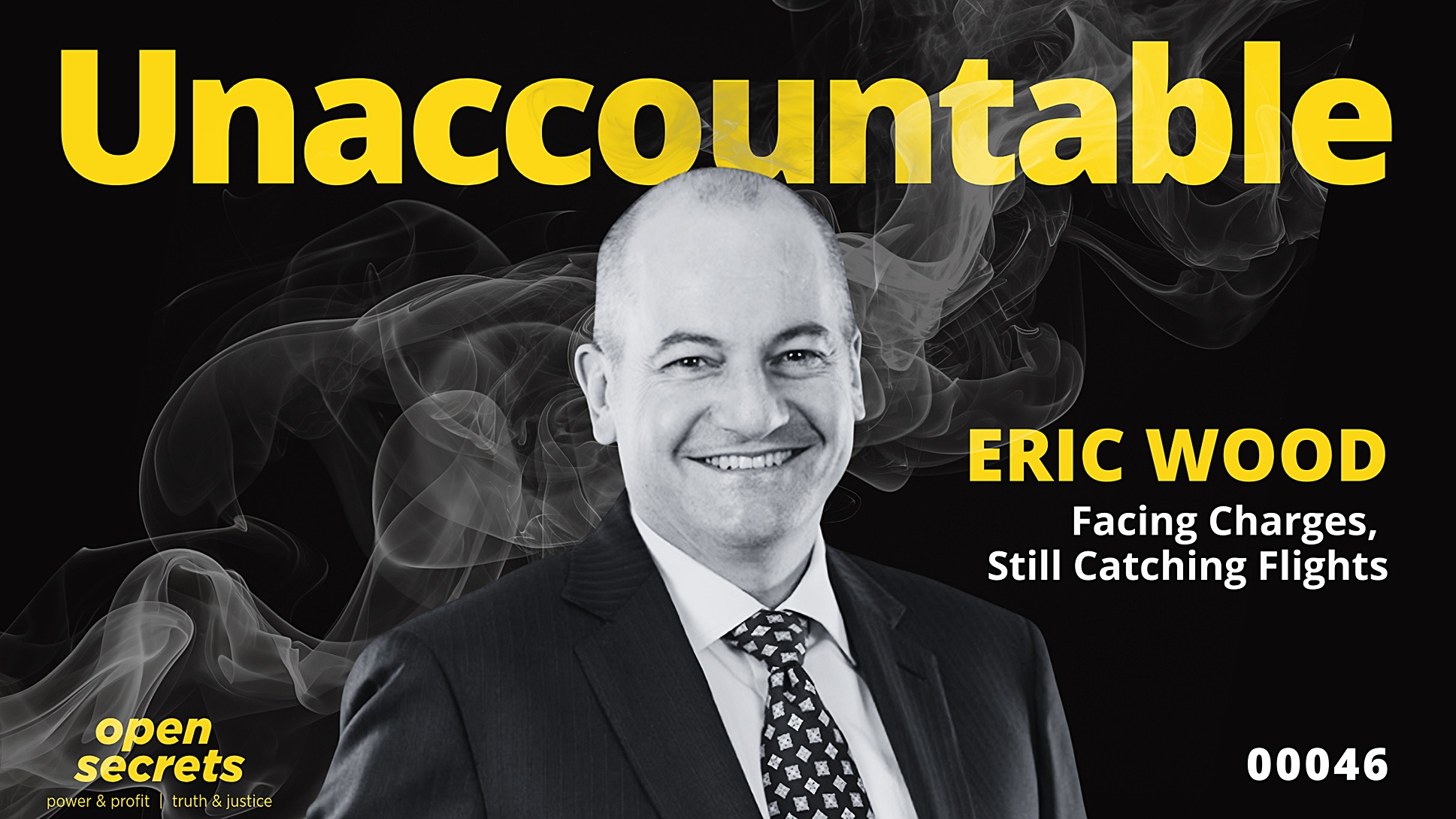
 Eric Wood’s trial for State Capture linked to Transnet has faced significant delays, with no proceedings in nearly four years since his arrest. (Image: Shakeelah Ismail, Open Secrets)
Eric Wood is accused of enabling and benefitting from millions of rand of unlawful payments made by Transnet and Eskom to Regiments and Trillian. Wood, along with former Transnet officials Garry Pita, Siyabonga Gama and Phetolo Ramosebudi, and Trillian executive Daniel Roy, were arrested on 27 May 2022, after handing themselves over at Brackendowns police station in Johannesburg. Another co-accused, so-called “Gupta fixer” Kuben Moodley, was arrested in September 2021 at OR Tambo International Airport just before he boarded a flight to Dubai.
Since then, further arrests have been made and more charges filed, including against State Capture big fish Brian Molefe and Anoj Singh. The group of now 13 co-accused – including Wood – face charges in the Gauteng Division of the High Court in Johannesburg that include corruption, fraud, money laundering and violations of the Public Finance Management Act. These charges relate to various deals and transactions linked to the infamous procurement of 1,064 locomotives by Transnet.
The evidence in the case against Wood and his co-accused includes a staggering 55 terabytes of information, but numerous delays have obstructed accountability.
February 2026 marked the latest delay in the case. The latest delays are at the request of the lawyers for the accused, who claim that the evidence against Wood and his co-accused was only given to the defence teams in December 2025, more than three years after the arrests were made. The NPA disputes this and told Open Secrets that the evidence provided to the defence in 2025 was simply to authenticate documents provided in 2022.
The 1,064 locomotives deal was the single largest site of extraction for the Gupta enterprise, and the R16-billion escalation on the deal allowed for more than R7-billion in kickbacks to be paid to Gupta-linked firms. It also left Transnet in huge debt and without functioning rolling stock, sending shockwaves through SA’s economy that are still felt today.
/file/dailymaverick/wp-content/uploads/2022/10/Transnet-Friday_9.jpg "Kuben Moodley, Eric Wood, Siyabonga Gama, Garry Pita, Daniel Roy, Phetolo Ramosebudi and other Transnet officials appear at Palm Ridge Specialised Crimes Court on October 14, 2022 in Palm Ridge, South Africa. The suspects were arrested on Transnet related R398.4 million fraud and corruption charges. (Photo: Gallo Images / OJ Koloti)")
Nearly 1,400 days have passed since Wood’s first court appearance, and his trial has not started. This instalment in the Unaccountable series serves as a reminder of Wood’s central role in State Capture, and why the stakes will be so high when the Transnet trial finally does begin.
Wood and his lawyers did not respond to Open Secrets’ request to comment for this story.
The Regiments, Trillian and Gupta nexus
Consultants and advisory services were a critical part of the State Capture era in SA, with networks of large and small advisory firms and individuals coalescing to gut the state and line their pockets. Eric Wood was a key figure in this regard. Wood was an employee and director of Regiments Capital between 2004 and 2016 and joined Trillian Capital Partners in 2016.
Trillian was established after the relationship between Regiments and the Gupta camp, including Gupta network lieutenant Salim Essa, soured from around 2014. Regiments’ director Niven Pillay claimed to journalists that Wood took him to the Guptas’ Saxonwold compound where the Gupta family made an offer to buy Regiments.
Pillay and Litha Nyhonyha, the third director of Regiments, refused to sell, which led Essa to cut their deals. Essa then began to establish Trillian Capital Partners. Wood left Regiments and partnered with Essa to form Trillian, taking several employees from the company with him.
In his role at both firms, Wood worked closely with the Guptas and Essa. Together, they strategically used Regiments and Trillian to enrich themselves at the expense of state-owned entities like Eskom and Transnet.
/file/dailymaverick/wp-content/uploads/2022/10/Transnet-Friday_4.jpg "Businessman Eric Wood appears at Palm Ridge Specialised Crimes Court on October 14, 2022. The suspects were arrested on Transnet-related R398.4 million fraud and corruption charges. (Photo: Gallo Images / OJ Koloti)")
Troubles at Transnet
As early as 2016, AmaBhungane revealed that Transnet had paid more than R600-million to Regiments and Trillian, with Transnet insiders claiming that the payments were inflated and for work that should have been completed internally. In October 2012, McKinsey appointed Regiments as its supplier development partner. From this deal, Essa and Moodley received substantial percentages of all income received from Transnet, even though they didn’t provide any meaningful services.
The Zondo Commission later confirmed that more than R1-billion paid to Regiments by Transnet had been laundered through several shell companies that were nominated by Essa and Moodley in line with this agreement.
McKinsey subsequently paid back R650-million to Transnet. Later, in 2024, McKinsey entered into a settlement agreement with South African authorities and the US Department of Justice, and paid over R1-billion in “punitive reparations” to SA to avoid prosecution for the firm’s involvement in these contracts. However, by then years of damage had already been done.
The business case for the procurement of the 1,064 locomotives was developed by Transnet between 2011 and 2012. McKinsey, Regiments and Trillian were appointed to evaluate and advise on the business case, which was subsequently approved on 25 April 2013.
The cost of the acquisition, according to the initial business plan, was R38.6-billion. However, Regiments assisted Transnet in rewriting the business case to justify a R16-billion escalation in cost, ballooning the amount to R54.5-billion. The Zondo Commission confirmed that the R16-billion was the foundation of kickbacks laundered through Hong Kong and Dubai.
Later, Trillian received a R93-million payment for allegedly arranging a R12-billion club loan to help fund Transnet’s acquisition of 1,064 locomotives. However, the Zondo Commission concluded that Trillian had not in fact done any work, and Transnet had already paid Regiments for the same services. During the relevant period, Wood was both a director at Regiments and the CEO of Trillian.
Stealing from Transnet pensioners
In 2017, Transnet Second Defined Benefit Fund launched a R230-million claim against Regiments, which had managed more than R9-billion in its assets. It claimed that Regiments used a series of “bond-churn” transactions to siphon an additional R349-million from the pension fund over just four days between December 2015 and April 2016.
Explainer: What is a ‘bond-churn’?
These “bond-churn” transactions essentially meant that Regiments would make the Transnet Second Defined Benefit Fund purchase government bonds from Regiments Securities, its subsidiary, and then later, on the same day, make the Fund sell the bonds back to Regiments Securities at a lower price. Regiments kept the difference as a profit and the TSDBF suffered a massive loss. The TSDBF settled its dispute with the other directors of Regiments, Niven Pillay and Litha Nyhonhya, in August 2019, but it continued litigation against Wood, seeking a portion of the funds that were allegedly “misappropriated”.
In November 2019, the Investigating Directorate (ID) of the National Prosecuting Authority (NPA) – then led by Hermione Cronje — obtained an interim restraint order to freeze the assets of Wood, Nyhonyha and Pillay, their respective family trusts, as well as their companies. This provisional order sought to freeze R1-billion worth of Regiments assets, which the ID believed were the proceeds of crime related to corrupt deals at Transnet and the Transnet Second Defined Benefit Fund.
While the provisional order was discharged by the Gauteng Division of the High Court in Johannesburg in 2020, a full Bench of the high court set aside that decision in 2022. This effectively reinstated the provisional restraint order and increased the restrained amount to R1.6-billion.
Separate to the NPA’s process, in May 2021, the Transnet Second Defined Benefit Fund launched urgent court proceedings to sequestrate Wood, stating that it had “claims in excess of R300-million against Trillian”.
In addition to the claim that Wood, Essa, and the Guptas stole R239-million from the fund, and that Wood and Regiments Securities funnelled R348-million through bond-churning transactions, the fund alleged that the money stolen from it was used to assist in raising the funds for the Guptas purchase of Optimum Coal Mine.
The Transnet Second Defined Benefit Fund accused Wood of having deliberately disposed of valuable assets over numerous years, to leave his personal estate with almost no realisable assets which “prejudiced creditors”. Peet Maritz, principal officer of the fund, argued that it was unlikely that Wood’s personal estate only comprised the R14-million in assets that the fund was able to identify, leading the fund to target Wood’s late wife’s assets to ensure that Wood was not attempting to hide assets.
In his opposition to the fund’s attempt to sequestrate him, Wood argued that the payments that were made to different entities shouldn’t be equated to payments that were made to him.
In December 2023, the Gauteng Division of the High Court in Johannesburg ruled in favour of the funds and sequestrated Wood’s estate. Judge Seena Yacoob concluded that she was “satisfied that the Fund has established that the bond churning transactions were not justified, and in fact resulted in fixed and determined loss to the Fund and gain to Mr Wood’s entities and Mr Wood himself, and that Mr Wood is liable to the Fund for the amount that it has shown was paid to his nominated entities”.
Wood’s links to the capture of Eskom
On 2 October 2019, the Gauteng Division of the High Court in Pretoria ordered Trillian to pay back R595-million to Eskom. The judgment followed an application by the new management team at Eskom to review the awarding of a contract to McKinsey and Trillian. While McKinsey and Trillian never signed an agreement, Eskom still agreed to a R1.6-billion “settlement agreement to exit the contract”, resulting in huge payments to both firms. McKinsey paid back about R1-billion prior to this litigation.
The Zondo Commission later concluded that “the payments to Trillian [were] unconscionable and constituted corruption of the highest order”. It added that “the officials at Eskom who pushed for payments to be made to Trillian knowing that Eskom had no contract with Trillian and McKinsey had not appointed Trillian as its SDL should hang their heads in shame and need to face the full wrath of the law”. The latter certainly has not happened.
Wood himself was deeply enmeshed in the capture of Eskom. On various occasions, Anoj Singh – then CFO of Eskom – consulted with Wood on the irregular process of attempting to purchase Optimum Coal Mine (OCM). The commission found that Wood was privy to the emails, letters and agreements with the board on this matter, and that he and Salim Essa worked with Eskom executives to conceal the real reason behind this deal.
/file/dailymaverick/wp-content/uploads/2023/09/ED_398901.jpg "Former group chief executive of Transnet, Brian Molefe, and former group CFO Anoj Singh appear at the Palm Ridge Specialised Commercial Crimes Court on August 29, 2022. (Photo by Gallo Images/Daily Maverick/Felix Dlangamandla)")
The commission also concluded that former Eskom CEO Matshela Koko and Singh conspired with Wood and Mohammed Bobat, an employee of Regiments, to arrange the prepayment of R1.68-billion to Tegeta – the company used by the Guptas to purchase OCM in 2016.
The commission’s recommendation regarding the Eskom staff who facilitated these payments was clear; they were “prima facie guilty of theft and ought to face criminal charges for such corruption related conduct”. This, like so many of the commission’s recommendations, has not seen any progress.
Accountability long overdue
The arrests and charges in 2022, relating to the 1,064 locomotives deal, were seen as a huge first step towards accountability for one of the worst and most damaging deals in the Gupta State Capture era. While the accused were granted bail in 2022, they were ordered to hand their travel documents to the investigating officer. However, Wood has since been permitted to travel to Spain and London based on his request to visit family, and there have been a series of delays in the four years since the arrests.
In the intervening period, the NPA has seen several high-profile State Capture cases fall apart in court or be struck from the court roll. Other criminal investigations recommended by the Zondo Commission – including those related to the Eskom case discussed in this article – have yet to be finalised. This has seriously undermined the public’s trust in the National Prosecuting Authority (NPA) and other institutions of accountability.
We asked the NPA about the long delays in the Transnet prosecution. IDAC spokesperson Henry Mamothame insisted that the NPA is “trial ready” and laid the blame on the defence, saying that “with limited avenues available to the defence, they unfortunately resorted to using strategies and tactics to delay the trial and misguide the Court that it is the fault of the State”.
He also confirmed that the latest strategy of five of the defendants is their application requesting the court to investigate what they call unreasonable delays in the case. Mamothame said that this was “notwithstanding the fact that it was the defence who had requested that the trial be postponed”. These applications will further delay the trial, with the court set to hear them in June 2026.
Holding Wood and his co-accused to account remains vital. As this article reminds us, Wood was at the centre of corrupt deals that gutted the South African fiscus and gutted its state-owned enterprises. For new National Director of Public Prosecutions Andy Mothibi, ensuring this prosecution is successful must be a high priority. DM
Open Secrets is a non-profit organisation which exposes and builds accountability for private-sector economic crimes through investigative research, advocacy and the law. To support our work, including the investigations that go into the Unaccountable series, visit Support Open Secrets.
/file/attachments/orphans/OpenSecretslogo_965844.jpg)
Comments
Scroll down to load comments...