




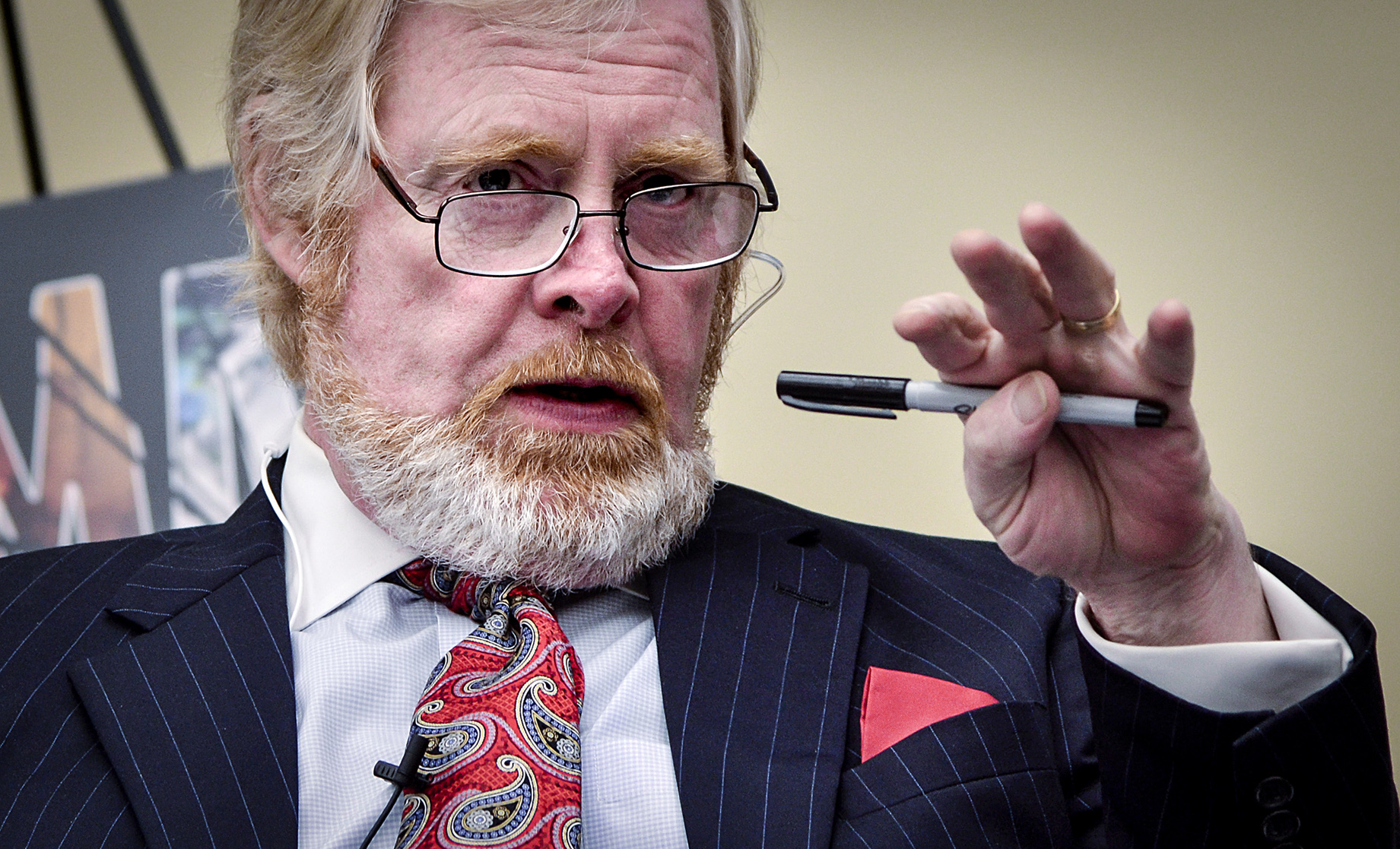
 The US ambassador to South Africa, Leo Brent Bozell III. (Photo: Kris Connor / Getty Images)
The Department of International Relations and Cooperation (Dirco) on Wednesday, 11 March, démarched the new US ambassador to South Africa, Leo Brent Bozell III, less than a month after he arrived in the country.
At a press conference on Wednesday evening, Dirco Minister Ronald Lamola and director-general Zane Dangor confirmed Bozell had been démarched, after News24 reported that he had been summoned to the Dirco offices in Pretoria that afternoon.
The publication reported that the démarche came after Bozell said he “didn’t care” about South African court rulings on the Struggle song “Kill the Boer”, adding that it constitutes hate speech.
He was quoted as saying: “We may not get clarity on the Kill the Boer chant that we believe is hate speech. I am sorry, I don’t care what your courts say, it’s hate speech.”
Bozell made the remarks at a BizNews conference in Hermanus on Tuesday.
In March 2025, the Constitutional Court upheld a ruling that the phrase “Kill the Boer, kill the farmer”, a liberation-era chant, does not constitute hate speech under South African law. The ruling followed an appeal by AfriForum against a previous judgment.
Read more: Leo Brent Bozell III — who is the US’s new ambassador to SA?
/file/dailymaverick/wp-content/uploads/2024/12/ED_532460-1.jpg "Minister of International Relations and Cooperation Ronald Lamola. (Photo: Alet Pretorius / Gallo Images)")
A démarche is essentially a diplomatic dressing down — a formal step against a representative of a foreign country, to express a position, complaint or request for action.
Lamola said on Wednesday: “The Department of International Relations and Cooperation has noted recent public remarks made by the United States ambassador to South Africa. While South Africa welcomes active public diplomacy and a strengthening of bilateral ties, we emphasise that such engagements must remain consistent with established diplomatic etiquette and international protocols.
“In this regard, we have called in the ambassador of the United States, Ambassador Bozell, to explain his undiplomatic remarks, and his engagements and visits to various sites in South Africa, including the Apartheid Museum, District Six and other historical places. In the engagements, he acknowledges that given our history, South Africa needs redress and he’s willing to work with us constructively in this regard.”
Lamola said that South Africa would “continue to monitor” Bozell’s comments and would act appropriately if there was “no improvement” in the engagement.
In response to a request for comment on Bozell’s démarche, a US State Department official told Daily Maverick, “We do not discuss private diplomatic conversations.”
‘Expressed his regrets’
Dangor confirmed that the department’s engagement with Bozell on Wednesday was, in fact, its second meeting with the ambassador since he arrived on 16 February.
He said Bozell had “expressed his regrets” about his comments made at the BizNews conference on Tuesday.
“Mr Bozell expressed his regrets that these comments detracted from any impression that he wanted to work with us constructively. At our very first meeting, he stated very clearly that he wanted to work very constructively with the government of South Africa, so in terms of what happened yesterday, he apologised and expressed regret,” said Dangor.
“That includes the comment that appeared to be undermining the judiciary,” he added.
/file/attachments/orphans/ED_587250_295523.jpg "Dirco’s director-general, Zane Dangor, (Photo: Sharon Seretlo / Gallo Images)")
On Wednesday, Bozell issued a brief statement on X clarifying that while it was his personal view that the chant was hate speech, “the U.S. government respects the independence and findings of South Africa’s judiciary”.
Thanks to @BizNewsCOM for hosting me yesterday. I want to clarify that while my personal view—like that of many South Africans—is that “Kill the Boer” constitutes hate speech, the U.S. government respects the independence and findings of South Africa’s judiciary.
— U.S. Ambassador to the Republic of South Africa (@USAmbRSA) March 11, 2026
Dangor added that, based on Bozell’s visits to various heritage sites in South Africa, he had also reaffirmed in the meeting that, given its history, South Africa “does need redress policies and measures”.
“He then concluded that he wanted to continue to work constructively with ourselves and the rest of government on building a mutually-beneficial relationship with South Africa and the US, and that includes looking at how the redress issues could be dealt with,” said Dangor.
Dangor and Lamola both emphasised that Bozell’s arrival and his visits to heritage sites were very positive.
‘Five demands’
Bozell’s summoning on Wednesday was the second time that South Africa has démarched a US envoy.
In May 2023, Dirco summoned Bozell’s predecessor, Reuben Brigety, after he publicly accused South Africa of supplying arms to Russia. Brigety told reporters that Washington was confident that weapons were loaded onto the Russian cargo ship Lady R when it docked at the Simon’s Town naval base in December 2022.
Relations between South Africa and the US have deteriorated sharply since US President Donald Trump’s return to office in January 2025.
Trump has falsely claimed that white Afrikaners are targets of race-based discrimination and a “white genocide” in South Africa, a claim he has used to support placing punitive tariffs on this country and boycotting its G20 presidency in 2025. He has also taken aim at South Africa’s affirmative action and land redistribution policies.
His false ”white genocide” claims have formed the basis for his administration’s relocation programme for white Afrikaners to the US as refugees.
/file/dailymaverick/wp-content/uploads/2025/06/13068549.jpg "Donald Trump meets with President Cyril Ramaphosa in the Oval Office of the White House on 21 May 2025. Ramaphosa’s visit came one week after Trump claimed there was an ongoing genocide in South Africa and granted refugee status to 59 Afrikaners. (Photo: Jim Lo Scalza / EPA-EFE)")
South Africa has not had an ambassador to the US since Trump expelled Ebrahim Rasool in March last year.
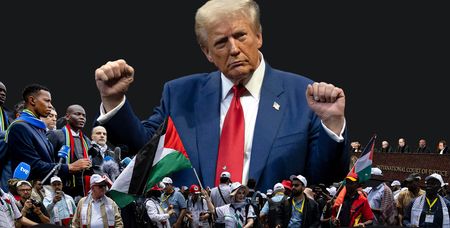
Trump nominated Bozell, a conservative writer, activist and media critic, as US ambassador to South Africa in March 2025.
On Tuesday, Bozell warned that Trump was losing patience with Pretoria, which has not addressed the US president’s five demands to smooth over diplomatic relations with SA.
Among the demands was for South Africa to rethink the Expropriation Act and Broad-Based Black Economic Empowerment (BBBEE), condemn the “Kill the Boer” chant, prioritise farm murders and be non-aligned in its foreign policy, according to a report by TimesLIVE. The publication reported that it is also believed the US wants South Africa to exit the BRICS group and drop its International Court of Justice case of genocide against Israel.
Dangor said the five demands emerged in discussions between South Africa and the US around trade-related matters.
However, he said, “no formal demand” was made to the South African government.
“On the five demands, we did not receive any official letter of the five demands. These demands had emerged out of negotiations on essentially a trade-related matter and a relationship between South Africa and the US,” said Dangor.
“There was no formal ask for us to not be part of BRICS,” he added. “I think that, in the discussions, BRICS had always been seen as a challenge to some in the administration, but there was no demand that South Africa withdraw from BRICS.”
On Wednesday, Lamola said that BBBEE “is not reverse racism, as regrettably insinuated by the ambassador. It is a fundamental instrument designed to address the structural imbalances of South Africa’s unique history. It is a constitutional imperative that the South African government can and will never abandon.”
‘Not a one-sided relationship’
Lamola said South Africa’s relationship with the US is “not a one-sided relationship.”
He was confident that the bilateral trade between the US and South Africa could grow.
“South Africa has been one of the largest importers of American products on the continent. The bilateral trade between the two countries is valued at $15-billion,” he said.
“While our policies possess specific features to address historical injustice, they are aligned with international investment practices. Even in the US, they do have localisation… As we cannot tell President Trump how to deal with localisation in the US, he also can’t tell us how to deal with our domestic issues of sovereignty.”
Additionally, Lamola said that South Africa’s foreign policy was “anchored in our constitutional commitment to multilateralism and the peaceful settlement of disputes.
“South Africa’s non-alignment does not entail a preference for any geopolitical bloc. However, it represents our ability to engage with all international partners and take positions on a case-by-case basis, guided by our human rights outlook and international law.
“We remain steadfast in our resistance to being drawn into great power contestations.” DM
Comments
Scroll down to load comments...