



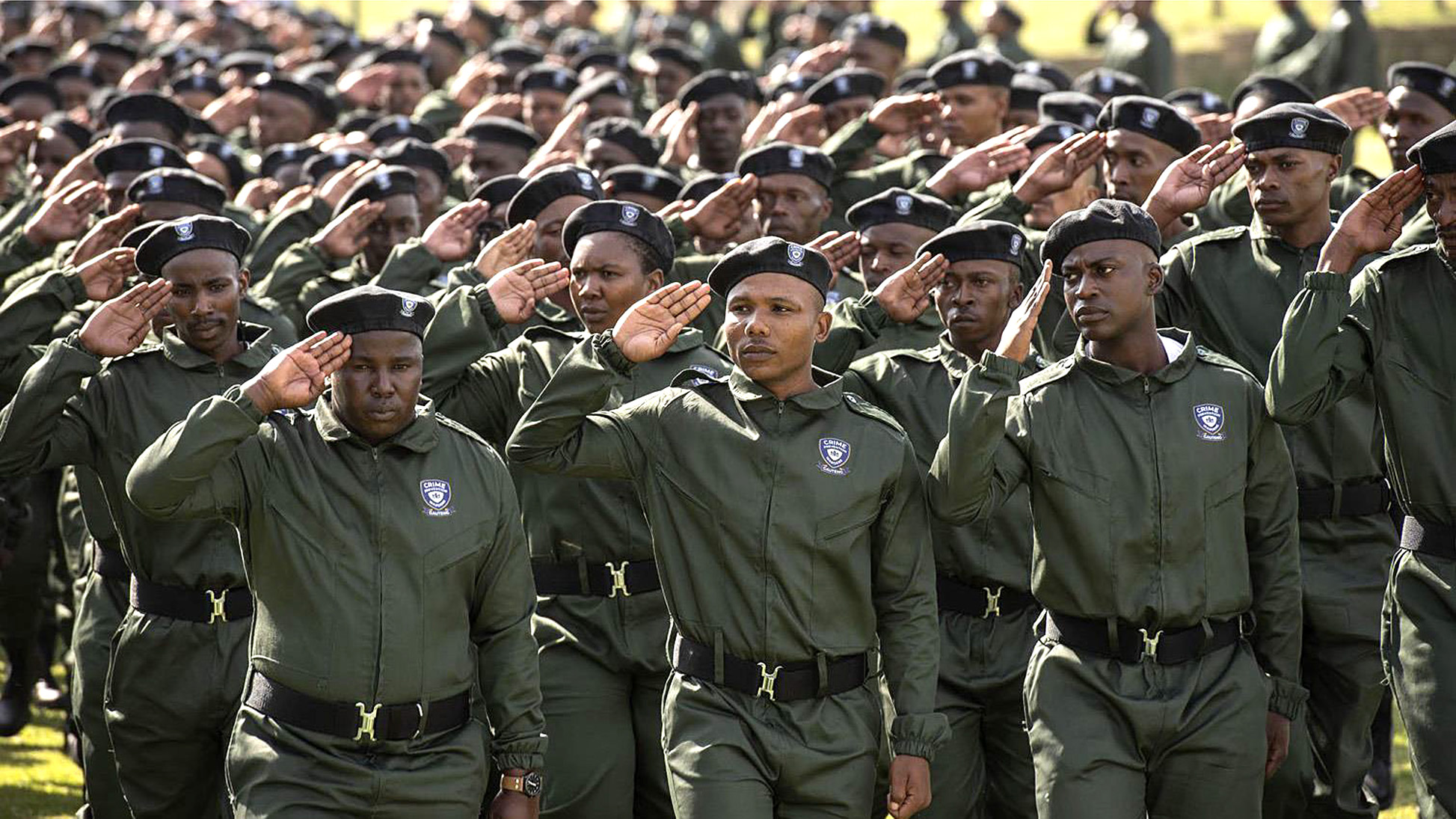
 The Gauteng Crime Prevention Wardens were last week declared to be ‘peace officers’ — but in reality, they are glorified traffic wardens.(Photo: @Fulstob / X)
Last Friday, the ministers of justice and of police (acting) announced that the Gauteng Crime Prevention Wardens, dubbed the AmaPanyaza, would be declared peace officers. Does this solve the problems with their establishment and continued existence? Will they support crime and safety, or is this an employment project reminiscent of the apartheid era “kitskonstabels”?
Both ministers, Mmamoloko Kubayi and Firoz Cachalia, respectively, pride themselves on their cooperative governance and “getting things done”. This declaration was made two weeks after a meeting was held between the premier of Gauteng, Panyaza Lesufi, the ministers and other stakeholders. The Public Protector had found that their establishment, appointment and deployment were indeed outside the law. But does this declaration “as peace officers” fix the problem?
/file/attachments/orphans/ED_585332_141519.jpg "Acting Police Minister Firoz Cachalia. (Photo: Brenton Geach / Gallo Images)")
/file/dailymaverick/wp-content/uploads/2025/09/ED_550105-1.jpg "Minister of Justice and Constitutional Development Mmamoloko Kubayi. (Photo: OJ Koloti / Gallo Images)")
Traffic wardens
The first point to make is that they will be, once properly qualified, not “crime prevention” wardens, but traffic wardens. This is because provinces have no powers in the policing of crime, but they do have powers in relation to traffic.
Hence, after passing the relevant training, being vetted and obtaining an appointment certificate from the national commissioner of police, each will be a “traffic warden” in terms of the National Road Traffic Act of 1996 (the 1996 Act).
Traffic wardens are a class of official below that of traffic officer. The definition of a traffic warden in the 1996 Act is circular, ie:
“‘Traffic warden’ means a person who has been declared by the Minister of Justice to be a peace officer in terms of section 334 of the Criminal Procedure Act, 1977 (Act 51 of 1977), and has been appointed as a traffic warden by the chief executive officer, the MEC or another competent authority to appoint a traffic warden, as the case may be.”
Declarations as peace officers in terms of section 334 do not give a blanket set of powers called “peace officer powers”. For example, liquor officers have a small set of powers in relation to the enforcement of liquor legislation, but not all the possible powers and not in respect of all offences. Law enforcement officers in municipalities have a set of many, but not all, powers in respect of by-law offences, as well as some other offences stipulated in the declaration.
Limited powers
Although traffic wardens (appointed by any municipality, or any province) had previously been declared peace officers in terms of section 334 in relation to the Road Traffic Act of 1989 (the 1989 Act), their powers were extremely limited (ie, the power to issue fines and to demand names and addresses for these), but the offences in relation to which they were so empowered, were almost all repealed by the 1996 Act.
The only remaining offence, section 12, refers to the failure to comply with the instruction of any person acting in terms of the (1989) Act — but there are no such powers not repealed in terms of which traffic wardens may act in the 1989 Act, so this power would only be exercisable together with another more senior authorised officer.
The declaration last week gives powers to “Gauteng Traffic Wardens” and not to traffic wardens employed in other provinces and other municipalities. Why should traffic wardens in Gauteng get powers and not those elsewhere? There are, however, only two offence categories in terms of which they are empowered:
- Offences in terms of section 68 of the 1996 Act, which relates to false, fraudulent or misused number plates, registration numbers, registration mark or documents; and
- Section 3J, which is the 1996 version of 1989’s section 12 — the offence of failing to follow an instruction of an authorised officer acting in terms of the Act.
In addition to the equivalent powers from the 1989 Act (issue fines in terms of sections 56 and 341, demand names and addresses in terms of section 41(1)), the following have been added:
- The section 23 power to search for and seize an article involved in the commission of an offence; and
- The section 40 power to arrest without a warrant someone committing an offence in their presence or obstructing them in their duties.
These powers are only in relation to the two offence categories in section 68 and section 3J. Thus, apart from false number plates and the like (section 68), and enforcing the instructions of officers senior to them (section 3J), the offences over which their powers may be exerted remain limited.
Warrants
In addition, they have the section 44 power to execute warrants, no matter what the offence in the warrant is. Will this include warrants in terms of the Administrative Adjudication of Road Traffic Offences (Aarto) Act, due to come into effect on 1 July 2026? It does not appear so, as the Act says these will be served by sheriffs appointed in terms of section 12 of the Act.
Aarto is partially in effect in Johannesburg and Tshwane, save for the provisions relating to demerit points. Section 17 of Aarto does away with section 56 and section 341 notices — unless an offence, and not just an “infringement”, has been committed. An infringement is defined as a contravention of Aarto and any road traffic legislation or transport legislation.
It seems then, that the Gauteng traffic wardens remain limited in their powers, although citizen’s arrest powers (in relation to serious offences committed in the presence of the arrestor) are also available to them. The risk is large that this will not be understood and that they will act outside their powers. It also calls into the question the significant investment in persons who have very little power at all. Elsewhere, the position of traffic warden is generally used as a learnership towards becoming a traffic officer. This does not appear to be the intention here.
Has the declaration solved concerns? It does nothing to rectify the explicitly political recruitment of “military veterans” (of the ANC and PAC). Nor does it rectify the illegality of any of their previous actions, such as illegal searches, proudly detailed in the annual reports of the Gauteng Department of Community Safety.
Further, it seems highly unlikely that the 9,400 have been or will be properly trained by accredited institutions (the army does not appear to be accredited for peace officer and traffic warden training). Vetting and the issuing of the relevant appointment certificate by the SA Police Service are subject to significant delays. Nor does there appear to be an adequate institutional structure of command and control over them.
Firearm training
Furthermore, some photos have shown them to be armed — in which case firearms competency certificates must be obtained for each person, refresher training must be held twice a year, and an official institution must take responsibility for the safe storage of firearms when they are not on duty. Which official institution is responsible? If it’s the Gauteng Department of Roads and Transport, does it have sufficient capacity for this?
A way out of the conundrum would be for them to be employed as trainee law enforcement officers at various Gauteng municipalities that do not have metro police, as such officials, once qualified, have much more extensive legal powers. (Metro police must be fully qualified traffic officers, an onerous qualification.)
However, this would require the premier to relinquish control over them to municipalities with possibly different political persuasions. Notably, the premier did not designate a community safety MEC, keeping the function to himself, and he has encouraged their fealty toward him.
The truth is that they were never intended to be traffic wardens. Empowering them in this way makes little sense, and it is likely their powers have been misunderstood by the premier, who has in the past exhorted them to “shoot the enemy”.
/file/dailymaverick/wp-content/uploads/2025/10/ED_571911-2.jpg "Gauteng Premier Panyaza Lesufi. (Photo: Gallo Images / Luba Lesolle)")
The constitutional and legislative framework of a “single national police service” — an ANC mantra for decades — is becoming increasingly difficult to sustain. Three decades of poor police management have resulted in a range of failures. In this environment, sub-national governments have tried — legally and illegally — to respond to crime and safety concerns, but the responses are spawned from a constitutional framework that does not really enable them.
The AmaPanyaza were not part of the original design but are creatures of uncertain motive and unsteady constitutional footing. DM
Dr Jean Redpath is a senior researcher at the Dullah Omar Institute, University of the Western Cape.