



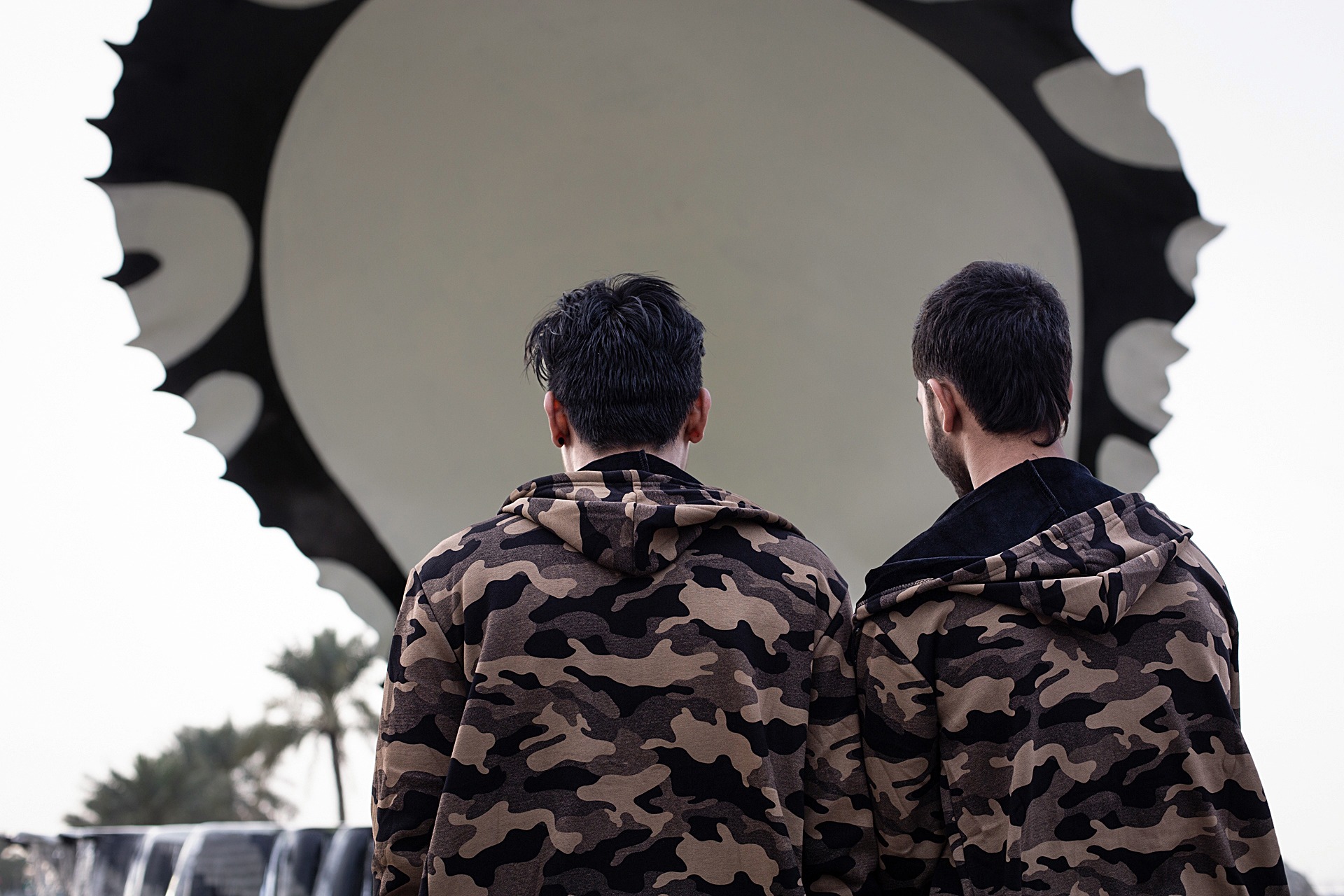
 Two Nepali friends in twinning camo jackets. (Photo: Aparna Jayakumar)
Across the Arabian Gulf, migrant labour is the engine of national development and the subject of sustained international scrutiny.
In Qatar, as in much of the region, the spectacular pace of urban growth has relied almost entirely on a transnational workforce drawn largely from Africa and South Asia. These workers build cities, clean homes, care for children and keep economies running – yet their presence is often framed in numbers rather than narratives, statistics rather than lived experience.
At the height of Qatar’s infrastructure expansion in the 2010s, migrant workers constituted close to half of the country’s population – nearly one million people at the time. This demographic reality has few parallels globally. Despite this numerical dominance, migrant workers have historically remained marginal within Qatar’s public visual culture, policy discourse and national storytelling.
Their labour is visible everywhere; their identities, less so.
There has been much international debate around labour rights in the Gulf, particularly in the lead-up to the 2022 Fifa World Cup. Investigative journalism and human rights reporting addressed labour conditions under sponsorship systems, drawing attention to pay, mobility, workplace safety and access to justice.
While these reports were important, they often relied on a narrow narrative framework, portraying migrant workers primarily through experiences of hardship rather than the full complexity of their lives. This reinforces a binary between those who observe and those who are observed, leaving little room for agency or self-representation.
It was within this context that Doha Fashion Fridays (conceived by Khalid Albaih and photographed by myself, Aparna Jayakumar) emerged in 2016 as a long-term visual documentation project examining migrant life in Qatar outside the workplace.
Rather than focusing on labour sites – construction zones, industrial camps or domestic interiors – the project centres on Fridays, the weekly day off for most migrant workers. On this day, thousands gather along Doha’s Corniche, a public waterfront that becomes a shared social space.
Here, workers reclaim visibility on their own terms.
/file/attachments/orphans/FromtheseriesDohaFashionFridays_AparnaJayakumar17_432015.jpg "Wale Kayode from Nigeria worked as a mechanical engineer. His fashion icon is Nigerian musician Davido. (Photo: Aparna Jayakumar)")
/file/attachments/orphans/FromtheseriesDohaFashionFridays_AparnaJayakumar16_278067.jpg "Terence and Modesta Nzume from Cameroon like to wear matching outfits. Terence worked as a safety manager, and Modesta was visiting him in Doha at the time. (Photo: Aparna Jayakumar)")
/file/attachments/orphans/FromtheseriesDohaFashionFridays_AparnaJayakumar15_492820.jpg "Jasbir Singh was from Punjab and worked as a crane operator. (Photo: Aparna Jayakumar)")
/file/attachments/orphans/FromtheseriesDohaFashionFridays_AparnaJayakumar20_195780.jpg "Nabin Karki was a 20-year-old construction worker. He measured his time in the Gulf in months and had been there for nineteen months. (Photo: Aparna Jayakumar)")
/file/attachments/orphans/FromtheseriesDohaFashionFridays_AparnaJayakumar14_497245.jpg "Anit Chaudhari from Nepal worked as a carpenter. (Photo: Aparna Jayakumar)")
Work uniforms are replaced with tailored suits, edgy streetwear, national costume, jewellery and carefully chosen accessories. Groups of friends pose, converse, celebrate and rest. The Corniche functions not only as a space for leisure but also as a site of cultural production, where identity is performed and renegotiated through fashion, posture and presence.
The choice to photograph migrant workers in this context is political. It resists the dominant visual grammar of migrant labour documentation, which often emphasises exhaustion, injury or anonymity. Instead, it insists on individuality and plurality. The images ask viewers to confront a more uncomfortable question: what does it mean that those who are systematically excluded from national belonging can still celebrate their individuality within the margins of the city?
The project brings together workers from Nepal, Pakistan, Ethiopia, Kenya, Nigeria, South Sudan, Bangladesh and India, among others. They are employed in construction, hospitality, education, transport and domestic work, reflecting the diversity of the migrant workforce.
Conversations accompanying the portraits explore not only working conditions, but family life, migration histories, remittances, relationships and future plans. Many speak of obligation as much as aspiration: siblings’ school fees, medical debt, ageing parents, children raised from afar.
Women’s labour emerges as a particularly fraught terrain. Many female migrant workers encountered in Doha work as domestic staff or nannies, caring for children while their own remain in home countries, often raised by relatives. Their stories complicate dominant narratives of empowerment through migration, revealing instead a landscape of emotional fragmentation and gendered sacrifice.
These are not experiences unique to the Gulf, but part of a global care economy that stretches from Addis Ababa to Manila to Dubai.
/file/attachments/orphans/FromtheseriesDohaFashionFridays_AparnaJayakumar19_618900.jpg "Ganesh Paswan was a 19-year-old electrician from Nepal. (Photo: Aparna Jayakumar)")
/file/attachments/orphans/FromtheseriesDohaFashionFridays_AparnaJayakumar18_467352.jpg "National pride for a Nepali migrant worker in Doha. (Photo: Aparna Jayakumar)")
/file/attachments/orphans/FromtheseriesDohaFashionFridays_AparnaJayakumar11_110316.jpg "Pamela Kwira from Kenya worked in hospitality as a tea girl. She supported her brother’s school fees. (Photo: Aparna Jayakumar)")
/file/attachments/orphans/FromtheseriesDohaFashionFridays_AparnaJayakumar10_849895.jpg "Hari Thapa, a construction worker from Nepal, had worked in the Gulf for eleven years. When asked how he worked in the heat, he said it had become a habit. (Photo: Aparna Jayakumar)")
/file/attachments/orphans/FromtheseriesDohaFashionFridays_AparnaJayakumar9_702789.jpg "Ram Babu, from Nepal, worked in a car workshop. He said what he missed the most about home was the lush, green landscape. (Photo: Aparna Jayakumar)")
Doha Fashion Fridays has been shared primarily through digital platforms, particularly Instagram, allowing the work to circulate beyond traditional gallery spaces and institutional gatekeeping.
This choice reflects both necessity and strategy. In much of the Gulf, public exhibition of politically sensitive work remains difficult, if not impossible. Social media, for all its limitations, offers a porous alternative – one that allows subjects, audiences and critics to encounter the work simultaneously.
The project has nevertheless entered international exhibition spaces, including shows in Qatar, Russia and the US. While these contexts positioned the work within global debates on mobility, vulnerability and citizenship, its deepest resonance often emerges in subtler exchanges: messages from workers who see themselves represented with dignity; reflections from viewers who recognise echoes of their own migration journeys; and a growing awareness of the questions of visibility – who is seen, and in what way.
/file/attachments/orphans/FromtheseriesDohaFashionFridays_AparnaJayakumar3_148858.jpg "Aakash Magar was a Nepali catering worker. He loved to dance. (Photo: Aparna Jayakumar)")
/file/attachments/orphans/FromtheseriesDohaFashionFridays_AparnaJayakumar12_275893.jpg "Kabindra Tamang from Nepal worked as a construction worker. He wanted to take a picture by “The Pearl.” (Photo: Aparna Jayakumar)")
/file/attachments/orphans/FromtheseriesDohaFashionFridays_AparnaJayakumar5_305812.jpg "Nepali migrant workers pose for a picture in matching camouflage shirts on the Corniche. (Photo: Aparna Jayakumar)")
/file/attachments/orphans/FromtheseriesDohaFashionFridays_AparnaJayakumar8_258145.jpg "Mohammed Parvez was an electrician foreman from Bangladesh. He drew inspiration from Bollywood fashion icons. (Photo: Aparna Jayakumar)")
/file/attachments/orphans/FromtheseriesDohaFashionFridays_AparnaJayakumar7_563321.jpg "Moses Mintah is from Ghana and worked as a document controller in construction. Seen in his (Sunday) Friday best for mass. (Photo: Aparna Jayakumar)")
As Gulf states move into a post-World Cup phase, questions of labour reform remain unresolved.
Visual culture has a role to play here – not as advocacy alone, but as evidence of presence. Photography cannot dismantle unequal systems, but it can challenge the narratives that make those systems palatable. By refusing to depict migrant workers solely as passive victims, Doha Fashion Fridays insists on a more complex political imagination – one that recognises joy and style as assertions of humanity.
The project offers a mirror as much as a window. It invites reflection on how societies represent their own migrant populations, how public space is shared or segregated and how visual narratives shape policy and perception. The ongoing challenge is to ensure that visibility leads not only to recognition, but to structural change.
Until then, the Corniche on a Friday remains a fleeting archive of possibility: a place where workers, briefly, step out of invisibility and claim the right to be fully seen.
/file/attachments/orphans/FromtheseriesDohaFashionFridays_AparnaJayakumar6_939197.jpg "Noman Khan was an AC technician from Karachi. He wanted to start his own business and felt that fashion came with money. (Photo: Aparna Jayakumar)")
/file/attachments/orphans/FromtheseriesDohaFashionFridays_AparnaJayakumar2_976101.jpg "Kadi Bariso worked as a construction worker. He was photographed on his wedding day, which he attended remotely. (Photo: Aparna Jayakumar)")
/file/attachments/orphans/FromtheseriesDohaFashionFridays_AparnaJayakumar1_393739.jpg "Arjun Bhandari from Nepal worked as a welder in construction. (Photo: Aparna Jayakumar)")
/file/attachments/orphans/FromtheseriesDohaFashionFridays_AparnaJayakumar4_687281.jpg "Naeeb is a gardener from Pakistan. His dream was to have a driver’s license. (Photo: Aparna Jayakumar) DM")