



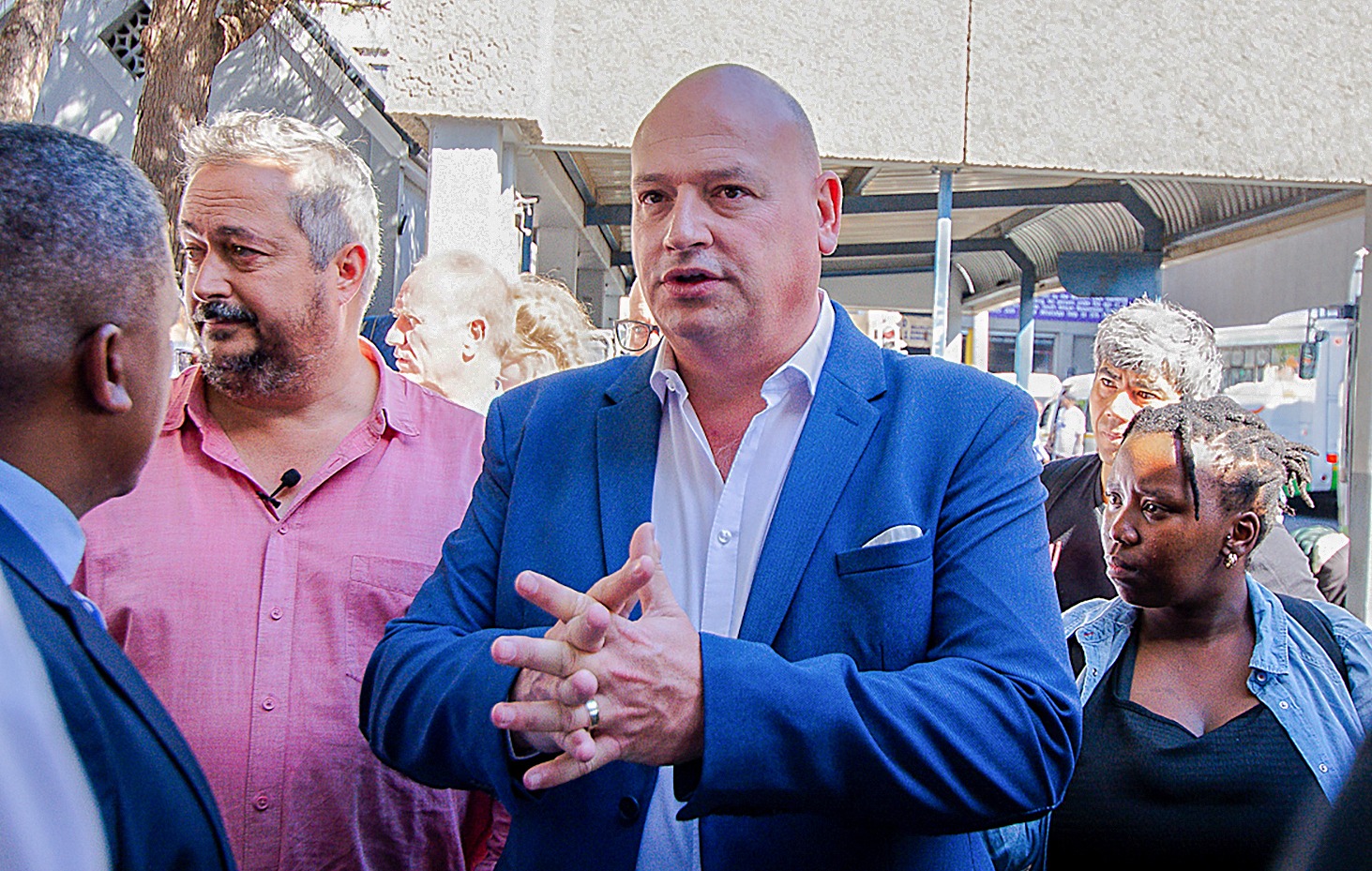
 Alderman James Vos makes an important point on a walking tour of the Golden Acre in the Cape Town CBD. (Photo: Supplied / City of Cape Town)
Cape Town’s acronym-loving Alderman James Vos has a policy that’s systematic and pragmatic to grease the wheels of the city’s economy. With a focus on everything from tourism frameworks to business support, the mnemonic-driven plan is betting that these five sparks will ignite a new era of job creation and competitiveness.
Read more: Inequality patterns haunt Cape Town Golden Acre revival
Unfortunately, two particular points in his plan don’t mesh so well with his political party’s policy gearing – if the mayoral committee member wants to boost informal traders and synchronise his manufacturing support programme with the national agenda, he is going to need to win the local election race outright.
The people’s champ
“Informal traders are vital to South Africa’s economy,” explains Dr David Jeffery, an ANC senior researcher in Parliament. “The number of people engaged in the informal sector – supporting themselves, employing other people – is staggering. We cannot reduce unemployment unless we support the informal sector. And so we need to think carefully how to do this.”
Jeffery has been a vocal commentator on the plight of the street vendor, but jives to the Vos talk about amending the informal trader by-laws.
“The problem is not that so many informal traders do not follow the rules and regulations,” Jeffery argues. “As it currently stands, the problem is that those rules and regulations are almost impossible to follow.”
This is where the alderman’s Modernised Public Trading By-law (point two of his Big Five) faces its sternest test.
Read more: A welcoming heartbeat is throbbing in Cape Town’s inner city
The City’s plan promises to set out transparent rules and give dignity to work, yet the historical friction lies in the execution. Jeffery warns that municipalities often default to using a stick to compel registration (policing streets and homes) rather than offering the carrot of support.
If Vos’s new by-law focuses on digitising applications without acknowledging that many traders lack internet access, or if the transparent rules remain dense legalese in English only, the policy will be a paper tiger.
For the informal sector to truly become an engine of growth rather than a survivalist mechanism, the City must, in Jeffery’s parlance, flip the script: make the benefits of formalising outweigh the hassle of compliance.
Kick-starting the manufacturing machine
Perhaps the most distinct shift in the alderman’s strategy is visible in his Manufacturing Support Policy (point number one). Here, Cape Town is diverging sharply from the national philosophy.
The National Manufacturing Support Programme, administered by the Department of Trade, Industry and Competition, is essentially a cash injection engine. It offers reimbursable grants of up to R10-million for capital expenditure and raw materials, with sweeteners for transformation targets. It is the classic “pay them to play” model.
Vos, however, is turning off the tap.
/file/attachments/orphans/AJP_7828_709784.jpg "James Vos greets mayor Geordin Hill-Lewis on the skybridge linking the train station with the Golden Acre in Cape Town’s CBD. (Photo: Supplied / City of Cape Town)")
The City’s updated draft policy explicitly moves away from the financial incentives of the 2018 framework, because previous attempts were too costly and yielded limited job creation.
Instead, the City is pivoting to non-financial value. Which means they won’t give you money, but they will give you time.
The new currency is what Vos described to Daily Maverick as the “Investment Facilitation Branch”, a collection of units within each of the city’s 33 industrial areas dedicated to cutting red tape, waiving development application fees and fast-tracking municipal permissions. It is a philosophy of enabling investment rather than incentivising it.
Ideally, these two approaches should be complementary. A savvy manufacturer in Atlantis could, theoretically, grab the national cash grant to buy new machinery and then lean on the City’s facilitation services to get the factory built without waiting until the economic moment has passed in the permit queue. However, it signals a clear ideological stance from the City: the local government’s job is not to fund business, but to get out of its way.
Data is the destination
The remaining points of the plan – Evolving the Ease of Doing Business (point three), Improved Business Support (point four) and a Tourism Development Framework (point five) – act as the supporting struts for this structure.
Cape Town was the first African city to adopt an Ease-of-Doing-Business Index, and Vos is doubling down on it.
It’s a smart play; in a data-driven world, being able to point to a dashboard that tracks planning approvals and utility connections gives investors the warm fuzzies. If you can’t measure it, you can’t manage it, and Vos clearly intends to manage the hell out of bottlenecks.
On the business support front, the City claims to have helped 5,816 participants through its business hub training initiatives in 2025 alone. It’s a solid metric, suggesting that while the manufacturing policy withdraws direct funding, the support for the little guy (SMEs and start-ups) is moving towards skills transfer and mentorship.
What this means for you
Cape Town is positioning itself as the easiest, most competitive city in Africa to start and grow a business – and the reforms rolling out in 2026 are designed to make that real for residents, traders and investors.
But Vos did also tell Daily Maverick that he wants to see other cities around the country thrive, because Cape Town doesn’t have enough room (or the transport infrastructure, for that matter) to seat the full business buffet.
Finally, Vos says that the Tourism Development Framework aims to ensure the visitor economy isn’t just about celebrities in the V&A Waterfront, but spreads benefits to communities outside of the tourist traps. “They are going to visit the Castle and climb Lion’s Head, but what if they had lunch at Blue Peter and stayed in Melkbos for a week?”
It’s the standard inclusive growth rhetoric, but essential for a city where inequality is often starkly visible from the deck of a tour bus.
The 2026 deadline
As we stare down the barrel of the 2026 local government elections, Vos is staking his campaign on the Big Five.
By crystallising these priorities now, the DA-led administration is trying to show that it has moved beyond crisis management (dams, power grids) and into a phase of sophisticated economic engineering.
Read more: Carnage: Absa PMI falls in December to lowest level since pandemic
The success of this plan, however, won’t be measured in mnemonics or catchy acronyms. It will be measured by whether the informal trader in Mitchells Plain finds it easier to get a permit than a fine, and whether the factory owner in Epping can get plans passed before their national grant expires.
Vos has set the table. Now he has to ensure everyone actually gets to eat. DM