



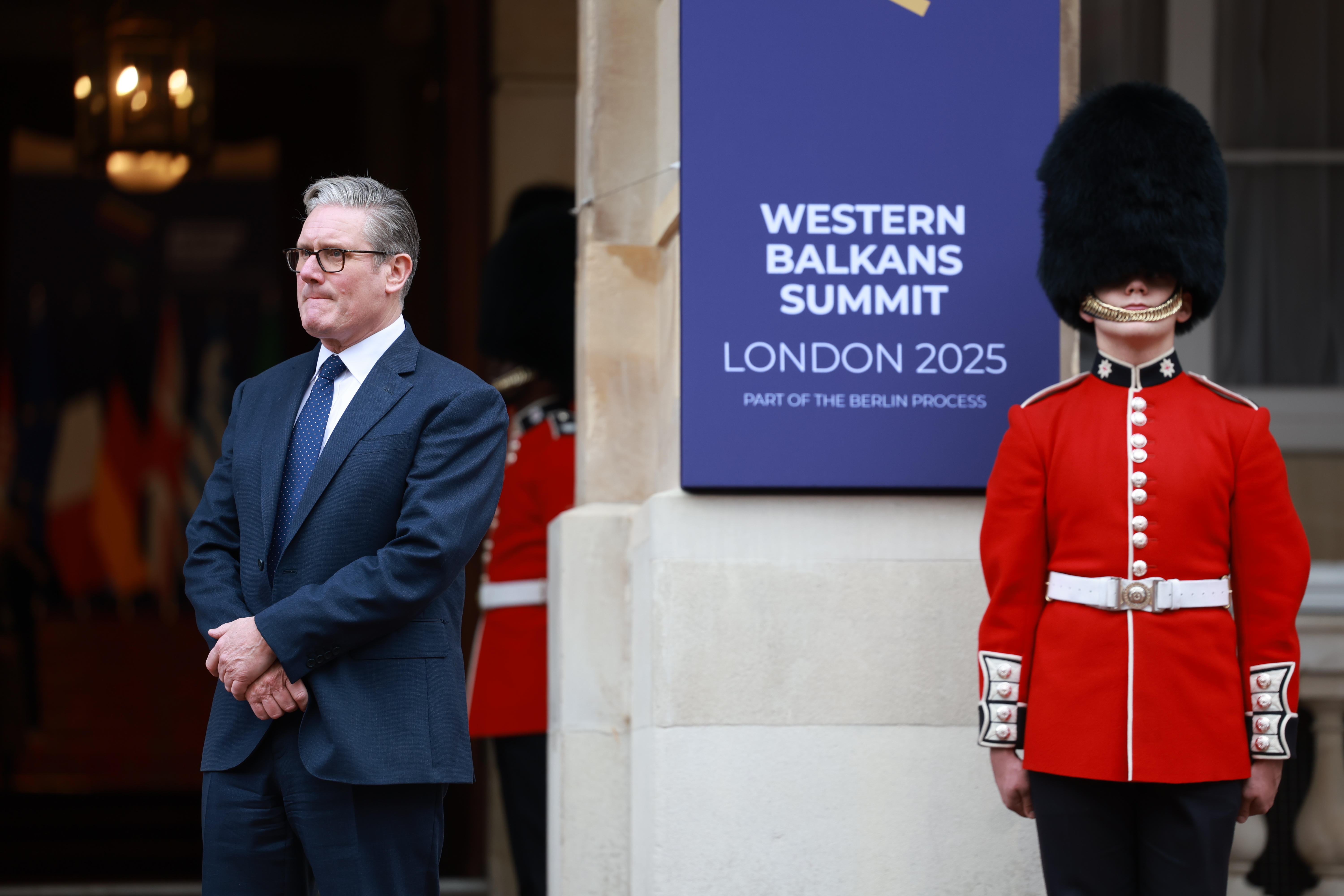
 British Prime Minister Keir Starmer waits to greet delegates to the Western Balkans Summit at Lancaster House in central London, Britain, 22 October 2025. The UK is hosting this annual summit, also known as the Berlin Process, a five-year programme focusing on six western Balkan countries which are not members of the EU: Albania, Bosnia and Herzegovina, Kosovo, Macedonia, Montenegro and Serbia. EPA/NEIL HALL / POOL
British Prime Minister Keir Starmer's office said he would press a meeting of the "Coalition of the Willing" countries that have pledged to strengthen support for Ukraine to take Russian oil and gas off the global market, use frozen Russian assets to support Ukraine, and give Kyiv more long-range missiles.
The meeting comes after U.S. President Donald Trump hit Russia's two biggest oil companies with sanctions, in a dramatic U-turn after he said last week that he and Russian President Vladimir Putin would soon hold a summit in Budapest to try to end the war in Ukraine.
Starmer said Putin had shown he was not serious about proposals to end the war.
"Time and again we offer Putin the chance to end his needless invasion, to stop the killing and recall his troops, but he repeatedly rejects those proposals and any chance of peace," Starmer said in a statement.
"We must ratchet up the pressure on Russia and build on President Trump’s decisive action."
Friday's talks in London will be a mixture of in-person and virtual, with NATO chief Mark Rutte, Dutch Prime Minister Dick Schoof and Danish Prime Minister Mette Frederiksen expected to join Starmer and Zelenskiy in London.
Zelensky welcomed Trump's energy sanctions in a trip to Brussels on Thursday, where he also urged European leaders to give Kyiv long-range weapons and use frozen Russian assets to arm Ukraine further.
Moscow has said it would deliver a "painful response" if the assets were seized under the plan to use them to provide a 140 billion-euro ($163 billion) loan to Kyiv.
In another bid to starve Moscow of revenue, the EU approved a 19th package of sanctions that includes a ban on Russian liquefied natural gas imports.
(Reporting by Alistair Smout, editing by Ed Osmond)