



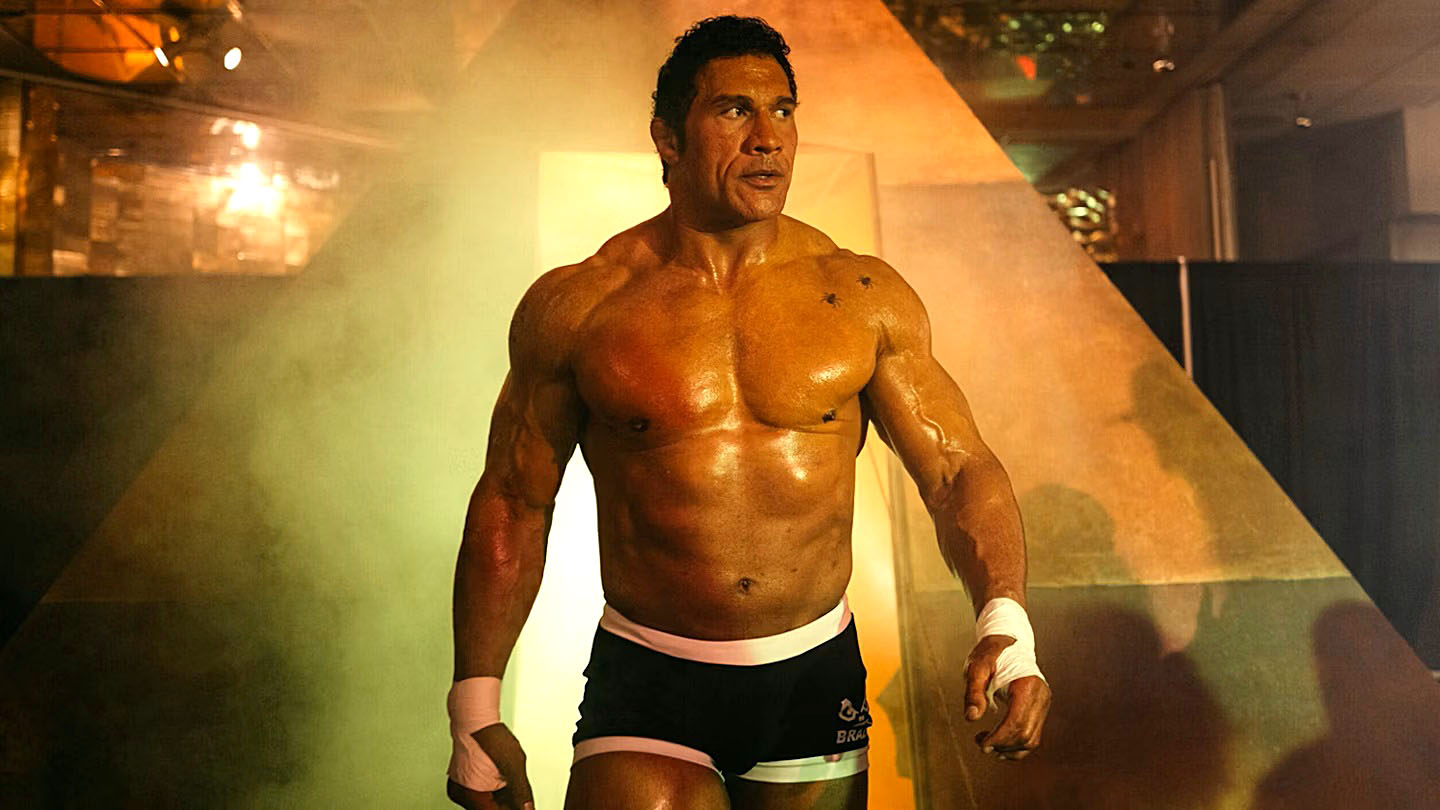
 Dwayne Johnson in The Smashing Machine. (Photo: A24)
A lot can change in 25 years. In the case of mixed martial arts (MMA), rewind back to the cusp of the new millennium and the sport was a controversial, fringe affair, flirting with bans and paying its fighters a pittance for putting their bodies on the line as the rules changed constantly. No pay-per-view spectacle. No weigh-in and press conference drama fuelled by ego, feuds and smack talk. No mega stardom for the participants.
It’s back to these early days of contests like Pride and the Ultimate Fighting Championship (UFC) that new sports drama The Smashing Machine transports audiences.
Uncut Gems filmmaker Benny Safdie writes, directs, edits and co-produces what is as much a takedown of sporting movie tropes as it is a setting the record straight on perceptions of MMA. Importantly, it’s also a celebration of Mark Kerr, a heavyweight champion from the period who arguably hasn’t received the credit he deserves for helping to entrench MMA in the public consciousness.
The Smashing Machine goes beyond the professional achievements of Kerr, though.
While serving as an articulate and affable ambassador for the sport, the exceptional athlete – who is played by WWE wrestler-turned-actor Dwayne “The Rock” Johnson – was fighting battles outside the ring too. An escalating addiction to painkillers, and a tumultuous relationship with girlfriend Dawn Staples (Emily Blunt), threatened to destroy Kerr’s career.
/file/dailymaverick/wp-content/uploads/2025/10/Dwayne-Johnson-in-The-Smashing-Machine_A241.jpg "Dwayne Johnson in The Smashing Machine. (Photo: A24)")
It’s actually a story that has already been covered in 2002 documentary feature The Smashing Machine: The Life and Times of Extreme Fighter Mark Kerr, which is also the basis of Safdie’s film – and which helps to explain why the new fictionalised retelling takes the form it does.
Because the previous documentary ticks so many factual boxes, Safdie doesn’t bother retreading the same ground, for better or worse.
The film zooms in on one pinpoint three-year period, meaning you’ll have to consult a wiki if you want to know how Kerr became addicted to painkillers in the first place, or the reasons that the former amateur wrestler made the move from UFC to Japan-based Pride, with its additional stresses.
You also won’t see key moments in Kerr’s life, such as a terrifying overdose, or his stint in rehab, both of which occur offscreen.
These creative choices reflect The Smashing Machine’s continual defiance of the obvious. This is an A24 film, after all, which means viewers should expect something more artful than the standard sporting crowd-pleaser.
In The Smashing Machine, MMA fighters are supportive comrades between fights, checking in on each other. A high-stakes clash between Kerr and his best friend, and on-the-mat rival, Mark Coleman (Ryan Bader) seems inevitable until it isn’t.
/file/dailymaverick/wp-content/uploads/2025/10/Emily-Blunt-and-Dwayne-Johnson-in-The-Smashing-Machine_A24.jpg "Emily Blunt and Dwayne Johnson in The Smashing Machine. (Photo: A24)")
And while the competitive bouts are violent, captured in an immersive handheld style like much of the film, they are nowhere near as brutal as the arguments between Kerr and Staples. Shifting between tentative and placatory to emotionally manipulative and downright vicious, the film could do with a trigger warning due to the rawness of its domestic, dialogue-driven scenes.
They’re not an easy watch, and the heavily flawed, emotionally struggling Kerr and Staples are clearly not good for each other. However, all the credit must go to Johnson and Blunt – who previously appeared together in Disney’s Jungle Cruise – for their fearlessness in tackling such messy, sometimes even unlikeable people.
Given her role in Oppenheimer, audiences may already expect Blunt to be capable of such a performance, but Johnson is a revelation. Though charismatic, the star is often accused of one-note acting, resting on his on-screen persona as opposed to actually performing.
The Smashing Machine isn’t The Rock playing The Rock, though.
/file/dailymaverick/wp-content/uploads/2025/10/Dwayne-Johnson-in-The-Smashing-Machine_A24.jpg "Dwayne Johnson in The Smashing Machine. (Photo: A24)")
The film is, at its heart, a character study, and Johnson has vanished into his portrayal of Kerr, adopting his softer voice and mannerisms in addition to physically transforming himself via facial prosthetics, a wig and an additional 13kg of muscle.
Johnson may not tear up on command like Blunt, and his fake brow may rob him of expressiveness, but The Smashing Machine is a big step up on the drama front for him; a declaration of his acting capabilities, and it sees him enter the same league as his former WWE colleague Dave Bautista.
Johnson and Blunt keep viewers engaged throughout The Smashing Machine, which is evidently the first prestige film about MMA since 2011’s Warrior. It’s an interesting watch, especially when it jabs at the concept of confidence and power gained from victory, and what happens when those all-important wins are taken away.
On a psychological front, The Smashing Machine hits hard. However, its explorations and experiments, as appreciable as they are, ultimately aren’t the most satisfying emotionally, resulting in a movie that feels like a win on points rather than knockout. DM
The film is in cinemas from Friday, 3 October. This review was first published on PFangirl.