



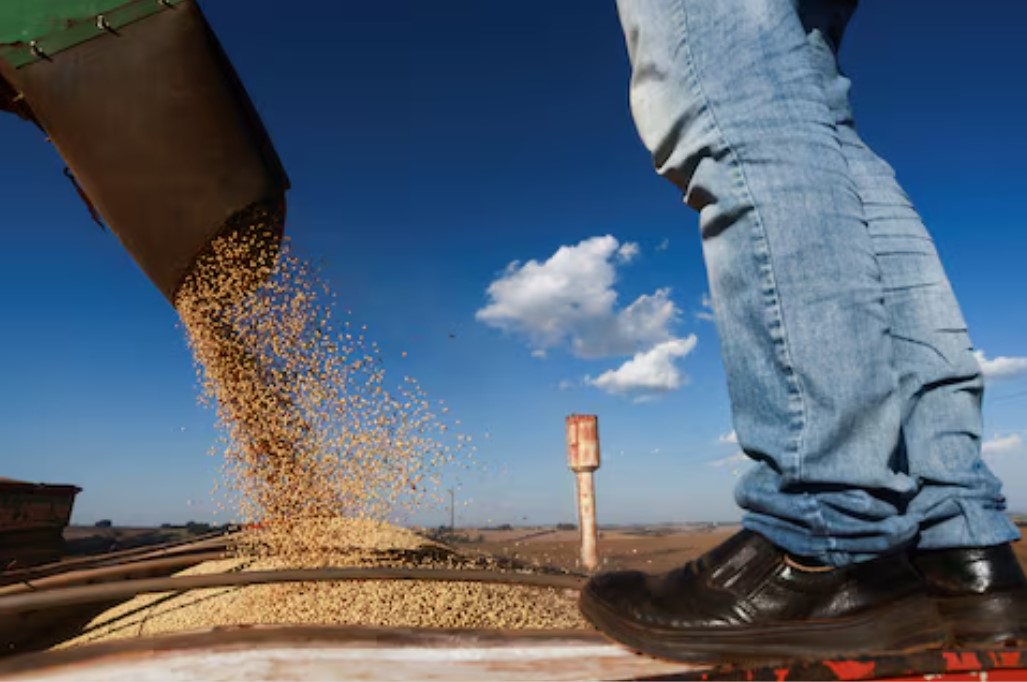

Global soybean exporting giant Brazil has increased plantings of the oilseed for 18 consecutive years, a staggering streak unmatched in the industry.
But for how much longer can Brazil continue boosting area before potentially running into an oversupply situation?
The United States encountered a similar scenario a few years ago, and this, along with recent trends in the Chinese economy, could offer some possible insight for Brazil’s future.
Around 2000, the United States accounted for at least 50% of annual world soybean exports, and Brazil supplied just under 30%.
Brazil took over as top soybean exporter in 2012-13 after a three-year string of crop shortfalls in the United States, and it was around this time that some of Brazil’s heaviest year-on-year increases in soybean area were observed.

Brazil has never relinquished the top supplier crown and currently accounts for about 57% of exports, while the US share has dropped to 28%.
USA reckoning
A decade ago, Chinese soybean demand was booming, and world soybean supplies were consistently overestimated as a result. US farmers in 2017 boosted soybean acres above 90 million, some 8% above the previous year’s record.
They nearly repeated this feat in 2018 despite very plentiful stock levels because the market dynamics, specifically the elevated prices of soybeans versus corn, called for it.

This was likely going to produce burdensome supplies by itself, but it turned out far more disastrous as the United States and China in mid-2018 plunged into a trade war, choking off US exports. Making matters worse was the drop in Chinese soy demand because of disease outbreak throughout its hog herds.
As a result, US soybean stocks by mid-2019 surged more than 60% above the prior record, though the market was bailed out of a longer-term, unmanageable situation by a steep, weather-driven acreage loss in 2019.
US soybean plantings have never since threatened to return to the 2017 high. That is especially true this year with corn prices unusually strong versus soybeans, which many farmers are struggling to find profitable.
Since the start of 2024, Chicago soybean futures have tumbled almost 20%. But priced in Brazilian reals, beans are down only 5% in this period, signaling for the Brazilian farmer to continue churning out bigger crops.
The sharp weakening of the real throughout 2024 was favorable for Brazilian producers, who sell their crops in dollar terms.
However, Brazil’s currency has strengthened notably since the beginning of 2025, and a continuation of this trend could eventually threaten Brazil’s expanding soy area if its producers are no longer seeing the profit advantage.
China risks
More than 70% of Brazil’s annual soybean exports go to China, the world’s leading buyer.
Over its 18-year streak, Brazil’s soybean area has increased by 130%. At the same time, China’s soybean consumption has risen 175%, though the recent growth rates are not as strong as they were a decade ago.
However, total global soybean consumption has risen just 80% over the last 18 years, highlighting the increasingly strong degree to which Brazil’s soy industry depends on China.
Obviously that strategy has worked thus far, but is it a reliable trend? China’s cooling economy may instill some doubts.
China’s annual economic growth rate has been slowing for the better part of two decades, and that shrinkage is generally expected to continue through this decade.

Additionally, China’s population in 2024 fell for a third consecutive year.
Not only could these factors pressure demand for certain food staples, but China over the last few years has taken steps to directly reduce soybean demand and dependence on imports by cutting soymeal rations in animal feed.
This is not exactly the China that the global soybean market was sold on 10 years ago, and the US soybean industry has grown cognizant of these developments ever since the first trade war, albeit somewhat reluctantly.
But the longer-term risks may reside with Brazil, which has yet to discover just how many soybeans are too many.DM
*Karen Braun is a market analyst for Reuters. Views expressed are her own.
Editing by Michael Perry