



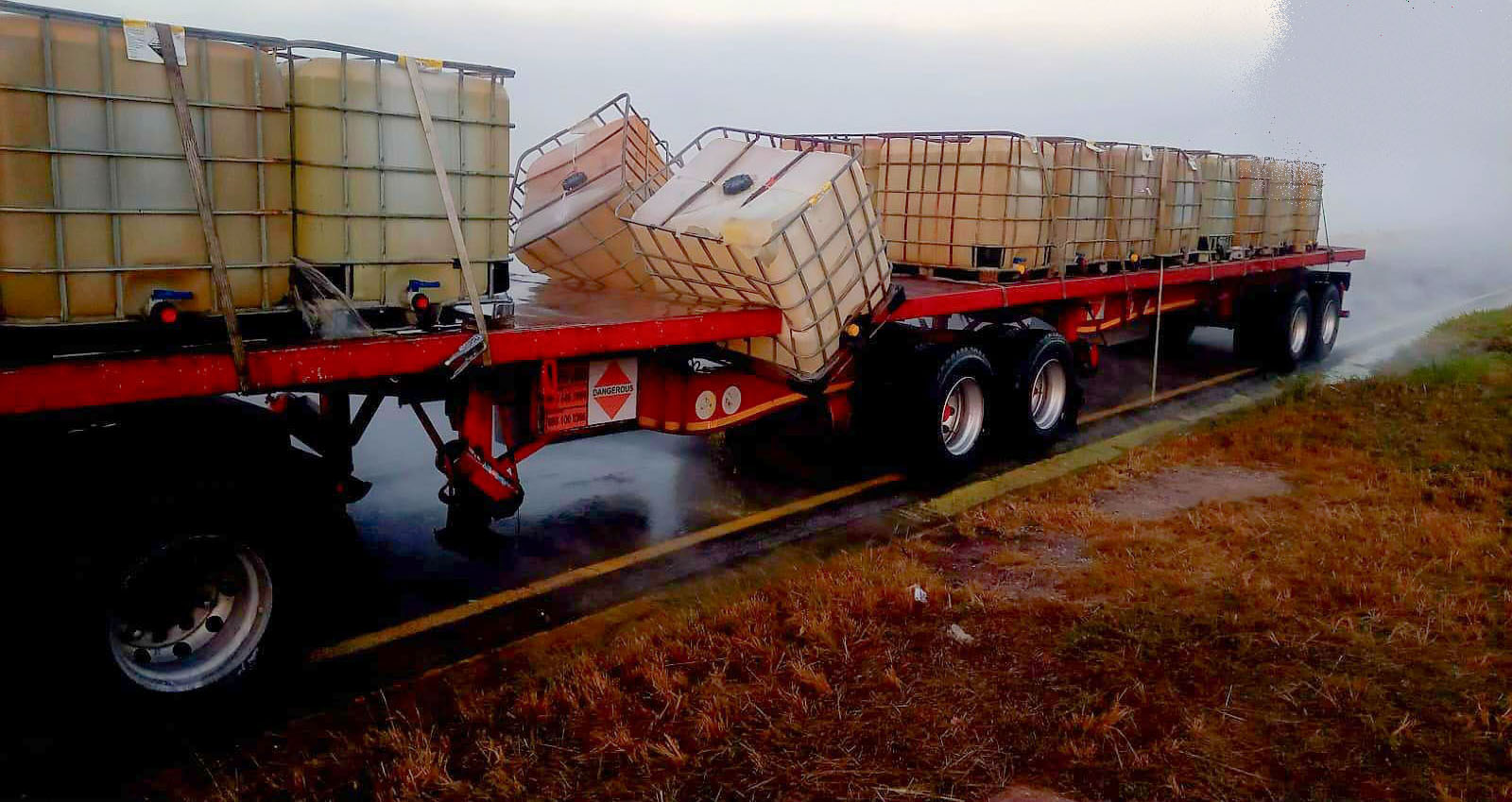
 Two plastic flow bins containing hydrochloric acid lie trapped between a truck and trailer on the N3 freeway outside Durban. Both bins were ruptured by the impact and spilt “a few hundred” litres of acid onto the road. 14 June 2024. (Photo: ALS Paramedics)
The emergency incident led to major traffic snarl-ups around the city, with both east and west-bound lanes closed for several hours while paramedics, police, the fire brigade and specialist personnel from a hazardous waste spill company contained the situation. It also coincided with heightened public security concerns in KwaZulu-Natal linked to political conflict.
Sources at the scene reported that “a few hundred” litres of hydrochloric acid (concentrated swimming pool acid) spilt onto the city-bound lane of the N3 freeway shortly before the Spaghetti Junction with the N2 freeway.
Because there was early-morning moisture on the road, some of the liquid acid reacted with the wet road and was transformed into a gaseous form.
According to ALS Paramedics spokesperson Gareth Jamieson, who attended the emergency scene, his staff transported three people to hospital after they inhaled gas fumes — two SA Police Services officers and a road construction worker who were busy trying to keep motorists away from the scene.
It is understood that at least two other people were treated for breathing difficulties after inhaling the powerful fumes.
/file/dailymaverick/wp-content/uploads/2024/06/durban-acid-gas-leak.jpg "Bystanders watch emergency personnel trying to contain the aftermath of a hydrochloric acid spill on a freeway outside Durban. 14 June 2024. (Photo: ALS Paramedics)")
The acid spilt from two of several plastic ‘flow bins’ being transported on a truck with a trailer. Each flow bin has a capacity of 1,000 litres, housed in steel mesh cages.
It is understood that two of these flow bins were punctured after they broke free from their strapping, apparently after the driver braked sharply in heavy traffic. The bins shifted forward, coming to rest against the back of the truck, spilling acid onto the road.
/file/dailymaverick/wp-content/uploads/2024/06/acid-truck-3-near-Spaghetti-junction-image-source-ALD-Paramedics.jpg "The chemical trailer truck came to a halt on the city-bound lane of the N3, near the Spaghetti Junction. 14 June 2024. (Photo: ALS Paramedics)")
Staff from the Drizit emergency spill response company, who attended the scene, were believed to have poured lime and soda ash onto the roadway to neutralise the acid spillage.
A spokesperson from the company could not be reached for comment, but sources suggested that the acid was contained to a small area and did not pose a pollution threat to local water courses.
In an earlier statement, the Ethekwini Metro Police reported that Inhalation of hydrochloric acid may cause eye, nose, and respiratory tract irritation and inflammation in humans.
A spokesperson urged members of the public in the immediate vicinity to wear masks or cover their noses with a damp cloth to avoid inhaling the poisonous gas. DM
This is a developing story.